The Patna High Court has reaffirmed that even contractual employees are entitled to the protections of natural justice before termination, especially when the order carries stigmatic implications. The judgment underscores that the State, as an employer, cannot bypass procedural fairness merely by labelling employment as contractual.
Background & Facts
The Dispute
The petitioner, Santosh Kumar, was engaged on a contractual basis as Traffic Manager by the Bihar State Road Transport Corporation (BSRTC). His engagement was initially for one year, beginning 15.11.2018, and was subsequently extended multiple times. Despite continuous satisfactory service, he was terminated by Memo No. 570 dated 19.02.2024 on the ground of unauthorized absence from duty with effect from 15.12.2023. The termination was issued without any prior show-cause notice, inquiry, or opportunity of hearing.
Key Facts
- The petitioner was appointed vide Letter No. 3675 dated 15.11.2018 following an advertisement and offer dated 23.10.2018
- His appointment was formally accepted on 16.11.2018 (Memo No. 3699)
- He was transferred to Head Office, Patna on 01.09.2021 and later to Aurangabad Depot on 17.06.2022
- Between May and November 2023, he submitted five written requests (16.05.2023, 18.06.2023, 01.07.2023, 29.08.2023, 16.11.2023) for physical verification of store and accounts, citing possible manipulation
- On 10.10.2023, he applied for leave due to a leg fracture, from 12.10.2023 to 18.10.2023
- On 14.12.2023, the Deputy Chief Accounts Officer issued a directive requiring bi-monthly physical verification of accounts
- On 15.12.2023, the Regional Manager, Gaya, issued Letter No. 885 directing the petitioner to remain at headquarters during the pending inquiry and not to leave duty
- On the same day, 15.12.2023, an FIR (Town P.S. Case No. 896 of 2023) was lodged against the petitioner and an outsourced cashier for alleged embezzlement of Rs. 4,00,140
- The petitioner was granted bail by this Court on 13.05.2024 in Cr. Misc. No. 24489 of 2024, with a condition to deposit Rs. 2,00,000 in installments
- The impugned termination order was issued on 19.02.2024, over two months after the alleged absence and without any inquiry or notice
Procedural History
- 15.11.2018: Initial contractual appointment
- 16.11.2018: Formal acceptance of appointment
- 01.09.2021: Transfer to Head Office, Patna
- 17.06.2022: Transfer and assumption of charge at Aurangabad Depot
- 16.05.2023 to 16.11.2023: Five written requests for verification of accounts
- 10.10.2023: Leave application submitted
- 14.12.2023: Directive for bi-monthly verification issued
- 15.12.2023: FIR lodged; Letter No. 885 issued directing petitioner to remain at headquarters
- 19.02.2024: Termination order (Memo No. 570) issued without notice or hearing
- 28.03.2025: Writ Petition No. 8551 of 2025 filed before Patna High Court
- 30.04.2026: Judgment delivered
The Parties' Positions
Petitioner: Argued that he was not absent on 15.12.2023 as he was under official directive to remain at headquarters. The termination was arbitrary, stigmatic, and violated principles of natural justice. He relied on Swati Priya Darshani v. State of Madhya Pradesh and Bhola Nath v. State of Jharkhand to assert that the State cannot exploit contractual labels to deny procedural rights.
Respondents: Contended that the petitioner was a contractual employee governed solely by Clause 6 of the engagement terms, which permitted termination with one month’s notice. They argued that no hearing was required, and that specific performance of a contract of personal service is barred under Section 14 of the Specific Relief Act, 1963. Relied on State Bank of India v. S.M. Goyal.
Relief Sought
The petitioner sought quashing of the termination order dated 19.02.2024, reinstatement to his post, and consequential benefits including back wages and service continuity, subject to outcome of a fair inquiry.
The Legal Issue
Can a contractual employee be terminated on stigmatic grounds such as alleged financial irregularity without a show-cause notice, opportunity of hearing, or departmental inquiry, and does such termination violate Article 14 of the Constitution?
Arguments Presented
For the Petitioner
The petitioner’s counsel argued that while contractual employment is not governed by statutory service rules, termination on grounds of misconduct or financial impropriety carries stigmatic consequences and must comply with natural justice. Relied on Swati Priya Darshani to distinguish between non-stigmatic termination for inefficiency and stigmatic termination for misconduct. Emphasized that the petitioner was under official directive to remain at headquarters on 15.12.2023, making the allegation of unauthorized absence factually incorrect. Invoked Bhola Nath to argue that the State, as a model employer, cannot indefinitely retain employees on contractual terms to evade statutory obligations.
For the Respondent
The respondents’ counsel contended that the employment was purely contractual, governed by terms explicitly excluding regularization, provident fund, or statutory benefits. Clause 6 permitted termination with one month’s notice, and no hearing was legally mandated. Cited State Bank of India v. S.M. Goyal to assert that courts cannot enforce specific performance of personal service contracts. Argued that the remedy, if any, lies in damages, not reinstatement.
The Court's Analysis
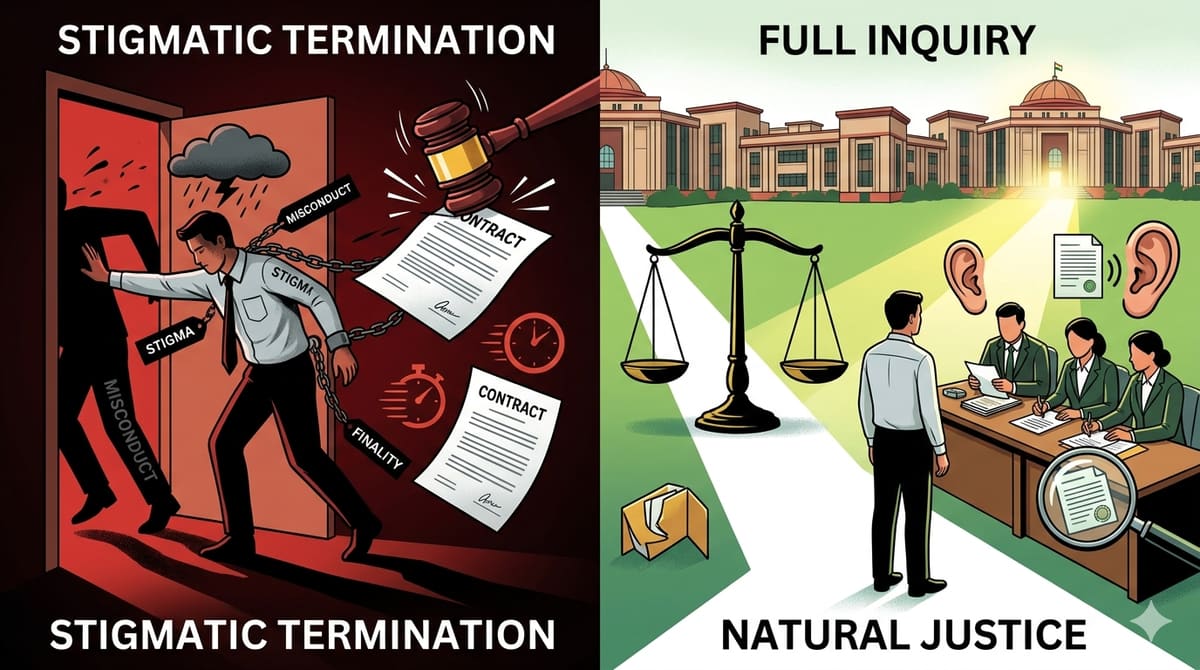
The Court examined the nature of the termination order and found it to be stigmatic in character, as it imputed financial misconduct and embezzlement - allegations that directly affect reputation and future employability. The Court noted that while Clause 6 of the engagement terms permitted termination with notice, such a provision cannot override the fundamental right to fair procedure under Article 14.
"The impugned order, having been passed without adherence to the principles of natural justice, is unsustainable in law."
The Court observed that the respondents’ own records confirmed the issuance of Letter No. 885 dated 15.12.2023, which directed the petitioner to remain at headquarters during the inquiry - directly contradicting the ground of unauthorized absence. The Court held that the absence of any show-cause notice, inquiry, or opportunity to defend himself rendered the termination arbitrary and violative of natural justice.
The Court distinguished State Bank of India v. S.M. Goyal, noting that case dealt with termination for inefficiency without stigma, whereas here, the termination was based on serious allegations of criminal misconduct. The Court also relied on Swati Priya Darshani to hold that when termination is stigmatic, even contractual employees are entitled to a fair hearing.
The Court further emphasized that the State, as a model employer, must uphold constitutional values even in contractual engagements. The absence of statutory benefits does not justify the absence of procedural fairness.
The Verdict
The writ petition is allowed. The termination order dated 19.02.2024 is set aside. The respondents are directed to reinstate the petitioner forthwith. The petitioner shall be entitled to all consequential benefits, including back wages and service continuity, subject to the outcome of a fresh departmental inquiry. The respondents must issue a show-cause notice, conduct a fair hearing, and pass a reasoned order within six weeks. The petitioner’s contractual tenure shall be deemed to continue until such inquiry concludes.
What This Means For Similar Cases
Stigmatic Termination Requires Due Process
- Even contractual employees cannot be terminated on grounds of misconduct without a show-cause notice and hearing
- Allegations of financial irregularity, theft, or corruption trigger the requirement of natural justice
- Employers cannot rely on contractual clauses to bypass procedural safeguards when reputational harm is involved
Contractual Status Does Not Override Article 14
- The nature of employment (contractual vs. statutory) is irrelevant when the termination carries stigmatic consequences
- The State’s role as a model employer imposes a constitutional obligation to act fairly
- Courts will intervene where termination is used as a tool to evade accountability or punish without process
Practical Takeaways for Practitioners
- Always challenge termination orders citing stigmatic grounds as violative of natural justice
- Cite Swati Priya Darshani and Bhola Nath to argue for procedural rights in contractual employment
- Demand reinstatement pending inquiry, not just damages, when termination is arbitrary
- Ensure that any letter directing an employee to remain on duty is preserved as evidence against claims of unauthorized absence