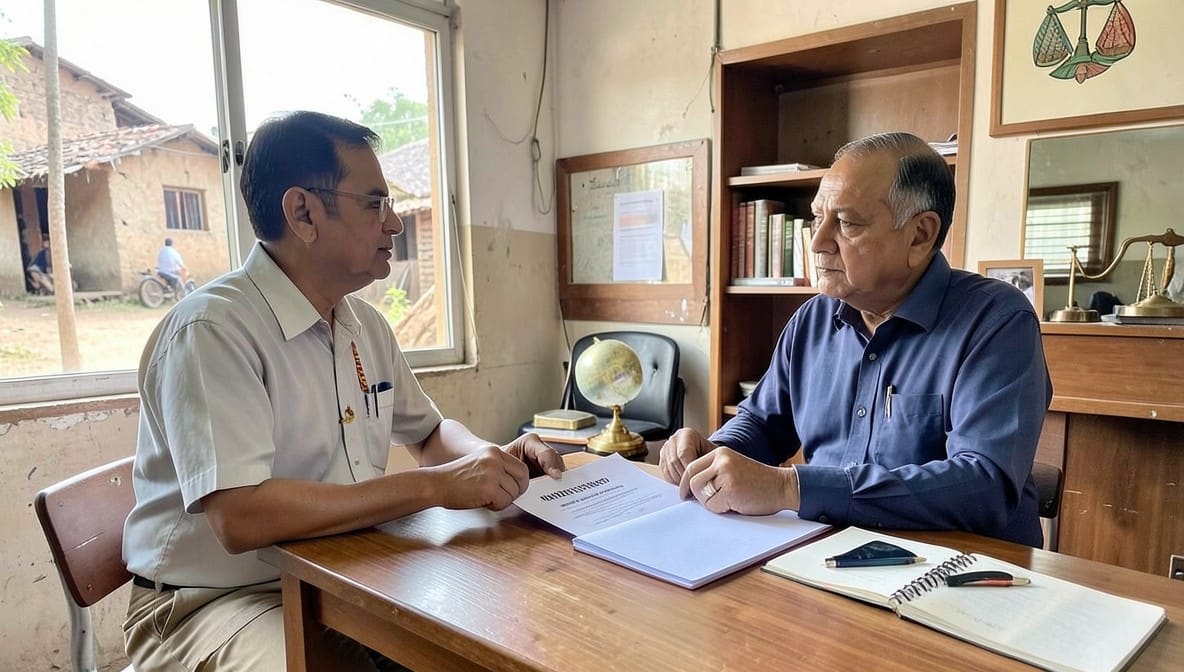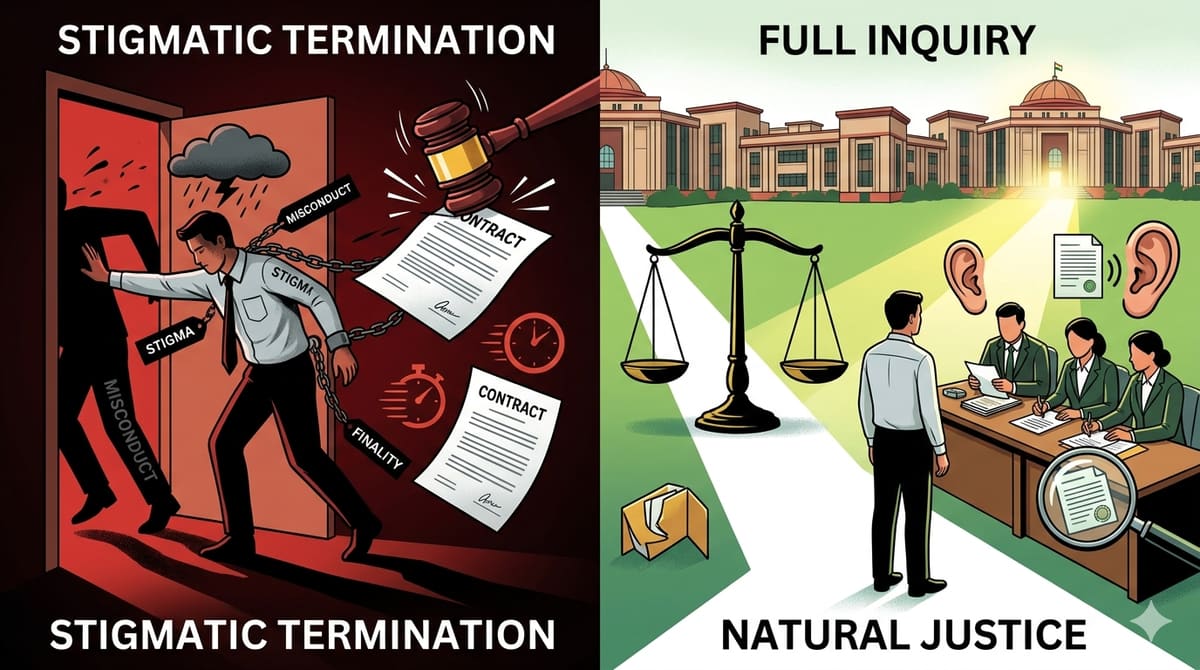
The Madhya Pradesh High Court has reaffirmed that termination of a long-serving Aanganvadi worker without a prior inquiry violates fundamental principles of natural justice and statutory mandates. This judgment reinforces procedural compliance as non-negotiable in public employment, especially for vulnerable workers with decades of service.
Background & Facts
The Dispute
The petitioner, Badam Bai, was appointed as an Aanganvadi Worker/Sahayika on 01.02.1998 and served continuously for over 25 years at Aanganvadi Kendra Gurutalai Morvan No. 1 in Ujjain district. She is a physically handicapped individual dependent on her honorarium for daily subsistence. On 08.05.2023, her services were terminated without any inquiry, hearing, or opportunity to defend herself. The termination was upheld on appeal by the Collector, Ujjain (13.10.2023) and the Commissioner (Revenue), Ujjain Division (31.07.2025).
Key Facts
- Appointed on 01.02.1998 as Aanganvadi Worker
- Rendered continuous service for 25 years until termination
- Physically handicapped, with documented difficulty in managing daily activities
- Between January 2022 and April 2023, received multiple inspection notices and letters from respondent No. 4 and Sector Supervisor
- Show cause notice dated 03.05.2023 issued, requiring explanation by 10.05.2023
- Termination order passed on 08.05.2023 - before the stipulated time to respond expired
- No inquiry, no hearing, no charge sheet, no recommendation from any authority
- Petitioner filed representations regarding financial hardship due to inflation and unemployment
Procedural History
- 08.05.2023: Termination order issued by respondent No. 4 (Aanganvadi Project Officer)
- 13.10.2023: First appeal dismissed by Collector, Ujjain (respondent No. 3)
- 31.07.2025: Second appeal dismissed by Commissioner (Revenue), Ujjain Division (respondent No. 2)
- 2025: Writ Petition No. 38375/2025 filed before the High Court of Madhya Pradesh, Indore
- 07.04.2026: Judgment delivered by Justice Jai Kumar Pillai
Relief Sought
The petitioner sought:
- Quashing of termination order dated 08.05.2023 and appellate orders dated 13.10.2023 and 31.07.2025
- Writ of mandamus directing reinstatement as Aanganvadi Worker
- Payment of all consequential benefits including arrears of honorarium and back wages with interest
The Legal Issue
The central question was whether termination of an Aanganvadi worker can be lawfully effected without conducting a prior inquiry and providing a reasonable opportunity of hearing, as mandated by the Government of Madhya Pradesh, Women and Child Development Department Rules dated 23.05.2025.
Arguments Presented
For the Petitioner
The petitioner contended that the termination order dated 08.05.2023 was passed in blatant violation of Clause G.1.1.1 of the Rules dated 23.05.2025, which mandates that an inquiry and hearing must precede any termination. She argued that the abrupt dismissal, without any opportunity to respond to allegations, amounted to arbitrariness and violation of Article 14 and Article 21 of the Constitution. She emphasized her long service, physical disability, and financial distress, highlighting the disproportionate impact of termination.
For the Respondent
The respondents did not file a detailed written submission. Their appearance was limited to opposing the petition orally, without challenging the factual assertion that no inquiry was conducted. No evidence was adduced to justify the absence of procedural compliance.
The Court's Analysis
The Court observed that the scope of judicial review under Article 226 extends to ensuring that administrative actions do not suffer from procedural illegality or violation of natural justice. The Court examined Annexure P/6, the Rules dated 23.05.2025, and specifically interpreted Clause G.1.1.1, which states that an Aanganvadi worker may be separated only after a proper inquiry and hearing, and upon being found guilty.
"Thus, it is abundantly clear that no inquiry was made and no proper opportunity of hearing has been provided to the petitioner by the respondents."
The Court noted that the show cause notice dated 03.05.2023 was issued with a deadline of 10.05.2023, yet the termination order was passed on 08.05.2023 - before the petitioner could even respond. This constituted a clear denial of the right to be heard, a cornerstone of natural justice.
The Court rejected the notion that temporary or contractual workers are exempt from procedural safeguards. It held that the length of service (25 years), the nature of public service, and the statutory framework collectively impose a duty to follow due process. The absence of any inquiry rendered the termination illegal, arbitrary, and void.
The Verdict
The petitioner succeeded. The Court quashed the termination order dated 08.05.2023, the first appellate order dated 13.10.2023, and the second appellate order dated 31.07.2025. The respondents are directed to reinstate the petitioner as an Aanganvadi Worker with all consequential benefits. The petitioner is entitled to 25% back wages. The entire process of reinstatement and payment of dues must be completed within 60 days of receipt of a certified copy of this order. The respondents are granted liberty to initiate a fresh inquiry, strictly following due process, if deemed necessary.
What This Means For Similar Cases
Procedural Compliance Is Non-Negotiable
- Practitioners must now argue that any termination of a long-serving Aanganvadi worker without inquiry is per se illegal, regardless of the worker’s contractual status
- The 2025 Rules are binding and cannot be bypassed even in the absence of formal service rules
- Failure to conduct inquiry renders the order void ab initio, not merely voidable
Long Service Triggers Enhanced Procedural Protection
- Courts will treat continuous service of 15+ years as a factor demanding heightened procedural safeguards
- Physical disability and socio-economic vulnerability are relevant considerations in assessing arbitrariness
- Financial hardship due to termination may be cited to reinforce the violation of Article 21
Fresh Inquiry Must Follow Due Process
- Any subsequent action against the reinstated worker must begin with a formal charge sheet
- The inquiry must be conducted by an impartial authority
- The worker must be given adequate time and opportunity to present evidence and cross-examine witnesses