The Rajasthan High Court has reaffirmed that even contractual employees are entitled to the protections of natural justice when faced with stigmatic allegations leading to termination. The judgment underscores that mere non-response to a show cause notice cannot substitute for a fair and impartial enquiry, especially when the allegations strike at personal reputation and employment rights.
Background & Facts
The Dispute
The petitioner, Mahesh Kumar, was employed on a contractual basis as a driver with the Department of Rural Development and Panchayati Raj, Government of Rajasthan. On 13.10.2022, he was terminated from service on the ground that he had allegedly tampered with official bills and vouchers in his custody. The termination order was issued without any formal departmental enquiry or opportunity for the petitioner to substantively respond to the allegations.
Key Facts
- The petitioner was engaged in contractual service as a driver, with no claim to permanent status
- A complaint was lodged by one Raj Kumar Gupta alleging that the petitioner had altered official bills and vouchers
- Based solely on this complaint, a show cause notice was issued to the petitioner
- The petitioner did not respond to the show cause notice
- The respondents terminated his service on 13.10.2022, citing his non-response as sufficient grounds
- No evidence was recorded, no witnesses examined, and no opportunity for defence was granted
- The termination order was stigmatic in nature, implying dishonesty and misconduct
Procedural History
- 13.10.2022: Termination order issued by the respondents
- 18.11.2022: Writ Petition No. 18887/2022 filed before the High Court of Judicature for Rajasthan, Jaipur Bench
- 17.04.2026: Hearing concluded and judgment delivered
Relief Sought
The petitioner sought quashing of the termination order dated 13.10.2022, reinstatement to service, payment of salary for the period of wrongful termination, and costs.
The Legal Issue
The central question was whether termination of a contractual employee on the basis of unproven stigmatic allegations, without a fair enquiry and opportunity of hearing, violates the principles of natural justice under Article 14 and Article 21 of the Constitution.
Arguments Presented
For the Petitioner
Mr. Tarun Choudhary argued that the termination was arbitrary and violative of natural justice. He emphasized that allegations of tampering with official records are stigmatic and require a full-fledged enquiry before any adverse action. Mere non-response to a show cause notice cannot be treated as admission of guilt, especially when no evidence was placed on record. He relied on State of U.P. v. Mohd. Noor and A.K. Krause v. Union of India to establish that even contractual employees are entitled to fair procedure when their reputation is at stake.
For the Respondent
Mr. Aditya Sharma contended that the petitioner was a contractual employee and not entitled to the same procedural safeguards as permanent employees. He argued that the show cause notice provided sufficient opportunity and the petitioner’s failure to respond justified termination. He relied on the principle that the State has the right to terminate contractual services without assigning reasons, provided there is no mala fide.
The Court's Analysis
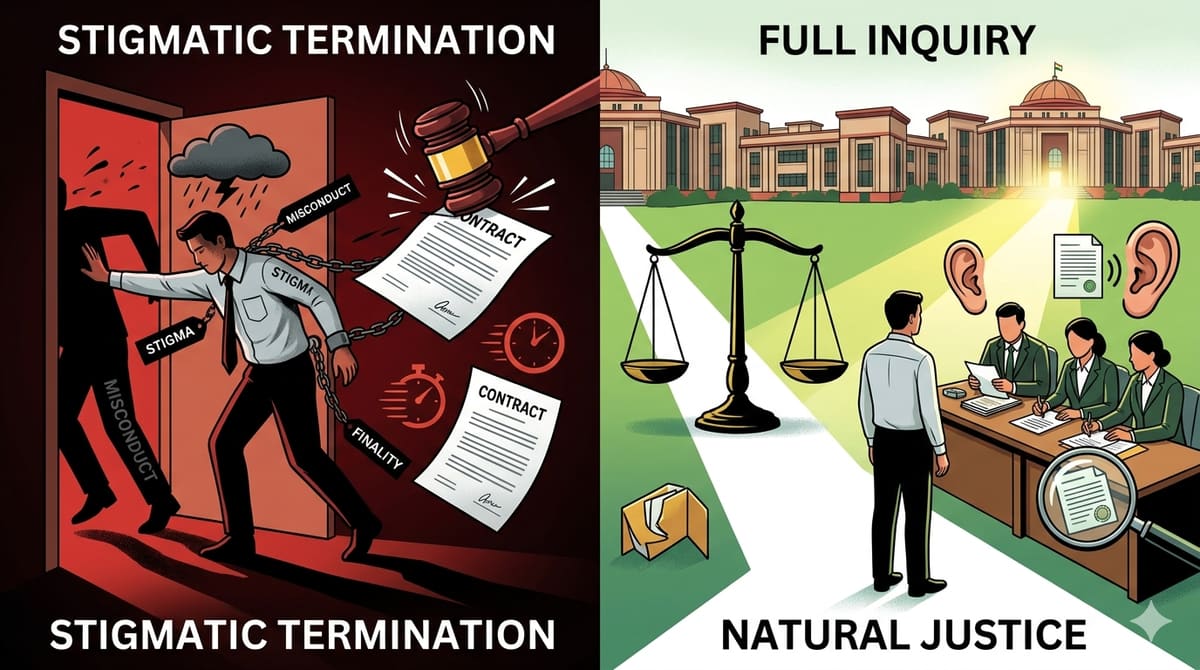
The Court held that the nature of the allegation - tampering with official records - is inherently stigmatic and goes beyond mere breach of contract. Such allegations, if proven, could lead to criminal liability and permanently damage the petitioner’s professional reputation. The Court observed that the respondents acted on a one-sided complaint without any corroborative evidence, without examining witnesses, and without affording the petitioner a meaningful opportunity to defend himself.
"The show cause notice is issued only on the basis of certain allegations made by one Raj Kumar Gupta. The allegations required to be established by conducting proper enquiry and evidence. Such an allegation cannot be treated as a proved but for the reason of no response by the petitioner to the show cause notice."
The Court rejected the argument that contractual employees are outside the purview of natural justice. It held that Article 14 and Article 21 protect all persons from arbitrary state action, regardless of employment status. The failure to conduct a fair enquiry rendered the termination illegal and void. The Court distinguished this case from routine termination of contractual services, emphasizing that stigmatic allegations demand procedural rigor.
The Verdict
The writ petition was allowed. The termination order dated 13.10.2022 was set aside. The petitioner was directed to be reinstated within 15 days from the date of judgment. If reinstatement is not effected within this period, the respondents shall pay the petitioner his full salary for the period of delay until actual reinstatement. The respondents were also directed to pay all unpaid salary due for work performed prior to termination within one month. The respondents were granted liberty to conduct a fresh and fair enquiry, and any further action must be based on the findings of such enquiry.
What This Means For Similar Cases
Stigmatic Allegations Demand Fair Enquiry
- Practitioners must insist on a full departmental enquiry before terminating any employee - contractual or permanent - on allegations of dishonesty, corruption, or tampering with records
- Non-response to a show cause notice cannot be treated as admission of guilt where the allegations are serious and stigmatic
- The burden shifts to the employer to prove the allegations through evidence, not silence
Contractual Status Does Not Bar Natural Justice
- Even temporary, contractual, or daily wage employees are protected under Article 14 and Article 21 when facing stigmatic charges
- Courts will not permit procedural shortcuts in cases where reputation is at stake
- This judgment reinforces that fairness is not a privilege of permanency but a constitutional right
Compliance Deadlines Are Enforceable
- Courts are now willing to impose financial consequences for non-compliance with reinstatement orders
- Failure to reinstate within 15 days triggers automatic liability for salary payment
- Payment of arrears must be completed within one month, creating clear accountability