
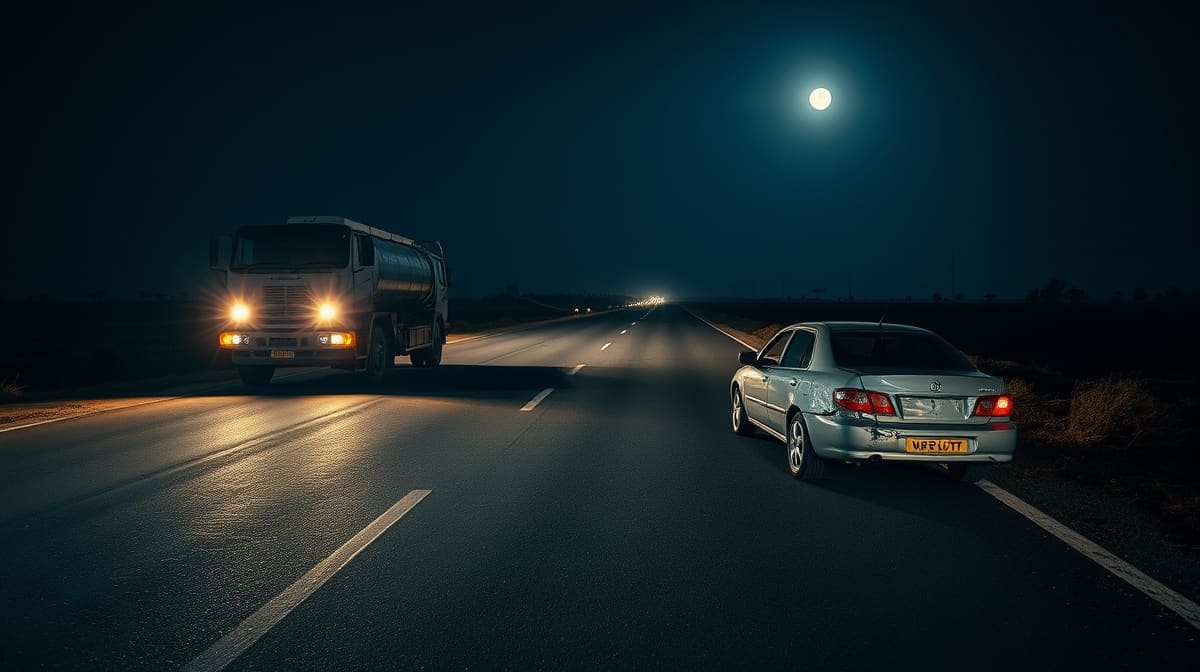
The Supreme Court's judgment in Manju Singh v. Avinash Singh & Ors. reaffirms the standard of proof in motor accident claims as preponderance of probabilities, not the strict criminal standard of proof beyond reasonable doubt. The Court critically examined evidentiary reliability, including the admissibility of delayed photographs and the non-production of key witnesses, to hold the tanker driver negligent and award substantial compensation to the claimants under Section 166 of the Motor Vehicles Act, 1988.
Background & Facts
The Dispute
The appeals arose from a tragic road accident on 30.01.2002 at approximately 10:00 p.m. on the Allahabad-Kanpur Road. A Maruti Car (Registration No. UP-92A-2223), carrying four occupants - Mata Prasad (driver), Ajeet Singh, Roop Singh, and Dr. Dileep Kumar Katiyar (PW-2) - collided with a tanker (Registration No. UP-81E-6258) driven by Vinod Kumar. The impact resulted in the deaths of Mata Prasad, Ajeet Singh, and Roop Singh, while Dr. Katiyar survived with grievous injuries.
Key Facts
-
Occupants and Income: The deceased were teachers by profession, earning monthly incomes of:
- Mata Prasad: Rs. 10,071/-
- Ajeet Singh: Rs. 10,345/-
- Roop Singh: Rs. 9,708/-
-
Uncontested Facts:
- The accident caused the deaths of the three occupants.
- Both drivers possessed valid driving licences.
- The tanker was insured on the date of the accident.
- The claimants were legal heirs and dependents of the deceased.
-
Parties' Positions:
- Claimants' Version: The accident occurred due to the rash and negligent driving of the tanker, while the Maruti Car was being driven cautiously on its correct side of the road.
- Respondents' Version: The tanker was stationary on the left side of the road, and the Maruti Car, driven rashly on the wrong side, collided with it.
Procedural History
- 30.01.2002: Accident occurred.
- Post-Accident Conduct:
- The tanker driver (DW-1) did not lodge an FIR but claimed to have given "oral information" at the police station before leaving to inform his employer.
- The tanker owner (DW-2) arrived at the accident spot the next morning (08:00 a.m.) and arranged for photographs (Exhibits 3 and 4) to be taken.
- Neither the driver nor the owner assisted the injured or remained at the scene for preliminary investigation.
- Police Investigation: A charge-sheet was filed against the tanker driver under Sections 279, 338, and 304A of the Indian Penal Code.
- Claim Petitions: Legal representatives of the deceased filed separate claims under Section 166 of the Motor Vehicles Act, 1988.
- Tribunal Proceedings:
- The Motor Accident Claims Tribunal, Jalaun at Orai, dismissed the claims under Section 166 but awarded compensation under the "no fault liability" provision.
- The Tribunal relied on Exhibits 3 and 4, holding the Maruti Car driver solely responsible for the accident.
- High Court Proceedings:
- 28.08.2024: The High Court of Judicature at Allahabad affirmed the Tribunal's Awards.
- Supreme Court Proceedings:
- 2026: The present appeals were filed, challenging the concurrent findings of negligence.
Relief Sought
The appellants sought:
- Setting aside of the impugned judgment dated 28.08.2024 and the Tribunal's Awards.
- A finding of negligence against the tanker driver.
- Compensation under Section 166 of the Motor Vehicles Act, 1988, calculated in accordance with the principles laid down in Sarla Verma v. Delhi Transport Corporation and National Insurance Co. Ltd. v. Pranay Sethi.
The Legal Issue
The central question was whether the Courts below erred in holding the driver of the Maruti Car solely responsible for the accident, thereby denying compensation under Section 166 of the Motor Vehicles Act, 1988, based on:
- The reliability of delayed photographs (Exhibits 3 and 4) as conclusive evidence of negligence.
- The credibility of the testimony of the sole surviving eyewitness (PW-2) vis-à-vis the defence version.
- The applicability of the principle of res ipsa loquitur in determining negligence.
Arguments Presented
For the Appellants
- Standard of Proof: The proceedings before the Tribunal are civil in nature, and the standard of proof is preponderance of probabilities, not proof beyond reasonable doubt. Reliance was placed on Sunita v. Rajasthan SRTC and Rajwati v. United India Insurance Company Ltd.
- Evidence of PW-2: Dr. Dileep Kumar Katiyar (PW-2), the sole surviving eyewitness, deposed that the Maruti Car was being driven on its correct side at a controlled speed when the tanker, coming from the opposite direction at high speed, collided with it. His testimony, being that of an injured witness, carries greater evidentiary value.
- Conduct of Respondents: The tanker driver and owner failed to lodge an FIR, did not assist the injured, and took photographs nearly 10-12 hours after the accident. Their conduct raises doubts about the credibility of their version.
- Non-Production of Key Witness: The conductor of the tanker, who was allegedly attending to nature's call, was not produced as a witness. No explanation was offered for his non-production, warranting an adverse inference.
- Photographs as Evidence: Exhibits 3 and 4, taken nearly 10-12 hours after the accident and arranged by the tanker owner, cannot accurately depict the position of the vehicles at the time of the collision. The photographs do not show the entire width of the road or establish that the tanker was parked safely off the carriageway.
- Res Ipsa Loquitur: The principle applies as the tanker was parked on the road at night without adequate warning signs, shifting the burden on the respondents to prove that all reasonable precautions were taken.
- Charge-Sheet: The filing of a charge-sheet against the tanker driver under Sections 279, 338, and 304A IPC lends support to the claimants' version.
For the Respondents
- Photographs as Conclusive Evidence: Exhibits 3 and 4 conclusively establish that the Maruti Car was being driven on the wrong side of the road and collided with the stationary tanker.
- Defence Version: The tanker was stationary on the left side of the road as its conductor had gone to attend the call of nature. The Maruti Car, driven rashly and negligently, hit the tanker.
- Testimony of DW-1 and DW-2: The tanker driver (DW-1) and owner (DW-2) supported the defence version, asserting that the tanker was parked safely.
The Court's Analysis
The Supreme Court undertook a meticulous examination of the evidence and legal principles governing motor accident claims:
-
Standard of Proof: Reiterating the settled law, the Court emphasized that the standard of proof in motor accident claims is preponderance of probabilities, not the strict criminal standard of proof beyond reasonable doubt. The Court relied on Sunita v. Rajasthan SRTC and Rajwati v. United India Insurance Company Ltd., which held that strict rules of evidence applicable in criminal trials do not apply to compensation cases under the Motor Vehicles Act, 1988.
"It is thus well settled that in motor accident claim cases, once the foundational fact, namely, the actual occurrence of the accident, has been established, then the Tribunal's role would be to calculate the quantum of just compensation if the accident had taken place by reason of negligence of the driver of a motor vehicle and, while doing so, the Tribunal would not be strictly bound by the pleadings of the parties. Notably, while deciding cases arising out of motor vehicle accidents, the standard of proof to be borne in mind must be of preponderance of probability and not the strict standard of proof beyond all reasonable doubt which is followed in criminal cases."
-
Reliability of Photographs: The Court critically assessed the evidentiary value of Exhibits 3 and 4. Admittedly taken 10-12 hours after the accident and arranged by the tanker owner (DW-2), the photographs were held to be inherently suspect. The Court observed:
"Admittedly, the photographs were not taken immediately after the accident. They were taken at about 8:00 a.m. on the following day, nearly ten to twelve hours after its occurrence. Such photographs cannot be treated as an accurate representation of the position of the vehicles at the time of impact / accident."
The Court further noted that the photographs neither depicted the entire width of the road nor established that the tanker was parked safely off the carriageway. The possibility of the vehicles' positions being altered before the photographs were taken could not be ruled out.
-
Conduct of Respondents: The Court placed significant weight on the conduct of the tanker driver and owner post-accident. Neither lodged an FIR, nor did they assist the injured or remain at the scene for preliminary investigation. The tanker driver first informed his employer, who then visited the spot and arranged for the photographs. This conduct, the Court held, raised serious doubts about the credibility of the defence version.
-
Testimony of PW-2: The Court accorded due weight to the testimony of Dr. Dileep Kumar Katiyar (PW-2), the sole surviving eyewitness. Being an injured witness, his testimony carried greater evidentiary value. PW-2 deposed that the Maruti Car was being driven on its correct side at a normal speed when the tanker, coming from the opposite direction at high speed, collided with it. The Court found no material contradiction, embellishment, or inconsistency in his testimony.
-
Non-Production of Conductor: The defence version rested on the assertion that the tanker was stationary because its conductor had gone to attend the call of nature. However, the conductor, being the most material witness, was never produced before the Tribunal. No explanation was offered for his non-production, leading the Court to draw an adverse inference against the respondents.
-
Res Ipsa Loquitur: The Court applied the principle of res ipsa loquitur, holding that parking a heavy vehicle on a public road at night without adequate warning signs constitutes negligence in itself. The burden shifted to the respondents to establish that all reasonable precautions had been taken, which they failed to discharge.
"The principle of res ipsa loquitur (the thing speaks for itself) also becomes applicable in the facts of the present case. Once it is shown that a heavy vehicle was left standing on the roadway at night without adequate warning signs and a collision occurred, the burden shifts upon the respondents to establish that all reasonable precautions had been taken. The respondents have failed to discharge that burden."
-
Charge-Sheet: The Court noted that a charge-sheet was filed against the tanker driver under Sections 279, 338, and 304A IPC, which, though not conclusive proof of negligence, lent support to the claimants' version.
-
Cumulative Assessment: Upon a cumulative assessment of the evidence, the Court concluded that:
- The testimony of PW-2 was reliable and trustworthy.
- Exhibits 3 and 4 were not dependable evidence for determining negligence.
- The defence version remained unsubstantiated due to the non-production of the conductor.
- The tanker was not shown to have been parked in a safe manner.
- The charge-sheet against the tanker driver corroborated the claimants' case.
The Verdict
The Supreme Court allowed the appeals and set aside the impugned judgment dated 28.08.2024 passed by the High Court of Judicature at Allahabad and the Awards passed by the Motor Accident Claims Tribunal, Jalaun at Orai. The Court held that the accident occurred due to the rash and negligent driving of the tanker (Registration No. UP-81E-6258).
The claimants were awarded compensation under Section 166 of the Motor Vehicles Act, 1988, calculated as follows:
-
SLP (C) No. 10565/2025 (Ajeet Singh):
- Total Compensation: Rs. 21,11,240/-
- Less No-Fault Liability (Section 140): Rs. 50,000/-
- Net Compensation: Rs. 20,61,240/-
- Interest: 9% per annum from the date of filing the claim petition until realization, amounting to Rs. 44,97,209.30.
- Final Amount: Rs. 65,58,449.30.
-
SLP (C) No. 33539/2025 (Mata Prasad):
- Total Compensation: Rs. 13,59,583.35/-
- Less No-Fault Liability (Section 140): Rs. 50,000/-
- Net Compensation: Rs. 13,09,583.35/-
- Interest: 9% per annum, amounting to Rs. 28,57,246.33.
- Final Amount: Rs. 41,66,829.68.
-
SLP (C) No. 33538/2025 (Roop Singh):
- Total Compensation: Rs. 11,61,300.20/-
- Less No-Fault Liability (Section 140): Rs. 50,000/-
- Net Compensation: Rs. 11,11,300.20/-
- Interest: 9% per annum, amounting to Rs. 24,24,832.58.
- Final Amount: Rs. 35,36,132.78.
The respondent-Insurance Company was directed to deposit the entire awarded amount within eight weeks. The claimants were entitled to interest at the rate of 6% per annum from the date of filing the claim petitions until realization. The amount of Rs. 50,000/- already paid under Section 140 was to be adjusted against the final compensation.
What This Means For Similar Cases
Evidentiary Reliability in Motor Accident Claims
- Delayed Photographs: Courts must critically assess the reliability of photographs taken with a significant time lag after the accident. Such photographs cannot be treated as conclusive evidence of the vehicles' positions at the time of the collision.
- Interested Witnesses: Testimonies of witnesses produced by the defence, particularly those with a vested interest (e.g., the tanker driver and owner), must be scrutinized with caution. Their conduct post-accident, such as failure to lodge an FIR or assist the injured, can significantly impact their credibility.
Burden of Proof and Res Ipsa Loquitur
- Res Ipsa Loquitur: The principle applies where the circumstances of the accident inherently suggest negligence (e.g., parking a heavy vehicle on a public road at night without warning signs). The burden shifts to the defendant to prove that all reasonable precautions were taken.
- Non-Production of Key Witnesses: Failure to produce material witnesses, such as the conductor in this case, warrants an adverse inference against the defence. Courts are justified in drawing negative conclusions when no reasonable explanation is offered for such non-production.
Standard of Proof: Preponderance of Probabilities
- Civil vs. Criminal Standards: Practitioners must emphasize that motor accident claims are governed by the preponderance of probabilities standard, not the criminal standard of proof beyond reasonable doubt. This distinction is crucial when arguing cases where the defence attempts to import criminal trial standards.
- Charge-Sheet as Corroborative Evidence: While a charge-sheet is not conclusive proof of negligence, it remains a relevant circumstance that can lend support to the claimants' version, particularly when other evidence aligns with the allegations.
Practical Takeaways for Legal Practitioners
- Injured Eyewitnesses: Testimonies of injured eyewitnesses carry significant weight and should be highlighted, especially when they are consistent and unshaken under cross-examination.
- Post-Accident Conduct: The conduct of the parties post-accident (e.g., failure to lodge an FIR, non-assistance to the injured, delayed photographs) can be pivotal in determining negligence. Such conduct should be meticulously documented and argued.
- Compensation Calculation: Ensure that compensation is calculated in accordance with the principles laid down in Sarla Verma and Pranay Sethi, including heads such as loss of income, consortium, estate, and funeral expenses. Interest should be claimed from the date of filing the claim petition until realization.





