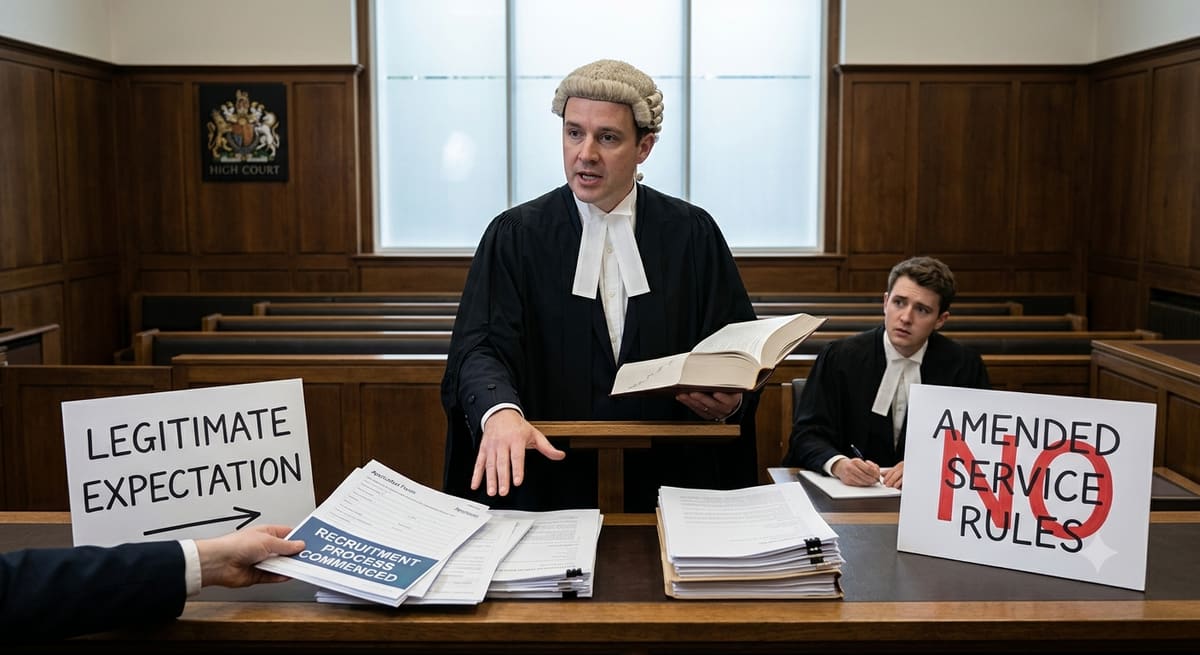
The Bombay High Court has reaffirmed a foundational principle of service jurisprudence: once a recruitment process is initiated, the State or its instrumentalities cannot alter eligibility criteria or selection methodology to the prejudice of candidates who have already participated in good faith. This judgment resolves a batch of writ petitions concerning the abrupt cancellation of a promotional exercise for Junior Engineer posts in Pune Municipal Corporation, setting a critical precedent for procedural fairness in public employment.
Background & Facts
The Dispute
The petitioners are Class IV employees of the Pune Municipal Corporation (PMC) seeking promotion to the post of Junior Engineer (Civil) under the PMC Service Rules, 2014. The dispute arose when the PMC cancelled a promotion process that had been underway since January 2021, citing a subsequent amendment to the Service Rules in December 2023. The petitioners argue that the cancellation violated their legitimate expectation and the settled legal principle that recruitment rules cannot be altered midway through a process.
Key Facts
The PMC Service Rules, 2014 provided for a 75% quota for direct recruitment and a 25% quota for promotion to the post of Junior Engineer (Civil)
Educational qualification for both direct recruitment and promotion: Degree or Diploma in Civil Engineering
Experience requirement for promotion: Five years of uninterrupted service with PMC
Selection method: Seniority-cum-merit (no competitive examination)
On 29 January 2021, PMC issued a circular inviting applications for promotion under the 2014 Rules
On 3 December 2021, PMC published a draft seniority list of eligible candidates, including the petitioners
On 31 May 2023, PMC issued a further draft seniority list of 20 eligible candidates
On 14 December 2023, the State Government issued a Government Resolution amending the PMC Service Rules, 2014
The 2023 amendment reduced the promotional quota from 25% to 15%
The 2023 amendment changed eligibility from "Degree/Diploma in Civil Engineering" to "Full-Time Degree/Diploma in Civil Engineering"
The 2023 amendment replaced seniority-cum-merit with selection by written examination
On 20 December 2023, PMC issued a circular announcing a written examination for promotion under the new rules
On 11 June 2025, PMC issued an order cancelling the entire promotion process initiated in 2021
The PMC had already filled 135 posts of Junior Engineer (Civil) by direct recruitment by December 2022
A further advertisement dated 9 January 2024 (later revised to 169 posts on 1 October 2025) was issued for direct recruitment
The PMC conceded in its reply affidavit that the promotional process was 99% complete as of June 2025
The petitioners had passed part-time diplomas in Civil Engineering from Government Polytechnic, Pune, recognized by AICTE and equivalenced by MSBTE
Procedural History
29 January 2021: PMC issues circular inviting applications for promotion under 2014 Rules
3 December 2021: PMC publishes draft seniority list of eligible candidates
17 November 2022: Pune Mahanagarpalika Kamgar Union files Writ Petition No. 15966 of 2022 seeking completion of promotion
31 May 2023: PMC issues second draft seniority list of 20 candidates
14 December 2023: State Government issues Government Resolution amending PMC Service Rules
11 January 2024: Writ Petition No. 15966 of 2022 disposed of with liberty to raise contentions
2024: Multiple writ petitions filed by affected employees challenging the amendment and cancellation
11 June 2025: PMC issues impugned order cancelling the 2021 promotion process
2026: Batch of writ petitions consolidated before Bombay High Court
The Parties' Positions
The petitioners, all Class IV employees of PMC, contend that they were eligible under the 2014 Rules, had participated in good faith, and had been included in two draft seniority lists. They argue that the cancellation was arbitrary, violative of Article 14 and 16, and contrary to the binding precedent in Tej Prakash Pathak & Ors. v. Rajasthan High Court & Ors.
The respondent, PMC, concedes the process was 99% complete but argues that since no final appointment orders were issued, the amended 2023 Rules apply. It relies on State of Himachal Pradesh v. Raj Kumar & Ors. to assert that the State has policy discretion to apply new rules to unfilled vacancies.
Relief Sought
The petitioners seek:
Quashing of the impugned order dated 11 June 2025
Declaration that the 2023 amendment is not applicable to the 2021 promotion process
Mandamus directing PMC to complete the promotion process under the 2014 Rules
Restraint on PMC from filling additional direct recruitment posts until the promotional quota is filled
The Legal Issue
Can a public employer cancel a promotion process that has substantially progressed and change the eligibility criteria and selection method after the recruitment process has commenced, on the ground that new rules have been notified?
Arguments Presented
For the Petitioner
The petitioners relied on the Constitution Bench decision in Tej Prakash Pathak & Ors. v. Rajasthan High Court & Ors. to argue that once a recruitment process commences, the eligibility criteria and selection methodology cannot be altered midway unless permitted by the extant rules or the advertisement. They emphasized that the 2014 Rules were binding, the petitioners were duly included in two draft seniority lists, and the cancellation was arbitrary and violative of Article 14. They further cited the legal opinion obtained by PMC under RTI, which advised against cancellation, to show the decision was not only legally flawed but also internally inconsistent.
For the Respondent
The PMC contended that since no final appointment orders had been issued, the vacancies remained unfilled and the governing rules at the time of final decision were the amended 2023 Rules. It relied on State of Himachal Pradesh v. Raj Kumar & Ors. to assert that the State has the discretion to change rules for efficient administration and that no vested right accrues to candidates until appointment is made. It argued that the 2021 process was merely initiated and not completed, and therefore the new rules applied.
The Court's Analysis
The Court undertook a meticulous review of the facts and the legal framework governing public employment. It noted that the recruitment process commenced on 29 January 2021 with the issuance of the circular, and progressed through two draft seniority lists - one in December 2021 and another in May 2023 - both of which included the petitioners. The Court emphasized that the process was 99% complete by June 2025, with no legitimate reason for the four-year delay.
"It was also a legitimate expectation of the petitioners that the PMC Service Rules, 2014 would be applied and that such completion of the selection exercise, would not be governed by any new rules which, in any case, at the relevant time were not in existence."
The Court held that the decision in Tej Prakash Pathak was squarely applicable. The Constitution Bench had unequivocally held that eligibility criteria cannot be altered midway through a recruitment process, as such alteration deprives candidates of equal opportunity under Article 16 and violates the non-arbitrariness requirement under Article 14. The Court rejected the PMC’s reliance on State of Himachal Pradesh v. Raj Kumar, noting that this case dealt with policy decisions to not fill vacancies at all - not with cancelling a process already 99% complete. The Court observed that Raj Kumar had been interpreted to permit policy discretion only where no process had commenced or where vacancies were left unfilled for legitimate administrative reasons - neither of which applied here.
The Court further noted that the PMC had acted inconsistently: it had swiftly filled 135 posts by direct recruitment and later announced 169 more, while deliberately stalling the promotional quota. This selective application of rules was held to be manifestly arbitrary. The Court also rejected the PMC’s argument that the part-time diploma was invalid under the 2023 Rules, since the petitioners were eligible under the 2014 Rules in force at the time of application.
The Court concluded that the doctrine of legitimate expectation, now firmly embedded in Article 14 jurisprudence, required the State to act consistently and predictably. The cancellation of the process was not only legally impermissible but also procedurally unfair.
The Verdict
The petitioners succeeded. The Bombay High Court quashed the impugned order dated 11 June 2025. It declared that the promotional process initiated under the Circular dated 29 January 2021 shall be governed by the PMC Service Rules, 2014, including its eligibility criteria and seniority-cum-merit selection method. The PMC is directed to complete the promotion process by issuing appointment orders to the candidates included in the draft seniority lists dated 3 December 2021 and 31 May 2023, within three weeks from the date of judgment. No costs were awarded.
What This Means For Similar Cases
Selection Process Once Commenced Is Legally Binding
Practitioners must argue that any alteration to eligibility criteria, quota, or selection method after the issuance of a recruitment advertisement violates Tej Prakash Pathak
The commencement of a process is triggered by the advertisement or circular inviting applications - not by the issuance of final orders
Draft lists, preliminary screenings, and eligibility verifications constitute substantive progress
Legitimate Expectation Is a Substantive Right in Public Employment
Candidates who have been included in draft seniority lists have a legitimate expectation of final appointment under the rules in force at the time of application
Public authorities must demonstrate objective public interest to override such expectations - mere administrative convenience is insufficient
Internal legal opinions obtained under RTI can be used to expose arbitrariness in decision-making
Policy Discretion Has Limits After Process Commences
State of Himachal Pradesh v. Raj Kumar permits non-filling of vacancies - not cancellation of ongoing processes
Where vacancies exist and a selection process is underway, the State cannot invoke policy discretion to evade its obligations under the original rules
Repeated direct recruitment while stalling promotions raises strong inference of arbitrariness under Article 14