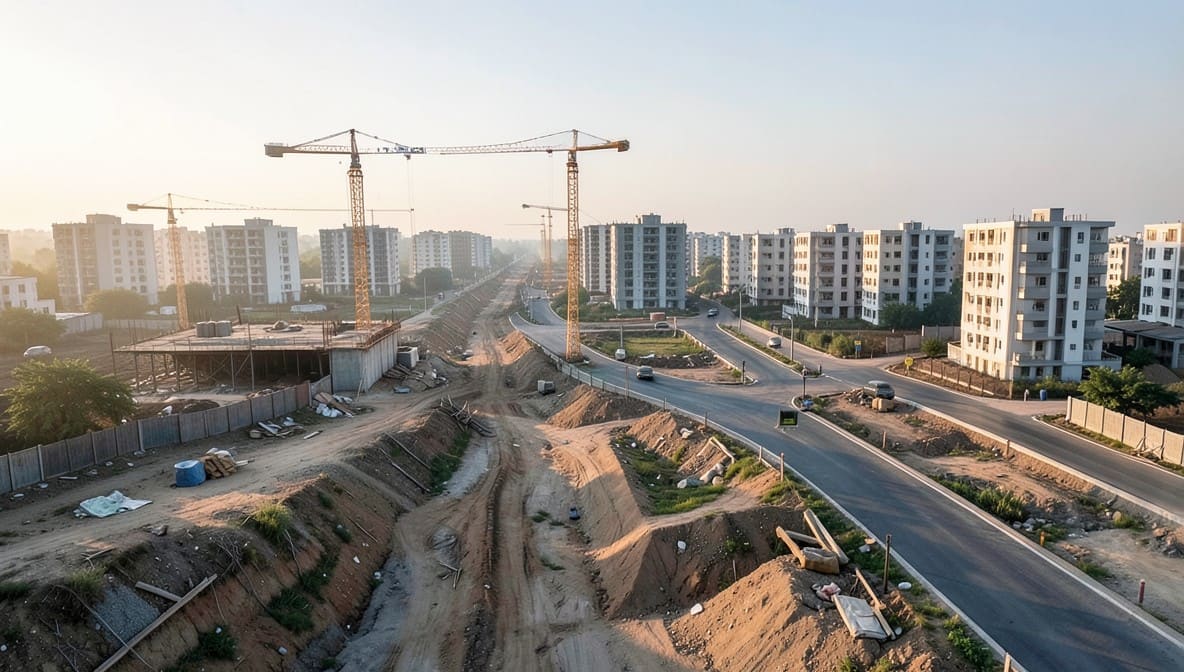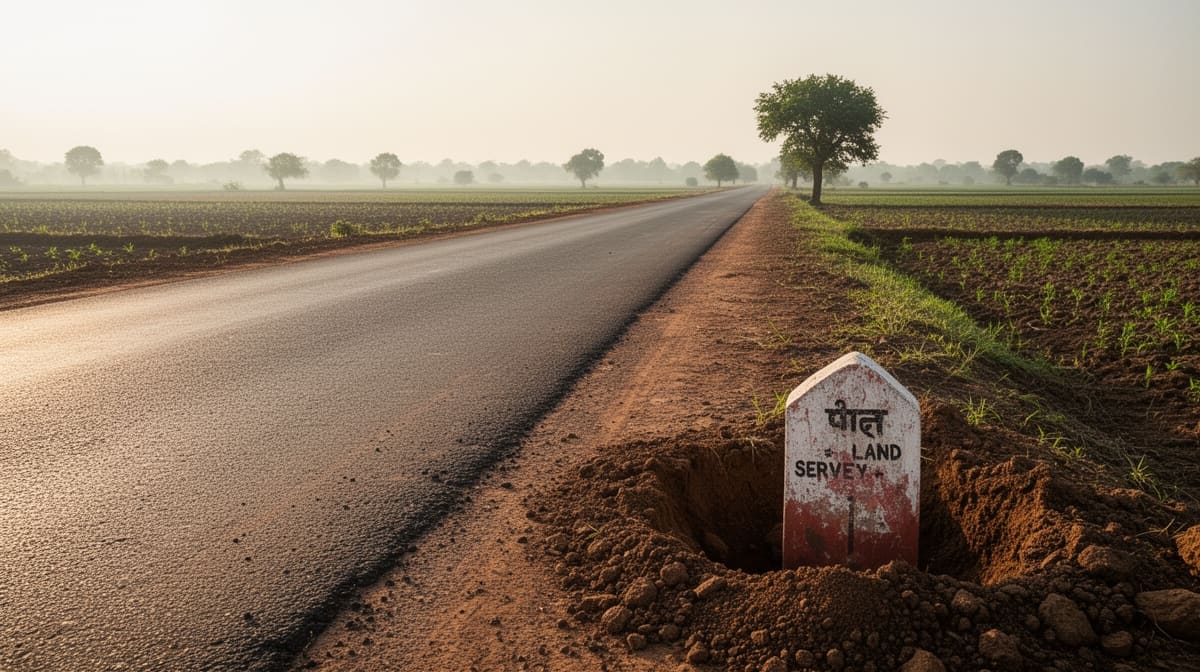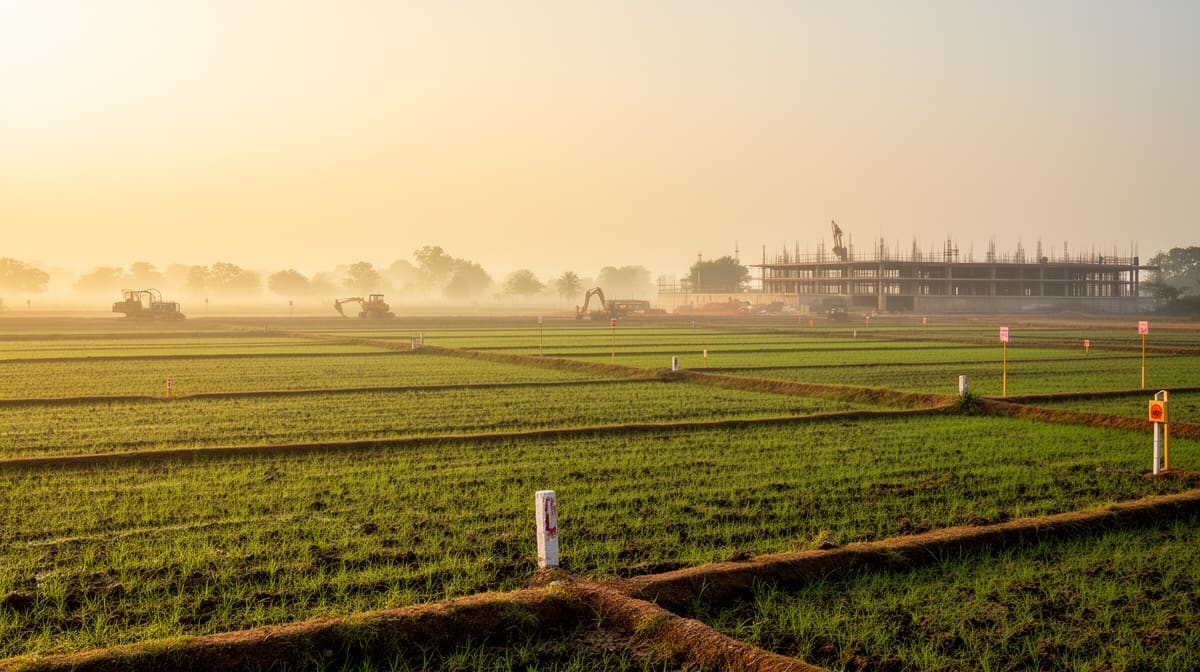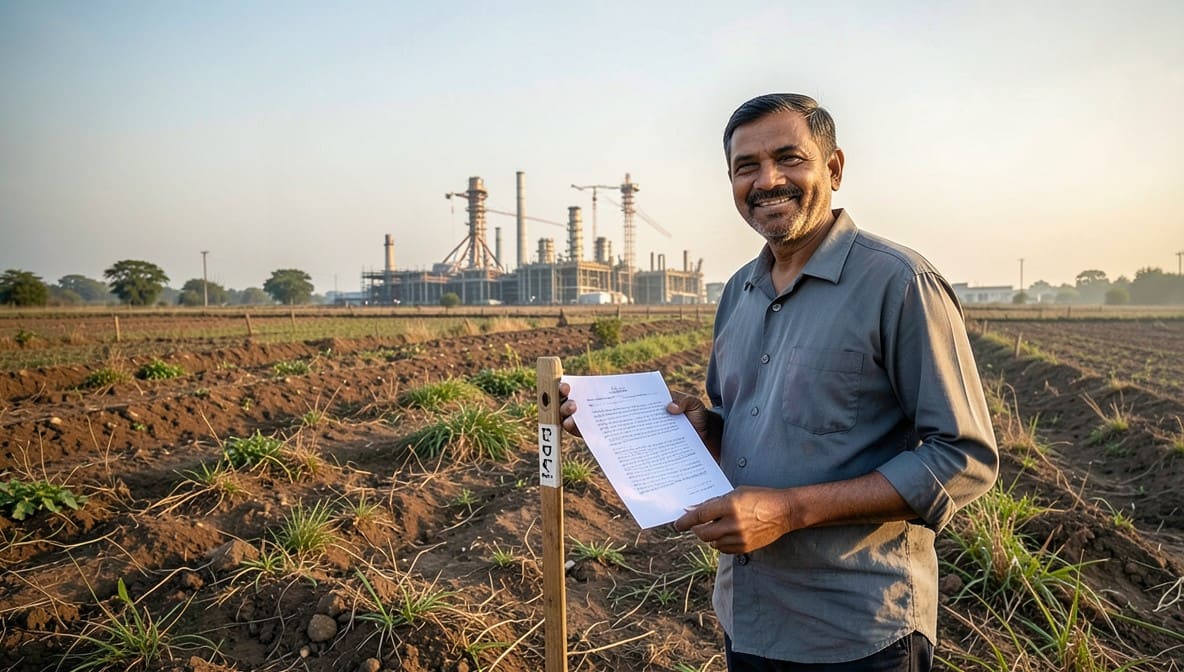
The Allahabad High Court has affirmed that the identification of land for rehabilitation and resettlement under Section 19(2) of the Right to Fair Compensation and Transparency in Land Acquisition, Rehabilitation and Resettlement Act, 2013, does not constitute an expansion of the acquisition area. The Court dismissed petitions challenging the acquisition for the Noida International Airport, holding that the entire process complied with statutory mandates, including consent, Social Impact Assessment, and procedural safeguards.
Background & Facts
The Dispute
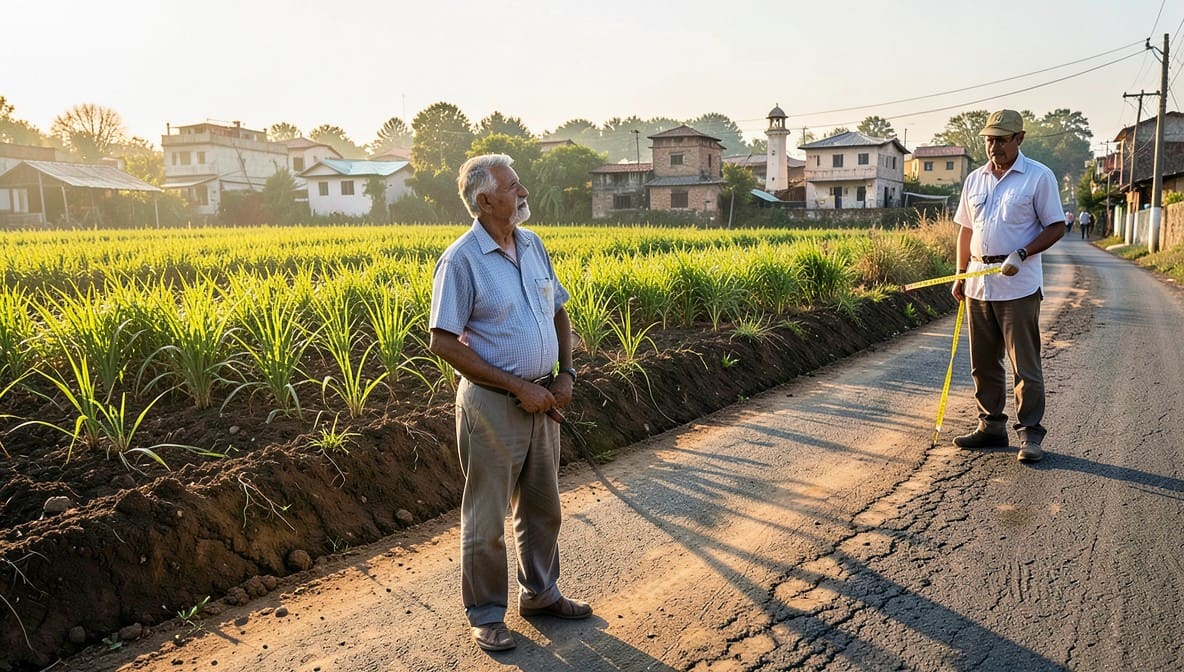
The petitioners, residents of Villages Neemka Shahjahanpur, Khawajpur, and Thora in Tehsil Jewar, District Gautam Buddha Nagar, challenged the issuance of notifications under Sections 11 and 19 of the Land Acquisition Act, 2013, relating to the Stage-2, Phase-2 and Phase-3 expansion of the Noida International Airport. While not opposing the acquisition of agricultural land, they specifically contested the displacement of their village abadi (residential areas), alleging violations of statutory procedures, lack of consent, and illegal expansion of the acquisition area through Schedule-B of the Section 19 Declaration.
Key Facts
- The Noida International Airport Project is a public-private partnership (PPP) project with a total land requirement of approximately 5,000 hectares across three stages.
- Stage-1 (1,239.1416 hectares) and Stage-2, Phase-1 (1,181.2793 hectares) have been completed, with rehabilitation of displaced families underway in planned residential sectors.
- The present acquisition (Stage-2, Phase-2 and Phase-3) involves 1,857.8871 hectares across 14 villages, including Neemka Shahjahanpur, Khawajpur, and Thora.
- The project is implemented by Noida International Airport Limited (NIAL), a State company, with Zurich Airport International AG (ZAI) as the private partner through its subsidiary Yamuna International Airport Private Limited (YIAPL).
- The total land proposed for acquisition includes 275.1820 hectares in Neemka Shahjahanpur, 272.3978 hectares in Khawajpur, and 577.3727 hectares in Thora.
- The Section 19 Declaration dated 24.10.2025 identified 437.9931 hectares across six villages, including 78.6776 hectares in Neemka Shahjahanpur, as the designated Rehabilitation and Resettlement (R&R) site.
- Awards for compensation were passed on 31.01.2026 for Neemka Shahjahanpur and Khawajpur, and on 02.02.2026 for Thora, providing total compensation of Rs. 4,772 - 4,778 per square metre.
- Disbursement of compensation has commenced.
Procedural History
- 30.06.2023: Section 4 Notification issued, nominating Gautam Buddha University as the Social Impact Assessment (SIA) Agency.
- 06.07.2023: Section 4 Notification published in Amar Ujala, Hindustan, and Times of India.
- 19.12.2023 & 21.12.2023: Public hearings conducted under Section 5 at Khawajpur and Neemka Shahjahanpur.
- 09.02.2024: Multi-Disciplinary Expert Group unanimously approved the SIA Report.
- 11.01.2025: State Government approved the SIA Report and published the approval.
- 01.03.2025: Consent of 73.02% of affected families obtained, exceeding the 70% statutory threshold for PPP projects.
- 11.04.2025: Section 11 preliminary notification issued for acquisition of 1,857.8871 hectares.
- 03.07.2025: Public notice issued for hearing objections under Section 15.
- 08.07.2025, 10.07.2025: Personal hearings conducted by the Collector for affected villages.
- 11.07.2025: Collector dismissed objections under Section 15(1) and submitted report.
- 29.07.2025: State Government approved the Collector’s report under Section 15(3).
- 26.06.2025: Draft R&R Scheme published; public hearings held on 09.07.2025 and 10.07.2025.
- 21.07.2025: Commissioner approved the R&R Scheme under Section 18.
- 24.10.2025: Section 19 Declaration issued, identifying R&R land.
- 27.10.2025: Section 19 Declaration published in Hindustan Times and Dainik Jagran.
- 31.01.2026 & 02.02.2026: Compensation awards passed for affected villages.
- 11.04.2025 - 28.04.2026: Writ petitions filed and heard together.
The Parties' Positions
Petitioners: Argued that the acquisition violated mandatory provisions of the Act, 2013, including lack of valid consent (alleging only 22.29% consent), flawed SIA process, non-compliance with Section 10 (food security), and illegal expansion of acquisition area via Schedule-B of the Section 19 Declaration. They also contended that the U.P. Industrial Area Development Act, 1976, barred acquisition under the 2013 Act.
Respondents (YEIDA and State): Contended that the entire process strictly followed the Act, 2013 and Rules, 2016. Consent was 73.02%, SIA was duly conducted, Expert Group recommendations were acted upon, objections were heard, R&R Scheme was approved, and Schedule-B land was identified solely for resettlement, not for airport expansion. They emphasized that the 1976 Act does not override the 2013 Act for public purpose acquisitions.
Relief Sought
The petitioners sought quashing of the Section 11 and Section 19 notifications, restraint on displacement of abadi land, and direction to decide pending representations. They also sought inclusion of pre-regularization service for pension purposes, though this was not substantively argued.
The Legal Issue
The central questions were: (1) Whether the identification of 78.6776 hectares in Schedule-B of the Section 19 Declaration constitutes an illegal expansion of the acquisition area beyond the Section 11 notification; (2) Whether the consent of 70% of affected families was validly obtained under Section 2(2)(b)(ii) of the Act, 2013; and (3) Whether the statutory procedures under Sections 4, 15, 16, and 18 were duly complied with.
Arguments Presented
For the Petitioner
Shri Mahesh Chand Sharma argued that:
- The consent obtained was only 22.29% as of 21.01.2025, far below the 70% threshold.
- Public hearings under Section 5 were not genuinely conducted in Neemka Shahjahanpur.
- The Expert Group’s recommendation for re-survey of Thora and Neemka was ignored.
- The Section 11 notification was issued before completion of Section 15 objections.
- Schedule-B of the Section 19 Declaration illegally added 78.6776 hectares not notified under Section 11.
- The acquisition violated Section 10 of the Act, 2013, as irrigated multi-cropped land was acquired without compliance.
- The U.P. Industrial Area Development Act, 1976, conferred exclusive jurisdiction on YEIDA, barring acquisition under the 2013 Act.
- The right to property under Article 300-A was violated due to non-compliance with procedural safeguards.
For the Respondent
Shri Rahul Agarwal, Senior Counsel for YEIDA, submitted that:
- Consent of 73.02% of affected families was obtained as of 01.03.2025, after removal of duplicate entries.
- The SIA process was fully compliant: public hearings were held, Expert Group approved the report, and PwC confirmed technical unavoidability of displacement.
- Objections under Section 15 were heard personally by the Collector and disposed of by reasoned order.
- Proceedings under Sections 15 and 16 were designed to operate concurrently to meet the 12-month deadline under Section 19.
- Schedule-B land was identified solely for R&R purposes under Section 19(2), requiring a separate acquisition process.
- The 1976 Act does not bar acquisition under the 2013 Act; Section 6 of the 1976 Act expressly contemplates acquisition under land acquisition law.
- Section 10 requirements were satisfied: total acquisition was within the 5% limit of net sown area, and no evidence established irrigated multi-cropped land.
- The petitioners suppressed material documents, including the final R&R Scheme and compensation awards.
The Court's Analysis
The Court undertook a meticulous review of the statutory framework under the Land Acquisition Act, 2013, and the Rules, 2016, and found complete compliance with each procedural stage.
"The statutory unit for computing consent is the 'affected family' as defined under Section 3(c) of the Act, 2013, and not village-wise landholdings or individual voters."
The Court accepted the respondent’s Consent Chart, which demonstrated that the initial figure of 22.29% was based on duplicated entries - families owning land in multiple villages were counted multiple times. After rectification, the corrected figure of 73.02% consent was well above the 70% threshold. The Court relied on its own precedent in Kichhu Ram v. State of U.P. to affirm that such statistical correction is lawful and necessary.
Regarding the SIA process, the Court held that public hearings under Section 5 are not adjudicatory but consultative, and the Expert Group’s suggestion to explore alternatives was acted upon by PwC, which confirmed that Villages Thora and Neemka lie on runway alignments, making relocation unavoidable.
"The identification of land for R&R purposes under Section 19(2) is a distinct statutory obligation and does not constitute acquisition of such land under Section 19(1)."
The Court clarified that Schedule-B of the Section 19 Declaration identifies land for future R&R resettlement, not for the airport project itself. Acquisition of this land requires a separate notification under Section 11 and cannot be conflated with the current acquisition. This distinction was critical in rejecting the petitioners’ claim of expansion.
On the parallel conduct of Sections 15 and 16, the Court held that a sequential reading would render compliance with the 12-month deadline under Section 19 impossible. The Act’s structure permits concurrent proceedings to ensure expeditious public purpose acquisition.
The Court also rejected the challenge under Section 10, noting that the petitioners failed to produce khasra or girdawari records proving the land was irrigated and multi-cropped. The total acquisition across all stages was 1.9% of the district’s net sown area, well within the notified 5% limit.
The Court dismissed the argument under the U.P. Industrial Area Development Act, 1976, holding that Section 6 of that Act expressly contemplates acquisition under land acquisition law, which, post-repeal of the 1894 Act, means the 2013 Act.
The Court further held that the right to property under Article 300-A was not violated, as the Act, 2013 itself embodies the constitutional safeguards required under Kolkata Municipal Corporation v. Bimal Kumar Shah. All seven procedural sub-rights - notice, hearing, reasoned decision, public purpose, fair compensation, expeditious process, and conclusion - were fully satisfied.
The Court also noted that the absence of an urgency clause under Section 40 demonstrated the authorities’ commitment to full due process, not haste.
The Verdict
The petitioners’ writ petitions were dismissed. The Court held that the Section 11 notification dated 11.04.2025 and the Section 19 Declaration dated 24.10.2025 are valid and lawful. Compensation awards of Rs. 4,772 - 4,778 per square metre, inclusive of solatium and interest, have been passed and disbursement has commenced. The Court directed that possession of abadi land shall not be taken until: (i) developed plots are carved out under the approved R&R Scheme; (ii) the R&R Award under Section 31 is passed; and (iii) plots are handed over to displaced families. Any deviation constitutes contempt. Affected persons aggrieved by compensation may seek reference under Section 64 of the Act, 2013.
What This Means For Similar Cases
R&R Land Is Not Acquisition Land
- Practitioners must distinguish between land identified under Section 19(1) (for public purpose) and Section 19(2) (for resettlement). The latter requires a separate acquisition process.
- Challenges alleging 'expansion' of acquisition based on Schedule-B will fail if the R&R land is properly identified and not included in the Section 11 notification.
Consent Must Be Calculated on 'Affected Family' Basis
- Consent under Section 2(2)(b)(ii) must be computed using the broad definition of 'affected family' under Section 3(c), including agricultural labourers, tenants, and urban residents whose livelihood is affected.
- Duplicate entries must be removed before final consent calculation; courts will uphold corrected figures if methodology is transparent.
Parallel Proceedings Are Permissible
- Proceedings under Sections 15 (objections) and 16 (R&R Scheme) may proceed concurrently to meet the 12-month deadline under Section 19.
- Courts will not invalidate acquisitions for procedural overlap if the statutory timeline is met and rights are preserved.
Statutory Compliance Trumps Alleged Technical Defects
- Absence of documentary proof (e.g., khasra records) for claims under Section 10 (food security) will result in dismissal.
- Courts will not interfere with public purpose declarations absent fraud or colourable exercise, as per Smt. Somawanti v. State of Punjab.
Judicial Restraint in Infrastructure Cases
- Where public infrastructure projects are substantially complete, courts will prefer compensation over quashing, as per Veena Singh v. Union of India.
- Writ jurisdiction is not a substitute for statutory remedies under Section 64 for compensation disputes.
Suppression of Material Facts Is Fatal
- Litigants must disclose all material documents, including approved R&R Schemes and compensation awards.
- Failure to do so may result in dismissal with adverse costs or contempt implications.