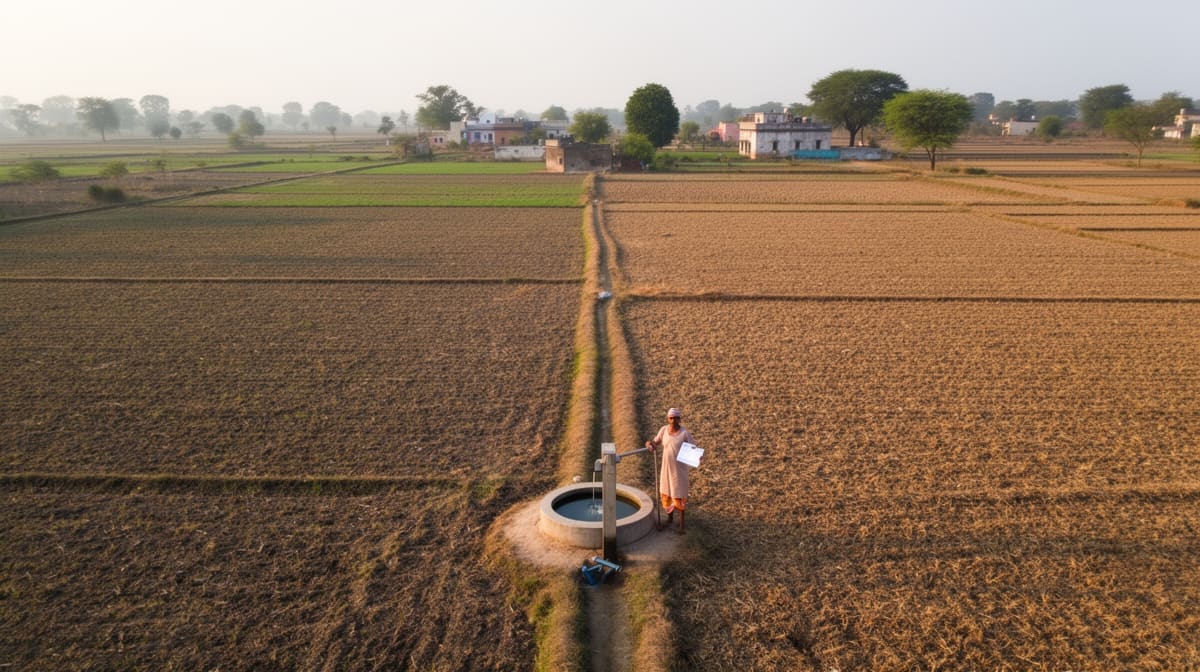
The Madras High Court has established a critical precedent in land acquisition jurisprudence by affirming that lands acquired under a single public project in contiguous villages must be valued as a unified economic belt, not fragmented by arbitrary administrative boundaries. This ruling reinforces the principle that market value must be anchored in the highest bona fide comparable sale, adjusted for objective differences, rather than arbitrary round figures.
Background & Facts
The Dispute
The appellants, landowners from Thenambakkam and Vellacherry villages in Ambattur Taluk, Tiruvallur District, challenged the compensation awarded under the Land Acquisition Act, 1894 for lands acquired for the Outer Ring Road Scheme. The Land Acquisition Officer (LAO) fixed the market value at Rs.500/- per cent for Thenambakkam and Rs.450/- per cent for Vellacherry, based on a limited sample of sale transactions from 2000 to 2003. The claimants contended that the actual market value was significantly higher, with sales recorded at up to Rs.4,00,000/- per acre prior to the notification.
Key Facts
- The acquisition was carried out under G.O.Ms. No.385, Housing & Urban Development (UD-III-1), dated 16.10.1998.
- Section 4(1) notifications were issued on 08.10.2003 and 16.05.2003.
- The LAO’s award dated 15.02.2006 and 27.02.2006 relied on 442 sale transactions for Thenambakkam and 27 for Vellacherry.
- The Reference Court, in its order dated 06.09.2017, enhanced compensation to Rs.5,000/- per cent across all seven acquisition proceedings (L.A.O.P. Nos. 1 to 7 of 2008).
- The appellants produced multiple registered sale deeds as evidence, including:
- Ex.C8 (L.A.O.P. No.1 of 2008): Registered sale deed dated 12.09.2003, showing Rs.16,530/- per cent for land in Morai Village.
- Ex.C1 (L.A.O.P. No.5 of 2008): Common award in L.A.O.P. No.280 of 2008 dated 23.03.2011, fixing Rs.16,500/- per cent for Morai.
- Ex.C4 (L.A.O.P. No.5 of 2008): Lok Adalat award dated 18.10.2014, fixing Rs.20,000/- per cent.
- The respondents argued the lands were uncultivated, low-lying, and unfit for habitation due to prior soil excavation for brick manufacturing.
- The guideline value for Thenambakkam (2007 - 2012) was Rs.1,800/- per cent; for Morai, it was Rs.26,136/- per cent.
Procedural History
- 16.10.1998: Government issued G.O. for Outer Ring Road Scheme.
- 08.10.2003 & 16.05.2003: Section 4(1) notifications issued.
- 15.02.2006 & 27.02.2006: LAO issued Awards Nos. 5, 6 & 1 of 2006 fixing market value at Rs.500/- and Rs.450/- per cent.
- 2008: Claimants filed L.A.O.P. Nos. 1 to 7 of 2008 before the II Additional District and Sessions Judge, Tiruvallur.
- 06.09.2017: Reference Court enhanced compensation to Rs.5,000/- per cent.
- 2019: Appeals filed before Madras High Court (A.S. Nos. 440 - 446 of 2019).
- 20.11.2025: Judgment reserved.
- 13.03.2026: Judgment pronounced.
The Parties' Positions
Appellants: Argued that Thenambakkam and Vellacherry are contiguous with Morai and other developed villages in the same corridor, and that the highest bona fide sale (Ex.C8) should form the benchmark. Relied on Union of India v. Harinder Pal Singh and Mehrawal Khewaji Trust v. State of Punjab.
Respondents: Contended that the lands were non-productive, lacked infrastructure, and that the Reference Court’s Rs.5,000/- per cent was reasonable. Submitted guideline values and argued against cross-village comparability.
Relief Sought
The appellants sought enhancement of compensation from Rs.5,000/- per cent to Rs.19,000/- per cent, with statutory benefits under Sections 23(1A), 23(2), and 28 of the Land Acquisition Act, 1894, and payment of interest from the date of possession.
The Legal Issue
The central question was whether market value for land acquired under a single public project spanning multiple contiguous villages must be determined by treating the entire corridor as a single economic unit, and whether the highest bona fide comparable sale within that unit must form the benchmark, subject to reasonable adjustments.
Arguments Presented
For the Appellant
The appellants relied on Union of India v. Harinder Pal Singh to argue that lands acquired for the same project in abutting villages should be treated as a single unit for valuation, irrespective of village boundaries. They invoked Mehrawal Khewaji Trust v. State of Punjab to assert that the highest bona fide sale transaction - Ex.C8 dated 12.09.2003 showing Rs.16,530/- per cent - must be the primary benchmark. They emphasized that the Reference Court erred by rejecting these exemplars on the ground of village separation, despite the absence of physical or economic discontinuity. They further noted that the LAO had fixed identical rates for Morai and Thenambakkam in earlier awards, undermining the claim of dissimilarity.
For the Respondent
The respondents argued that the lands were non-cultivable, low-lying, and lacked infrastructure, making them fundamentally different from developed areas like Morai. They submitted guideline values (Rs.1,800/- per cent for Thenambakkam) to argue that the Reference Court’s Rs.5,000/- per cent was already generous. They contended that the sale deeds relied upon by appellants were either too distant in location or lacked proper adjustment for transactional factors such as plot size, access, and development status.
The Court's Analysis
The Court undertook a rigorous analysis of the statutory framework under Section 23 of the Land Acquisition Act, 1894, which mandates that compensation be determined based on the market value of the land at the date of the Section 4(1) notification. The Court emphasized that market value cannot be determined by arbitrary round figures or generalized assumptions.
"A bare round-figure fixation, without a supporting analytical chain, cannot be sustained."
The Court acknowledged the appellants’ reliance on Harinder Pal Singh, noting that the principle of treating contiguous lands acquired for the same public purpose as a single unit is well-established. The Court observed that the Outer Ring Road Scheme is a linear infrastructure project spanning multiple villages, and that administrative boundaries cannot override economic reality.
The Court accepted Ex.C8 (sale deed dated 12.09.2003) as the most time-proximate and bona fide exemplar, reflecting Rs.16,530/- per cent for land in Morai, which is geographically and functionally contiguous with Thenambakkam. However, the Court declined to apply this rate mechanically, noting that the acquired lands may lack certain advantages such as immediate usability, plot shape, or road access.
"An exemplar transaction cannot be applied mechanically. If the exemplar reflects marketability advantages over the acquired lands... a deduction is necessary to arrive at a realistic market value."
In the absence of detailed comparative sketches or recorded adjustments, the Court applied a reasonable, moderate deduction of 20% to account for potential disadvantages. This yielded Rs.13,224/- per cent, rounded to Rs.13,500/- per cent for uniformity and administrative clarity.
The Court explicitly rejected the respondents’ reliance on guideline values, noting that these are not determinative of market value under the Act, especially where actual sale transactions are available.
The Verdict
The appeals were allowed. The compensation awarded by the Reference Court is enhanced from Rs.5,000/- per cent to Rs.13,500/- per cent. The claimants are entitled to statutory benefits under Sections 23(1A), 23(2), and 28 of the Land Acquisition Act, 1894, including solatium, additional amount, and interest, subject to credit for any amounts already paid. The appellants shall pay any deficit court fee on the enhanced compensation within four weeks of receiving a copy of this judgment. There shall be no order as to costs.
What This Means For Similar Cases
Single-Belt Valuation Is Mandatory for Linear Projects
- Practitioners must now argue that lands acquired under a single infrastructure project (e.g., highways, ring roads, metro lines) spanning multiple villages must be treated as a single economic belt.
- Administrative boundaries (village, panchayat, taluk) cannot be used to artificially depress compensation.
- Evidence of contiguous development, shared connectivity, and unified planning must be presented to invoke this principle.
Highest Bona Fide Sale Is the Starting Point
- The benchmark for market value must be the highest bona fide sale transaction within the relevant time frame and geographic belt.
- Lower sales or guideline values cannot override demonstrably higher market transactions.
- Courts must explicitly identify and justify the rejection of any comparable sale, not dismiss it on vague grounds of "distance" or "village separation."
Reasonable Deductions Must Be Quantified
-
Any adjustment from the benchmark sale must be based on specific, documented differences (e.g., plot size, access, topography).
-
Generic deductions without evidentiary basis are impermissible.
-
A 20% deduction, as applied here, sets a precedent for moderate, reasonable adjustments where detailed analysis is lacking.
-
Always produce sale deeds with registration details, dates, and location coordinates.
-
File sketches or maps showing proximity between the benchmark and acquired lands.
-
Challenge guideline values as irrelevant under Section 23 unless no market transactions exist.
-
Argue for interest from the date of possession, not just the date of award.