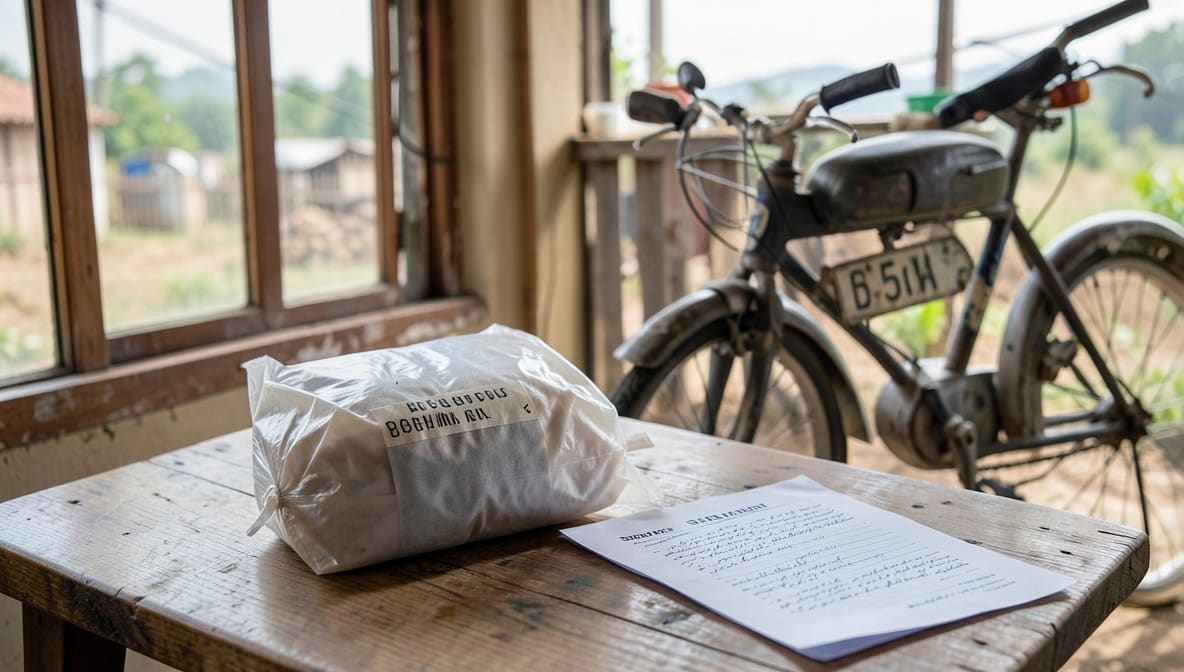
The Karnataka High Court has set aside a conviction under the Karnataka Excise Act, 1965, holding that failure to conduct mandatory chemical analysis of seized liquor and non-compliance with statutory seizure protocols render the prosecution’s case legally unsustainable. The judgment reinforces the principle that procedural lapses in excise enforcement cannot be overlooked when the burden of proof lies beyond reasonable doubt.
Background & Facts
The Dispute
The petitioner, Sri Khobanna s/o Madev Koli, a daily wage laborer, was charged with transporting 120 packets of illicit liquor (each 100 ml) on a two-wheeler bearing registration No. MH-13/W-8582 near Bandar Village, Indi Taluk, on 24.08.2019. The charge sheet was filed under Sections 32(1), 34, and 38-A read with Sections 13 and 14 of the Karnataka Excise Act, 1965. The prosecution alleged that the petitioner was caught in the act of transporting illicit arrack.
Key Facts
- The vehicle was registered in the name of Rajendra Balkrishna Pandhare, a resident of Solapur, Maharashtra.
- The petitioner was not the owner of the vehicle.
- On 27.09.2019, the Excise Sub-Inspector sent a notice to the vehicle owner, Rajendra Pandhare, seeking his statement.
- On 10.10.2019, Rajendra Pandhare replied, stating he was paralyzed and had permitted the petitioner to use the vehicle for personal purposes.
- The prosecution did not file a charge sheet against the vehicle owner for the offence under Section 38-A.
- Only one of the 120 seized packets was sent for chemical examination; the remaining 119 were not forwarded.
- The seizure report under Section 43-A of the Karnataka Excise Act was submitted on 02.10.2019 - 39 days after seizure on 24.08.2019.
- The motor vehicle was not seized or produced as material evidence.
- No independent witnesses were examined; all prosecution witnesses were excise officials.
- The petitioner did not lead any defence evidence.
Procedural History
- 24.08.2019: Arrest of petitioner; seizure of 120 packets of illicit liquor and vehicle.
- 25.08.2019: FIR registered as Crime No. 13/2019-20.
- 14.03.2024: Trial Court (Civil Judge & JMFC, Indi) convicted petitioner under Sections 32(1), 34, and 38-A of the Karnataka Excise Act; sentenced to 1 year rigorous imprisonment for each offence, with fines of Rs. 10,000 each, to run consecutively.
- 08.11.2024: First Appellate Court (I Additional Sessions Judge, Vijayapura) dismissed appeal and confirmed conviction.
- 27.04.2026: Criminal Revision Petition heard and allowed by Karnataka High Court, Kalaburagi Bench.
Relief Sought
The petitioner sought quashing of the conviction and sentence, acquittal on all charges, and refund of any fine paid, on grounds of insufficient evidence, procedural violations, and failure to prove guilt beyond reasonable doubt.
The Legal Issue
The central question was whether a conviction under Section 38-A of the Karnataka Excise Act, 1965 can be sustained when the accused is not the owner of the vehicle and no charge sheet is filed against the owner, and whether the prosecution’s failure to send all seized liquor for chemical examination and to comply with mandatory reporting under Section 43-A vitiates the entire case.
Arguments Presented
For the Appellant/Petitioner
Learned counsel argued that: (i) Section 38-A applies only to owners or persons having control over premises or vehicles used for commission of offences - the petitioner was neither owner nor manager of the vehicle; (ii) the prosecution failed to prove the seized substance was illicit liquor, as only one of 120 packets was sent for chemical analysis; (iii) the 39-day delay in reporting seizure under Section 43-A violated mandatory procedure; (iv) non-seizure of the vehicle rendered the chain of custody incomplete; (v) reliance on self-interested official testimony without independent corroboration is legally impermissible; and (vi) the judgment of conviction was perverse and contrary to evidence.
For the Respondent/State
The High Court Government Pleader contended that the Trial Court and First Appellate Court had correctly appreciated the evidence, that the petitioner was caught red-handed, and that procedural lapses were technical and did not affect the substantive guilt. It was argued that the petitioner’s denial of guilt was not supported by any defence evidence, and the conviction was based on credible prosecution testimony.
The Court's Analysis
The Court undertook a meticulous review of the prosecution’s compliance with statutory mandates under the Karnataka Excise Act, 1965. It emphasized that Section 43-A requires immediate reporting of seizure to the competent authority, and Section 54 mandates that all seized contraband be sent for chemical examination. The Court noted that the Investigating Officer’s failure to send 119 of the 120 packets for testing created an irrebuttable doubt as to the nature of the seized substance.
"The prosecution has not established the identity of the seized article as illicit liquor. The non-examination of the author of Ex.P7 and the failure to send all packets for chemical analysis are fatal to the case."
The Court further held that Section 38-A requires proof that the accused was the owner, occupier, or person having control over the vehicle used for the offence. Since the petitioner was not the owner, and the owner was not prosecuted, the charge under Section 38-A was legally unsustainable. The Court observed:
"The Investigating Officer has not explained why the owner was not charged under Section 38-A despite clear evidence of ownership and knowledge. The mechanical application of Section 38-A against the driver, without any nexus to control or management of the vehicle, is legally untenable."
The Court also highlighted the 39-day delay in submitting the seizure report under Section 43-A, which deprived the accused of the opportunity to challenge the legality of seizure at the earliest stage. The absence of independent witnesses and the exclusive reliance on excise officials - who stood to benefit from successful prosecution - further eroded the credibility of the case.
The Court reiterated the principle from State of U.P. v. Krishna Kumar that when statutory procedures are mandatory and their violation creates reasonable doubt, the benefit must go to the accused. The cumulative effect of these lapses rendered the conviction unsafe.
The Verdict
The revision petition was allowed. The High Court set aside the conviction and sentence dated 14.03.2024 and 08.11.2024. The petitioner is acquitted of all charges under Sections 32(1), 34, and 38-A read with Sections 13 and 14 of the Karnataka Excise Act, 1965. The bail bond stands cancelled. The Trial Court is directed to refund any fine deposited by the petitioner. The Registry is directed to send a copy of this order to the concerned court with the Trial Court Record.
What This Means For Similar Cases
Procedural Compliance Is Non-Negotiable in Excise Cases
- Practitioners must insist on proof of compliance with Section 43-A (immediate reporting) and Section 54 (full chemical analysis of all seized contraband) in every excise prosecution.
- Delay in reporting seizure beyond 48 hours, without explanation, is now a ground for acquittal.
Section 38-A Cannot Be Applied to Non-Owners
- Prosecution must establish that the accused had ownership, control, or management of the vehicle or premises.
- Charging a driver or transporter under Section 38-A without prosecuting the owner is legally invalid.
- Defence counsel should immediately challenge charges under Section 38-A if the accused is not the registered owner.
Independent Evidence Is Required for Conviction
- Convictions based solely on self-interested official testimony, without independent corroboration, are vulnerable to reversal.
- Courts will not overlook the absence of forensic proof when the nature of the seized article is central to the charge.
- Practitioners should file applications for production of chemical analysis reports at the earliest stage of trial.