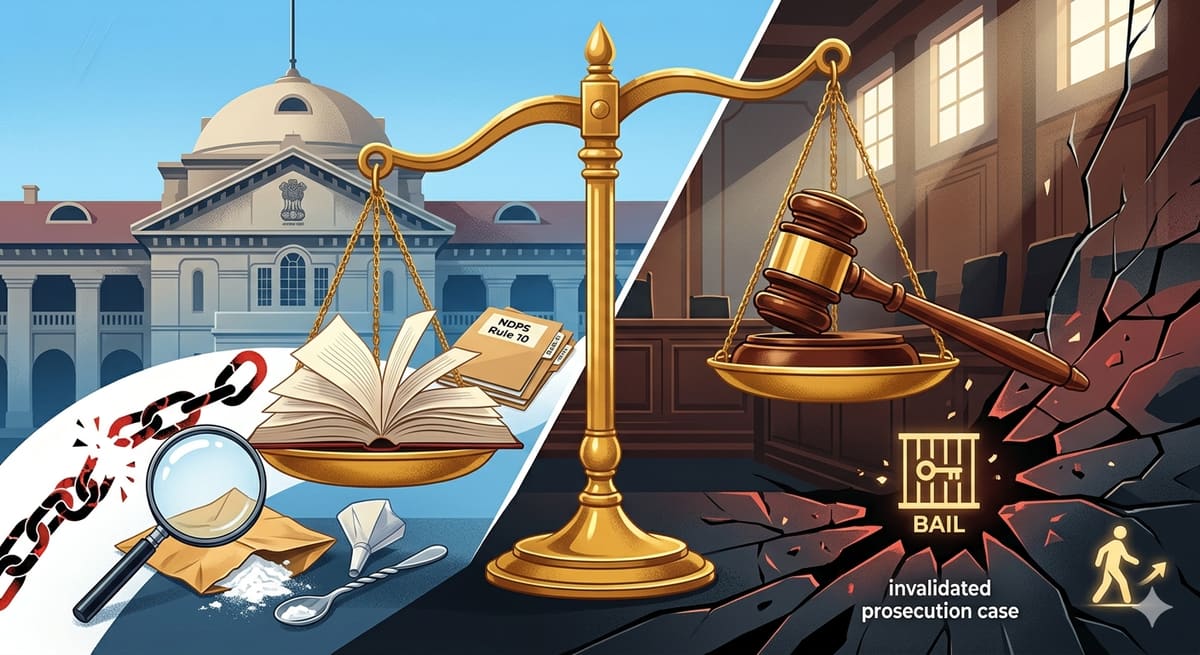
The Karnataka High Court has held that an unlawful arrest under the Bharatiya Nyaya Sanhita, 2023, renders subsequent medical examination and forensic testing inadmissible, thereby collapsing the entire prosecution under the NDPS Act. This judgment reinforces the principle that procedural legality is not a formality but a constitutional prerequisite for evidence to carry weight in criminal proceedings.
Background & Facts
The Dispute
The petitioner, Sriman Eman Abbas Topiwala, was named as Accused No.12 in Special Case No.1182/2025, filed before the VIII Additional District and Sessions Judge and Special Judge for NDPS Cases at Bengaluru Rural District. The case arose from a late-night gathering at a private residence, Ellavoma House, on the night of 24-04-2025 to early morning of 25-05-2025. The event, attended by approximately 30 to 35 persons, was alleged to involve consumption of alcohol and narcotic substances, including cocaine and ganja, alongside loud music and dancing. No prior permission had been obtained for the gathering.
Key Facts
- The Devanahalli Police Station registered Crime No.68 of 2025 on 25-05-2025 against unknown persons based on a suo motu complaint.
- A raid was conducted at approximately 2:30 p.m. on 25-05-2025, supervised by the Assistant Commissioner of Police, with five panch witnesses and a medical officer present.
- Blood and urine samples were collected from all attendees, including the petitioner, marked as Article Nos. 59 and 60.
- The samples were forwarded to the State Forensic Science Laboratory, Madiwala, Bengaluru.
- The Forensic Science Laboratory report dated 24-06-2025 indicated that the petitioner’s blood and urine samples tested positive for cocaine.
- The petitioner was not formally arrested on 25-05-2025; instead, a notice under Section 67 of the BNSS was issued directing her to appear before the police station on 27-05-2025 at 10:30 a.m.
- No arrest memo, witness attestation, or recorded reasons for arrest were produced.
- The charge sheet was filed on 31-12-2025, and cognizance was taken on the same date.
- The petitioner was never detained beyond the day of the raid.
Procedural History
- 24-04-2025: Alleged gathering at Ellavoma House begins at 9:30 p.m.
- 25-05-2025: Police register Crime No.68 of 2025; raid conducted at 2:30 p.m.; blood and urine samples collected; notice issued under Section 67 BNSS for appearance on 27-05-2025.
- 24-06-2025: Forensic Science Laboratory report submitted, testing positive for cocaine in petitioner’s samples.
- 31-12-2025: Charge sheet filed; cognizance taken by Special Judge; Special Case No.1182/2025 registered.
- 23-03-2026: Criminal Petition No.3020/2026 filed under Section 482 CrPC and Section 528 BNSS seeking quashment of proceedings.
- 10-04-2026: Judgment pronounced by Justice M. Nagaprassanna.
The Parties' Positions
Petitioner: Argued that she was merely an attendee at the event, with no possession of contraband, no overt act attributed to her, and no lawful arrest. Contended that the blood sample collection was unlawful as it followed an invalid arrest, violating Section 35 BNSS and the guidelines in D.K. Basu v. State of West Bengal. Asserted that the forensic report was inadmissible and the prosecution was an abuse of process.
Respondent (State): Contended that the positive test result for cocaine was conclusive proof of consumption. Argued that the petitioner was arrested and released on the same day, and that the medical examination was lawful under Section 51 BNSS. Submitted that the petitioner was already on bail and that the petition should be dismissed.
Relief Sought
The petitioner sought quashing of the FIR, charge sheet, and all proceedings in Special Case No.1182/2025 against her, on the grounds that the prosecution was founded on illegally obtained evidence and violated constitutional safeguards.
The Legal Issue
The central questions were: (1) Whether the arrest of the petitioner was lawful under Section 35 of the Bharatiya Nyaya Sanhita, 2023? (2) Whether a medical examination under Section 51 BNSS can be lawfully conducted in the absence of a lawful arrest? (3) Whether a forensic report derived from an illegally obtained biological sample can serve as the sole basis for prosecution under Section 27(b) of the NDPS Act, 1985?
Arguments Presented
For the Petitioner
The petitioner’s counsel relied on D.K. Basu v. State of West Bengal and Satender Kumar Antil v. Central Bureau of Investigation to argue that arrest for offences punishable with up to seven years’ imprisonment requires strict compliance with Section 35 BNSS. He emphasized that no arrest memo, witness attestation, or recorded reasons were produced. He contended that the blood sample collection under Section 51 BNSS was invalid because it followed an illegal arrest. He further argued that Section 27(b) requires proof of actual consumption, which cannot be established without a legally obtained forensic report. He cited Hanumanta v. State of Karnataka, Deon Josey v. State of Kerala, and Anurag Shaji v. State of Kerala to show that courts consistently quash proceedings where the sole evidence is a tainted forensic report.
For the Respondent
The Additional State Public Prosecutor argued that the positive test result for cocaine was sufficient to establish consumption under Section 27(b). He contended that the petitioner was arrested and released on the same day, implying lawful custody. He asserted that the medical examination was conducted in good faith and that the procedural irregularities, if any, did not vitiate the scientific result. He submitted that the petition should be dismissed as the petitioner was already enlarged on bail and that quashing would undermine law enforcement efforts.
The Court's Analysis
The Court undertook a meticulous analysis of Section 35 of the Bharatiya Nyaya Sanhita, 2023, which governs arrest without warrant for offences punishable with imprisonment up to seven years. It held that the power to arrest under Section 35(1)(b) is discretionary and conditional, requiring two cumulative elements: (i) a reasonable belief based on complaint, information, or suspicion that the person committed the offence, and (ii) satisfaction that arrest is necessary to prevent further offence, tampering with evidence, or ensuring court appearance. The Court emphasized that the absence of any recorded reasons for arrest rendered the purported arrest a legal nullity.
"Arrest is not a fleeting administrative act; it is a profound intrusion upon personal liberty. It must be preceded by reason, accompanied by transparency and justified by necessity."
The Court further relied on Satender Kumar Antil and D.K. Basu to affirm that communication of grounds of arrest, preparation of an arrest memo, and attestation by a witness are mandatory constitutional safeguards under Articles 21 and 22(1). The absence of these elements, the Court held, vitiated the arrest ab initio.
Turning to Section 51 BNSS, the Court observed that medical examination, including collection of blood samples, is permissible only upon lawful arrest. The provision is inextricably linked to the existence of a valid arrest. Since the arrest was illegal, the medical examination was inherently unlawful. The Court cited Ritesh Sinha v. State of Uttar Pradesh and Chotkau v. State of Uttar Pradesh to affirm that Section 51 cannot be invoked as a routine investigative tool.
"The very substratum of this process - a lawful arrest - is conspicuously absent. The petitioner was never arrested in accordance with law. Consequently, the subsequent act of subjecting her to medical/biological examination lacks legal foundation."
The Court then examined the evidentiary value of the forensic report. It held that Section 27(b) of the NDPS Act requires proof of actual consumption, which must be established through credible, legally obtained evidence. The forensic report, being a direct product of an illegal process, was tainted and inadmissible. The Court relied on Hanumanta v. State of Karnataka, Deon Josey v. State of Kerala, and Anurag Shaji v. State of Kerala to affirm that in the absence of a legally obtained forensic report, no prosecution under Section 27(b) can survive.
The Court concluded that permitting the prosecution to continue would amount to an abuse of process, as it would sanction a chain of illegality beginning with unlawful arrest and culminating in reliance on tainted evidence.
The Verdict
The petitioner succeeded. The Court allowed Criminal Petition No.3020/2026 and quashed all proceedings in Special Case No.1182/2025 pending against the petitioner, including the FIR, charge sheet, and all actions leading thereto. The Court explicitly clarified that its observations were confined to the petitioner’s case and would not bind proceedings against other accused. The Court directed that the forensic report derived from the illegal blood sample be excluded from any future proceedings involving the petitioner.
What This Means For Similar Cases
Arrest Cannot Be a Formality
- Practitioners must now insist on production of arrest memos, recorded reasons, and witness attestations in all cases involving offences punishable with up to seven years’ imprisonment.
- Absence of these documents must be raised as a jurisdictional defect, not merely a procedural irregularity.
- Courts are now bound to treat non-compliance with Section 35 BNSS as fatal to the prosecution’s case.
Forensic Evidence Is Not Infallible
- A positive forensic report alone cannot sustain a prosecution under Section 27(b) of the NDPS Act if the sample was obtained unlawfully.
- Defence counsel must challenge the chain of custody and legality of sample collection at the earliest opportunity.
- Courts will not permit reliance on evidence derived from illegal arrests, even if the scientific result is accurate.
Procedural Compliance Is Non-Negotiable
- The judgment reinforces that constitutional safeguards under Articles 21 and 22(1) are not optional.
- Police officers must document every step of arrest and medical examination; failure will result in exclusion of evidence.
- Prosecutors must now ensure that every forensic report is preceded by a lawful arrest - otherwise, the entire case collapses.