The Punjab and Haryana High Court enhanced motor accident compensation from Rs.20,069 to Rs.54,000, holding that a third-party claimant can recover the entire amount from any one joint tortfeasor under the principle of joint and several liability. The Tribunal erred in apportioning 50% liability to an unidentified tortfeasor not impleaded in the proceedings. The Court reassessed compensation under established heads including pain and suffering, loss of income, and treatment expenses, applying minimum wage benchmarks for the student claimant.
Background & Facts
The Dispute
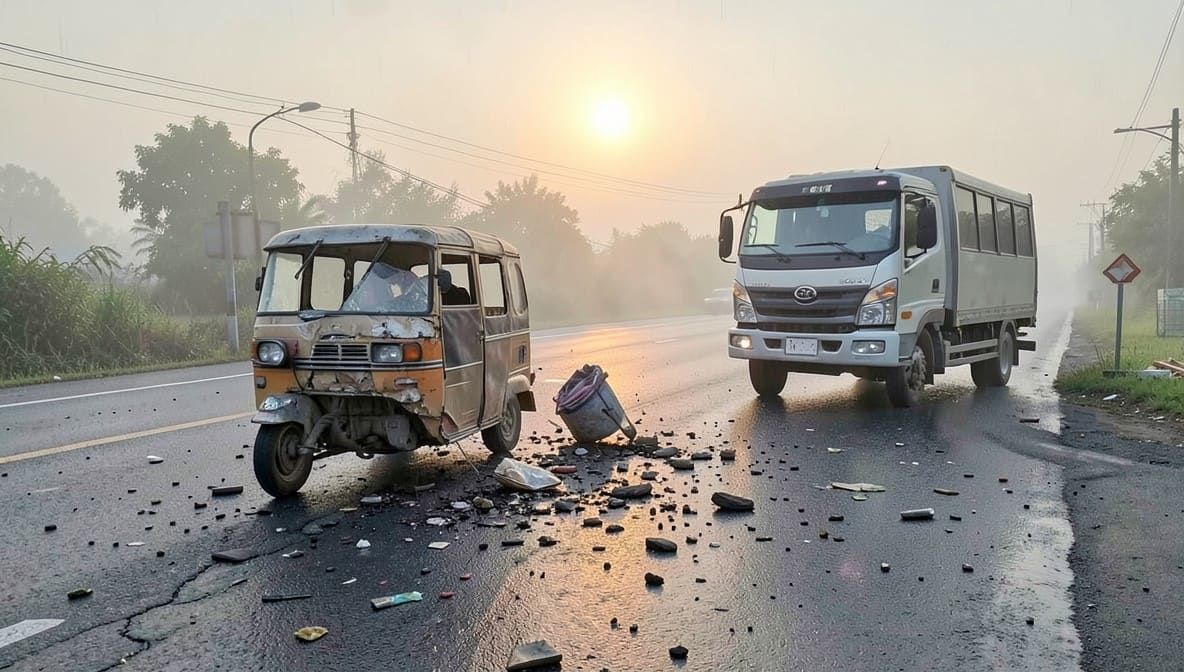
The appellant, Rishi Pal, then an 18-year-old student of Class 10, suffered grievous injuries in a motor vehicular accident on 29.01.2001. The accident involved a three-wheeler bearing registration HNE-5442, driven by respondent No.1 and owned by respondent No.1-A, and a Tata-407 vehicle whose driver and owner could not be identified. Both offending vehicles were uninsured. The claimant filed a petition under Section 166 of the Motor Vehicles Act, 1988 before the Motor Accident Claims Tribunal, Kaithal (MACT Case No.10 of 2001) seeking compensation for injuries sustained due to rash and negligent driving of both vehicles.
Key Facts
- Date of accident: 29.01.2001
- Claimant: Rishi Pal, aged 18 years, student of Class 10
- Offending vehicles: Three-wheeler HNE-5442 (driver: respondent No.1, owner: respondent No.1-A) and Tata-407 (driver and owner unidentified)
- Insurance status: Both vehicles uninsured
- Injuries suffered: Head injury, fracture patella, fracture femur condyle
- Medical treatment: Referred from PGI Chandigarh to General Hospital, Kaithal on 09.02.2001; operated for patella fracture on 23.03.2001; discharged on 13.04.2001
- Medical evidence: Bed head ticket and treatment record (Ex. PA) tendered by PW2 Dr. V.K. Nagpal
- Treatment bills: Ex. P1 to P20 produced, Tribunal awarded Rs.7,069/- on this account
- Claim petition filed: 26.02.2001
Procedural History
- 26.02.2001: Claim petition filed under Section 166 MV Act before MACT, Kaithal (Case No.10 of 2001)
- 13.05.2003: Tribunal awarded Rs.20,069/- as compensation with interest @ 9% per annum from date of filing till realization
- Tribunal's liability finding: Accident due to contributory negligence of both drivers; 50% recoverable from respondent No.1 and 1-A; 50% from unidentified Tata-407 owner/driver (not impleaded)
- Present appeal: FAO-2912-2003 (O&M) filed by claimant for enhancement of compensation
- 17.08.2026: High Court judgment delivered by Hon'ble Mr. Justice Yashvir Singh Rathor
Relief Sought
The appellant sought enhancement of compensation on grounds that: (i) Tribunal failed to award compensation under all pecuniary and non-pecuniary heads despite grievous injuries and huge treatment expenditure; (ii) Tribunal erred in apportioning 50% liability to unidentified tortfeasor not impleaded; (iii) Claimant as third party could recover entire compensation from either tortfeasor under joint and several liability.
The Legal Issue
The central questions were: (1) Whether the Tribunal erred in directing the claimant to recover 50% compensation from respondents No.1 and 1-A and 50% from the unidentified owner and driver of the Tata-407, where the latter were not impleaded; (2) Whether the compensation of Rs.20,069/- was grossly inadequate given the nature of injuries and established heads of damages.
Arguments Presented
For the Appellant
Learned counsel argued that the compensation was inadequately assessed across all heads. The claimant suffered grievous injuries requiring surgery and prolonged recovery, yet the Tribunal awarded only Rs.10,000/- for pain and suffering and Rs.7,069/- for treatment. Counsel contended that the Tribunal's finding of contributory negligence was misplaced; the case involved composite negligence where the claimant, a third party, had not contributed to the accident. Relying on Khenei v. New India Assurance Co. Ltd. (Law Finder Doc ID #669171), counsel submitted that in composite negligence, liability of joint tortfeasors is joint and several, and the claimant is entitled to recover entire compensation from any one tortfeasor. The Tribunal erred in apportioning liability without impleading the other tortfeasor.
For the Respondent
Learned counsel for respondent No.1 supported the Tribunal's award as well-reasoned and justified. Counsel submitted that the material on file was correctly appreciated and no interference was warranted. The respondent did not challenge the liability apportionment but defended the quantum assessment.
The Court's Analysis
Liability: Joint and Several Liability of Joint Tortfeasors
The Court held that the Tribunal gravely erred in apportioning liability. Citing the Supreme Court in Khenei v. New India Assurance Co. Ltd. (Law Finder Doc ID #669171), the Court affirmed:
"In the case of composite negligence, the claimant is entitled to sue both or any one of the joint tortfeasors and to recover the entire compensation, as the liability of joint tortfeasors is joint and several. It will not be appropriate for the Court/Tribunal to determine the extent of composite negligence of the drivers of two vehicles in the absence of the impleadment of the other joint tortfeasors."
The Court drew a clear distinction between contributory negligence and composite negligence. In contributory negligence, the claimant contributes to the accident and recovery is reduced to the extent of own negligence. In composite negligence, the claimant has not contributed; the outcome results from negligence of two or more other persons, and the claimant can recover full compensation from any tortfeasor. The impleaded tortfeasor may subsequently sue the other in independent proceedings.
Since Rishi Pal was a third party qua both drivers, he was entitled to recover the entire compensation from respondents No.1 and 1-A jointly and severally.
Quantum: Principles of Just Compensation
The Court reiterated that compensation must be just and equitable - fair, reasonable, and based on evidence, neither a windfall nor a pittance. The objective is to restore the victim to the position he would have been in but for the accident, to the extent money can do so.
Following G. Ravindranath @ R. Chowdary v. E. Srinivas (2013 (3) RCR (Civil) 934), the Court applied the following heads:
Pecuniary damages (Special damages):
- (i) Treatment, hospitalization, medicines, transportation, nourishing expenditure
- (ii) Loss of earnings: (a) during treatment; (b) future earnings on permanent disability
- (iii) Future medical expenses
Non-pecuniary damages (General damages):
- (iv) Pain, suffering and trauma
- (v) Loss of amenities/prospects of marriage
- (vi) Loss of expectation of life
In routine personal injury cases, compensation is awarded under heads (i), (ii)(a), and (iv). Heads (ii)(b), (iii), (v), (vi) apply only in serious cases with specific medical evidence.
Reassessment of Heads
Pain and suffering: The Tribunal awarded Rs.10,000/-. The Court found this grossly inadequate given head injury, fracture patella, fracture femur condyle, and surgery. Enhanced to Rs.20,000/-.
Loss of income: Claimant was 18, a student. Citing Karuna Parmar v. Prakash Sinha (2025 ACJ 1624) and Baby Sakshi Greola v. Manzoor Ahmad Simon (2024 SCC Online SC 3692), the Court held minimum wages for skilled workers in the concerned State must be considered. In 2001, minimum wages were ~Rs.3,000/- per month. Income assessed at Rs.3,000/- per month. Treatment and recovery took at least three months. Loss of income: Rs.9,000/-.
Transportation expenses: Rs.5,000/- awarded.
Attendant charges: Rs.5,000/- awarded.
Nutritious diet: Rs.5,000/- awarded.
Treatment costs: Claimant alleged >Rs.1,00,000/- but bills (Ex. P1-P20) supported only Rs.7,069/-. Acknowledging patients often fail to preserve all bills, the Court applied guesswork and awarded Rs.10,000/- for present and future treatment.
Total compensation assessed: Rs.54,000/-.
The Verdict
The appeal was partly allowed with costs. The Court set aside the Tribunal's liability apportionment and held respondents No.1 and 1-A (driver and owner of three-wheeler HNE-5442) jointly and severally liable for the entire enhanced compensation of Rs.54,000/-. This represents an enhancement of Rs.33,931/- (rounded to Rs.34,000/-) over the Tribunal's award of Rs.20,069/-. Interest at 9% per annum is payable from the date of filing of claim petition (26.02.2001) till realization. Pending miscellaneous applications, if any, stand disposed of.
What This Means For Similar Cases
Joint and Several Liability Is Non-Negotiable in Composite Negligence
- A third-party claimant can recover 100% compensation from any one joint tortfeasor; courts cannot apportion liability between impleaded and non-impleaded tortfeasors.
- The impleaded tortfeasor's remedy is a separate contribution proceeding against the non-impleaded tortfeasor after decree/award.
- Tribunals must not determine "extent of composite negligence" when all tortfeasors are not before them.
Minimum Wage Benchmark for Student/Unorganised Sector Victims
- For victims without documented income (students, unorganised sector), minimum wages for skilled workers in the State serve as the baseline for notional income assessment.
- Karuna Parmar and Baby Sakshi Greola establish this principle; strict documentary proof is not mandatory.
- Courts must apply "preponderance of probabilities" and reasonable guesswork to ensure just compensation.
Pain and Suffering Must Reflect Injury Severity
- Rs.10,000/- for head injury with multiple fractures and surgery is "grossly inadequate"; Rs.20,000/- is the corrected floor for such injuries.
- Common knowledge of pain component in fracture injuries (patella, femur condyle) must inform judicial assessment.
- Future treatment costs warrant separate allocation even when bills are incomplete.
Procedural Takeaways for Practitioners
- Always implead all identifiable tortfeasors to avoid liability apportionment disputes; if impossible, argue joint and several liability upfront.
- Lead medical evidence on all injury heads (pain, disability, future treatment) to unlock higher compensation heads.
- Produce minimum wage notifications for the relevant year and State to establish notional income for young/unorganised sector victims.
- Claim all special damage heads (transport, attendant, diet) with specific pleadings; courts award them routinely once injury severity is established.