The Bombay High Court has reaffirmed that registered vehicle owners bear primary liability for accidents caused by their vehicles unless they conclusively prove a superseding cause. In this case, the absence of evidence to substantiate a third-party collision led to the dismissal of the appeal and the upholding of the Motor Accident Claims Tribunal’s award.
Background & Facts
The Dispute
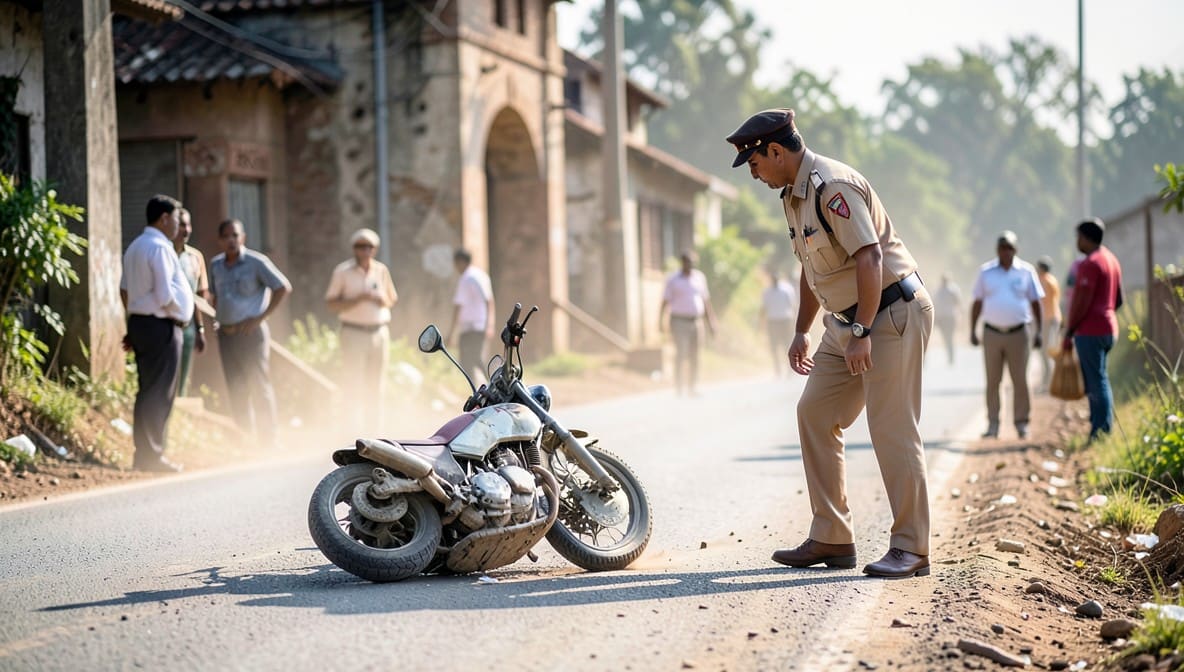
The dispute arose from a motor vehicle accident on 14.08.2003, in which Ajabrao Surwade, a pillion rider on a Hero Honda motorcycle, sustained fatal injuries. The accident occurred near Tirupati Dal Mill, Akola, while he was traveling from Kapshi towards Akola. The offending vehicle was a motorcycle registered in the name of Shivcharan Kewat, the appellant. The claimants, being Ajabrao’s widow and two children, filed Claim Petition No.173/2011 before the Motor Accident Claims Tribunal, Akola, seeking compensation for wrongful death.
Key Facts
- The deceased, Ajabrao Surwade, was a pillion rider on a Hero Honda motorcycle on 14.08.2003 at approximately 12:00 noon.
- The motorcycle owned by the appellant (Shivcharan Kewat) collided with the deceased’s motorcycle from behind.
- The deceased succumbed to his injuries on the same day of the accident.
- The appellant, as the registered owner of the offending motorcycle, filed a written statement denying liability, alleging that a black-and-yellow taxi had first collided with his vehicle, causing the chain reaction.
- No witness testimony was adduced by the appellant to support the taxi collision claim.
- The appellant did not appear as a witness in the proceedings.
- Documentary evidence including the First Information Report (FIR), Spot Panchanama, Inquest Panchanama, Postmortem Report, and Form Comp. AA were on record and consistently pointed to the appellant’s motorcycle as the direct cause of the accident.
Procedural History
- 14.08.2003: Motor accident resulting in death of Ajabrao Surwade.
- 2003: FIR lodged by police at Patur Police Station.
- 17.03.2011: Claim Petition No.173/2011 filed before the Motor Accident Claims Tribunal, Akola.
- 20.02.2016: MACT awarded compensation of Rs.5,00,000/- with interest at 6% per annum to the claimants.
- 12.05.2016: Appeal No.1200/2016 filed before the Bombay High Court, Nagpur Bench, by the appellant.
- 23.03.2026: Hearing concluded before Justice Neeraj P. Dhote.
The Parties' Positions
Appellant (Owner of Offending Motorcycle): Contended that a black-and-yellow taxi had first collided with his motorcycle, causing it to veer and strike the deceased’s vehicle. Asserted that he had lodged a police report regarding the taxi’s involvement.
Respondents (Legal Representatives of Deceased): Maintained that the appellant failed to provide any corroborative evidence for the taxi collision theory and that the documentary record clearly established the appellant’s motorcycle as the direct and sole cause of the accident.
Relief Sought
The appellant sought setting aside of the MACT award dated 20.02.2016 and dismissal of the claim petition on grounds of alleged third-party intervention. The respondents sought confirmation of the award and costs.
The Legal Issue
The central question was whether the registered owner of a vehicle can escape liability for a motor accident by merely alleging a third-party cause without adducing any evidence to substantiate that claim under Section 140 and Section 166 of the Motor Vehicles Act, 1988.
Arguments Presented
For the Appellant
The appellant’s counsel argued that the accident was not caused by the negligence of the appellant’s motorcycle but by an intervening act of a black-and-yellow taxi. He contended that the MACT erred in ignoring the police report allegedly filed by the appellant regarding the taxi’s involvement. He relied on the principle that liability cannot be imposed without proof of causation and urged the Court to remand the matter for further inquiry.
For the Respondent
The respondents, who were unrepresented, did not file any written submissions. However, the Court noted that the documentary evidence on record - FIR, Spot Panchanama, Inquest Panchanama, Postmortem Report, and Form Comp. AA - collectively established a clear chain of causation linking the appellant’s motorcycle to the fatal collision. The absence of any evidence to support the taxi theory rendered the defense legally unsustainable.
The Court's Analysis
The Court emphasized that under Section 140 of the Motor Vehicles Act, strict liability is imposed on the owner of a motor vehicle involved in an accident resulting in death or injury, unless the owner proves the accident occurred without his knowledge or consent, or due to an act of God or third party. The burden of proving such an exception lies squarely on the owner.
"Though he has taken a defence that his motorcycle was being dashed by one Black. Yellow taxi, he did not enter the witness box to substantiate his defence. His defence is therefore cannot be believed and accepted to be true and correct."
The Court observed that pleadings unsupported by evidence are legally meaningless. The appellant’s mere assertion of a taxi collision, without any witness, documentary proof, or police record corroborating the claim, could not displace the overwhelming documentary evidence pointing to his vehicle as the direct cause. The MACT correctly applied the principle that in motor accident claims, the burden of proof shifts to the owner to rebut the prima facie case established by the claimants.
The Court further noted that the MACT’s findings were based on a careful evaluation of the official records - all of which were consistent and unchallenged. The absence of any contradictory evidence from the appellant rendered his defense speculative and legally insufficient. The Tribunal’s conclusion that the accident resulted from the rash and negligent driving of the appellant’s motorcycle was fully supported by the record.
The Verdict
The appeal was dismissed. The High Court upheld the MACT’s award of Rs.5,00,000/- with interest at 6% per annum from the date of filing of the claim petition until realization. The record was directed to be sent back to the MACT for compliance. No costs were awarded.
What This Means For Similar Cases
Owner Liability Cannot Be Evaded by Unsubstantiated Allegations
- Practitioners must advise clients that mere allegations of third-party involvement, without corroboration, will not defeat a claim under the Motor Vehicles Act.
- The burden of proving an exception under Section 140 is on the owner and must be discharged through credible evidence, not pleadings alone.
Documentary Evidence Is Paramount in MACT Proceedings
- FIR, Spot Panchanama, Inquest Panchanama, and Postmortem Reports form the backbone of claim adjudication.
- Any defense that contradicts these documents must be supported by independent, verifiable evidence - oral testimony without corroboration is insufficient.
Failure to Testify Is Fatal to Defense
- Vehicle owners who wish to contest liability must appear as witnesses and testify under oath.
- Non-appearance or refusal to testify will be construed as an admission of the claimants’ version of events, as per established precedent in State of Haryana v. Ram Singh and K. Srinivas v. M.V. Tribunal.