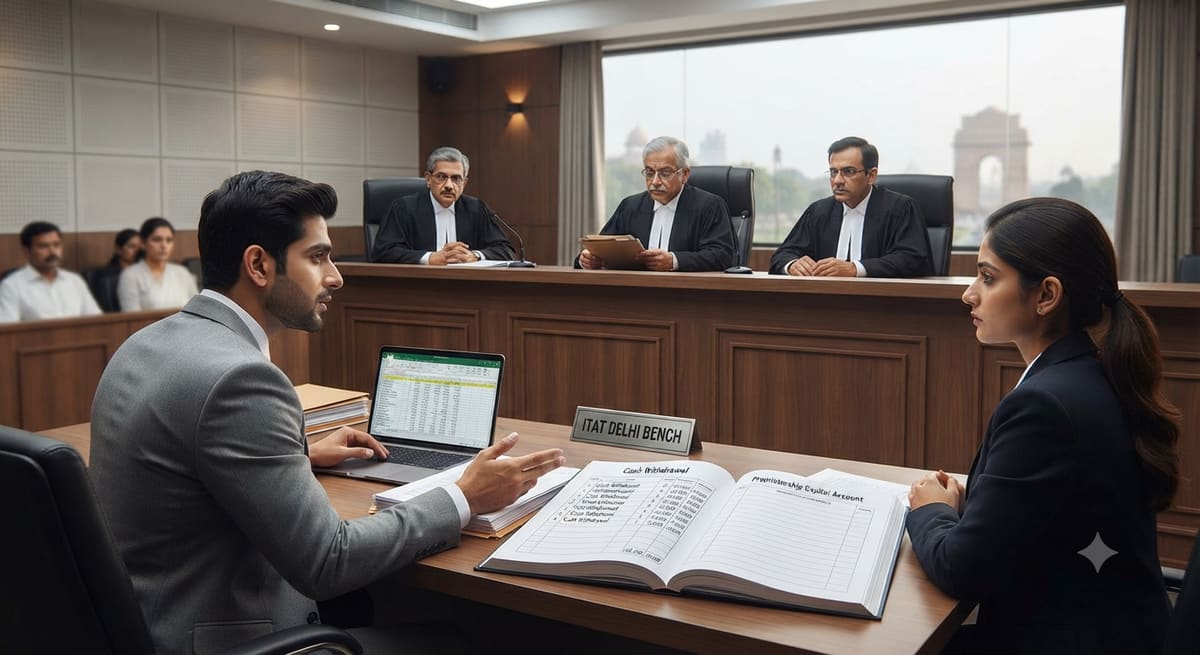
The Income Tax Appellate Tribunal, Jaipur Bench, has set aside an addition of Rs.10,90,100 made under Section 69A of the Income Tax Act, 1961, for unexplained cash payments towards credit card dues. The Tribunal held that the assessee had sufficiently explained the source of the payments through cash withdrawals from his bank account, and rejected the Revenue's insistence on a date-wise reconciliation. The decision clarifies the evidentiary burden under Section 69A and reinforces the principle that double taxation cannot be imposed where income has already been taxed under the presumptive regime.
Background & Facts
The Dispute
The assessee, an individual, filed his return of income for Assessment Year 2023-24 declaring a total income of Rs.4,94,760 under the presumptive taxation scheme under Section 44AD of the Income Tax Act, 1961. The case was selected for scrutiny due to large cash payments made for credit card purchases. The Assessing Officer (AO) issued statutory notices under Sections 143(2) and 142(1) of the Act, requiring the assessee to explain the source of such cash payments.
Key Facts
- The assessee made cash payments of Rs.10,90,100 towards credit card dues during the year.
- The assessee explained that the source of these payments was cash withdrawals from his SBI bank account, totaling Rs.28,02,000 during the year.
- The assessee furnished a copy of the bank statement to evidence the withdrawals.
- The assessee claimed to be a contractor carrying on business under Section 44AD of the Act, but did not produce any documentary evidence such as contract agreements, work orders, bills raised, TDS certificates, or confirmations from parties.
- The AO completed the assessment under Section 144 read with Section 144B on 12.03.2025, making an addition of Rs.10,90,100 under Section 69A, treating the cash payments as unexplained money.
- The assessee appealed to the National Faceless Appeal Centre (NFAC), which confirmed the addition, holding that the assessee had failed to file a date-wise reconciliation of cash withdrawals vis-à-vis the credit card payments.
Procedural History
- 31.07.2023: Assessee filed return of income declaring Rs.4,94,760 under Section 44AD.
- 12.03.2025: AO passed assessment order under Section 144 read with Section 144B, making addition of Rs.10,90,100 under Section 69A.
- 08.09.2025: NFAC upheld the addition, rejecting the assessee's explanation.
- 06.07.2026: Appeal heard before ITAT, Jaipur Bench.
- 21.07.2026: ITAT pronounced its order allowing the appeal.
Relief Sought
The assessee sought deletion of the addition of Rs.10,90,100 made under Section 69A, deletion of interest charged under Sections 234A, 234B, and 234C, and deletion of penalty notices issued under Sections 272A(1)(d) and 271AAC.
The Legal Issue
The central question was whether the assessee had satisfactorily explained the source of cash payments of Rs.10,90,100 made towards credit card dues under Section 69A of the Income Tax Act, 1961, and whether the Revenue Authorities were justified in rejecting the assessee's explanation solely on the ground that no date-wise reconciliation was furnished.
Arguments Presented
For the Appellant
The assessee contended that the cash payments for credit card dues were made from cash withdrawals from his bank account, which were adequately reflected in the bank statement. The assessee argued that the Revenue Authorities had not pointed out any specific anomaly in the explanation and that the addition amounted to double taxation since the income from the contract business had already been taxed under Section 44AD.
For the Respondent
The Revenue Authorities argued that the assessee had failed to furnish a date-wise reconciliation of cash withdrawals vis-à-vis the credit card payments, and that the assessee had not substantiated his claim of carrying on contract work under Section 44AD. The Revenue contended that the addition was justified under Section 69A and that the issue of double taxation was misconceived.
The Court's Analysis
The Tribunal examined the evidence on record, including the bank statement of the assessee, which showed frequent cash withdrawals totaling Rs.28,02,000 during the year. The Tribunal noted that the Revenue Authorities had not pointed out any specific anomaly in the assessee's explanation regarding the correlation between the cash withdrawals and the credit card payments.
The Tribunal observed that the assessee had returned income from contract business under the presumptive taxation scheme under Section 44AD, which was accepted by the Revenue Authorities. The Tribunal held that the Revenue Authorities could not take a contrary stand by rejecting the assessee's explanation of the credits in the bank account being attributable to his contract income.
The Tribunal further held that the addition of Rs.10,90,100 for cash payments made for credit card dues would amount to double taxation, as the income from the contract business had already been taxed under Section 44AD. The Tribunal rejected the Revenue's argument that the assessee had failed to discharge the burden under Section 69A, stating that the assessee had sufficiently explained the source of the payments through the bank withdrawals.
"We see no substance in this reasoning of the Revenue Authorities. All the facts and details relating to both the cash payment made for credit card dues, and the cash withdrawals made by the assessee from bank account were available with the AO. It was for the Revenue Authorities to point out any anomaly in the explanation of the assessee, with regard to the cash withdrawals not correlating with the cash payments."
The Verdict
The ITAT, Jaipur Bench allowed the assessee's appeal in full. The Tribunal deleted the addition of Rs.10,90,100 made under Section 69A, holding that the assessee had sufficiently explained the source of the cash payments through cash withdrawals from his bank account. The Tribunal also held that the addition amounted to double taxation and was therefore unsustainable. The appeal was allowed with no order as to costs.
What This Means For Similar Cases
Section 69A Requires Reasonable Explanation, Not Perfection
- The decision clarifies that the burden under Section 69A is to provide a reasonable explanation for the source of cash payments, not to furnish a date-wise reconciliation unless specifically called for by the Revenue.
- The Revenue cannot reject an explanation solely on the ground that no date-wise reconciliation was furnished, unless it points out specific anomalies in the explanation.
Presumptive Taxation Under Section 44AD Is Conclusive
- Once income is returned and accepted under the presumptive taxation scheme under Section 44AD, the Revenue Authorities cannot reject the assessee's explanation of the source of funds on the ground that the assessee did not maintain books of account or produce documentary evidence.
- The acceptance of income under Section 44AD precludes the Revenue from taking a contrary stand regarding the source of funds.
Double Taxation Is Not Permissible
- The decision reinforces that where income has already been taxed under the presumptive regime, the same funds cannot be taxed again under Section 69A for unexplained money.
- The Revenue cannot treat the same funds as unexplained money where the income has already been taxed, as it would amount to double taxation.
Cash Withdrawals Are Sufficient Evidence of Source
- The Tribunal held that as long as there are sufficient cash withdrawals in the bank account to cover the cash payments, and no specific anomaly is pointed out by the Revenue, the assessee's explanation must be accepted.
- The decision underscores that the Revenue must point out specific anomalies in the assessee's explanation before rejecting it, rather than relying on generalized and sweeping statements.