Topic

Section 69A

Section 69A of the Income Tax Act, 1961, allows tax authorities to treat unexplained cash credits, deposits, or investments as taxable income if the taxpayer fails to provide a credible source.

27 articlesLatest September 2026
Section 69A IT Act | Mere Mobile Phone Estimates Without Corroborative Evidence Insufficient for Unexplained Investment Addition : ITAT Jaipur
Case Law Analysis
|Income Tax Appellate Tribunal

Section 69A IT Act | Mere Mobile Phone Estimates Without Corroborative Evidence Insufficient for Unexplained Investment Addition : ITAT Jaipur

ITAT Jaipur holds that rough estimates of jewellery purchases found on a mobile phone, without proof of actual transactions or physical possession, cannot justify additions under Section 69A of the Income Tax Act. The ruling reinforces strict evidentiary standards for unexplained investments, protecting assessees from double taxation based on loose notings.

Section 69A IT Act | Cash Withdrawals from Disclosed Accounts Cannot Be Taxed as Unexplained Money Without Evidence of Undisclosed Income: ITAT Surat
Case Law Analysis
|Income Tax Appellate Tribunal

Section 69A IT Act | Cash Withdrawals from Disclosed Accounts Cannot Be Taxed as Unexplained Money Without Evidence of Undisclosed Income: ITAT Surat

ITAT Surat holds that cash withdrawals from disclosed bank accounts cannot be treated as unexplained money under Section 69A of the Income Tax Act unless there is evidence linking such withdrawals to undisclosed income. The ruling underscores that mere cash withdrawals, without proof of unaccounted sources, do not justify tax additions, reinforcing the need for concrete evidence in best judgment assessments.

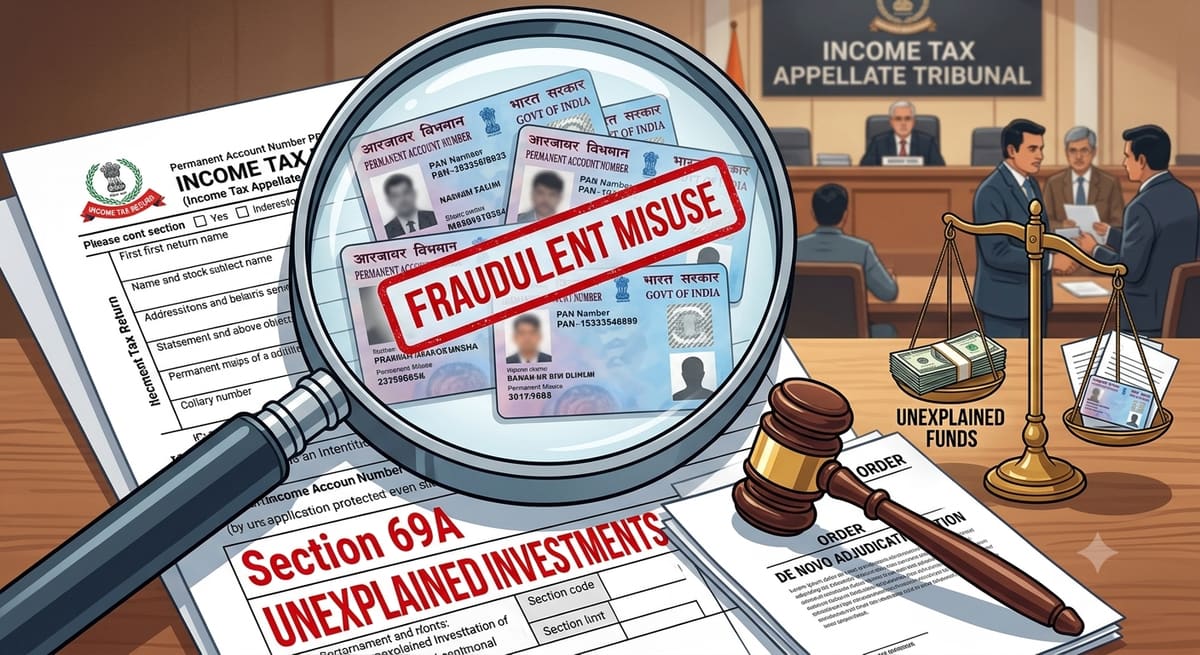
Section 69A Income Tax Act | Fraudulent PAN Misuse Requires De Novo Adjudication on Unexplained Investments: ITAT Delhi
Case Law Analysis
|Income Tax Appellate Tribunal

Section 69A Income Tax Act | Fraudulent PAN Misuse Requires De Novo Adjudication on Unexplained Investments: ITAT Delhi

ITAT Delhi remands a case for fresh adjudication under Section 69A after finding fraudulent third-party misuse of the assessee’s PAN, limiting tax liability to just 1% commission income. The ruling underscores the need for proper assessment of unexplained investments before imposing penalties, offering relief to taxpayers facing wrongful additions due to identity fraud.

Sections 68, 69A, 69C IT Act | Accommodation Entries Require Concrete Evidence - Not Presumption: ITAT Delhi
Case Law Analysis
|Income Tax Appellate Tribunal

Sections 68, 69A, 69C IT Act | Accommodation Entries Require Concrete Evidence - Not Presumption: ITAT Delhi

The ITAT Delhi has ruled that tax authorities cannot impose additions for accommodation entries based on mere suspicion or circumstantial links to search-seized entities. Concrete, verifiable proof of fictitious transactions is mandatory, protecting businesses from arbitrary assessments grounded in procedural shortcuts rather than substantive evidence.

Peak Theory Applied to Digital Books | Only Peak Negative Cash Balance May Be Added Under Section 69A IT Act: ITAT Delhi
Case Law Analysis
|Income Tax Appellate Tribunal

Peak Theory Applied to Digital Books | Only Peak Negative Cash Balance May Be Added Under Section 69A IT Act: ITAT Delhi

The ITAT Delhi has ruled that negative cash balances in digital accounting records cannot be aggregated as unexplained income under Section 69A. Only the highest single negative balance - if substantiated - may be considered, preventing automatic tax additions from system errors or duplicate entries. This protects businesses from punitive assessments based on flawed digital data and clarifies the limits of the Peak Theory in modern bookkeeping contexts.

Section 69A Income Tax Act | Cash Deposits via Fiduciary Agent for Cooperative Society Not Unexplained Income : ITAT Guwahati
Case Law Analysis
|Income Tax Appellate Tribunal

Section 69A Income Tax Act | Cash Deposits via Fiduciary Agent for Cooperative Society Not Unexplained Income : ITAT Guwahati

The ITAT Guwahati ruled that cash deposits in an individual’s account, made solely as a fiduciary agent for a cooperative society and fully accounted for through corresponding business debits, cannot be treated as unexplained income under Section 69A. This sets a critical precedent for cooperative societies and their administrative agents, affirming that functional role and fund tracing override mere possession in tax assessments.

Section 154 IT Act | Rectification Cannot Recharacterize Debated Business Income as Unexplained Income Under Section 69A : ITAT Ahmedabad
Case Law Analysis
|Income Tax Appellate Tribunal

Section 154 IT Act | Rectification Cannot Recharacterize Debated Business Income as Unexplained Income Under Section 69A : ITAT Ahmedabad

ITAT Ahmedabad has ruled that an assessing officer cannot use rectification under Section 154 to convert income previously accepted as business income into unexplained income under Section 69A when the classification is genuinely debatable. This protects taxpayers from retrospective reclassification via procedural shortcuts, reinforcing that rectification is for clerical errors only - not for revisiting contested tax positions.

Agricultural Land Beyond Municipal Limits Not a Capital Asset | Section 50C and 69A Additions Quashed for Lack of Legal Basis : ITAT Ahmedabad
Case Law Analysis
|Income Tax Appellate Tribunal

Agricultural Land Beyond Municipal Limits Not a Capital Asset | Section 50C and 69A Additions Quashed for Lack of Legal Basis : ITAT Ahmedabad

The ITAT Ahmedabad has ruled that agricultural land situated beyond municipal limits cannot be treated as a capital asset under Section 2(14) of the Income-tax Act, rendering capital gains tax, Section 50C adjustments, and Section 69A cash addition inapplicable. This clarifies a critical exemption for rural landowners and invalidates revenue department tactics that misapply urban property valuation norms to agricultural sales.

Section 69A & 69C Income Tax Act | Only Profit Element in On-Money Receipts Taxable; Telescoping Permitted Against Unexplained Expenditures : ITAT Ahmedabad
Case Law Analysis
|Income Tax Appellate Tribunal

Section 69A & 69C Income Tax Act | Only Profit Element in On-Money Receipts Taxable; Telescoping Permitted Against Unexplained Expenditures : ITAT Ahmedabad

ITAT Ahmedabad rules that only the profit component of on-money receipts is taxable at 15%, while unaccounted expenditures can be offset against such income if sufficient funds exist. The ruling clarifies the scope of taxable income under Sections 69A and 69C, offering relief to taxpayers facing additions for undisclosed transactions.

Natural Justice | Ex-Parte Assessment Under Section 144 Income Tax Act Void Without Effective Opportunity of Hearing: ITAT Delhi
Case Law Analysis
|Income Tax Appellate Tribunal

Natural Justice | Ex-Parte Assessment Under Section 144 Income Tax Act Void Without Effective Opportunity of Hearing: ITAT Delhi

ITAT Delhi sets aside an ex-parte assessment order for failing to provide the assessee a genuine chance to respond to notices, emphasizing that procedural fairness under natural justice is non-negotiable even in tax proceedings. The ruling mandates de-novo proceedings, reinforcing that mechanical compliance with notice issuance does not suffice to uphold an ex-parte order.

Section 69A IT Act | Cash Deposits During Demonetization Require Strict Documentary Proof of Source: ITAT Jodhpur Remands Case for Fresh Assessment
|Income Tax Appellate Tribunal

Section 69A IT Act | Cash Deposits During Demonetization Require Strict Documentary Proof of Source: ITAT Jodhpur Remands Case for Fresh Assessment

ITAT Jodhpur rules that cash deposits during demonetization under Section 69A of the Income Tax Act demand rigorous documentary proof of source. The Tribunal remanded the case for fresh assessment, emphasizing procedural compliance and the assessee’s burden to substantiate transactions with valid evidence, impacting tax litigation and banking law.