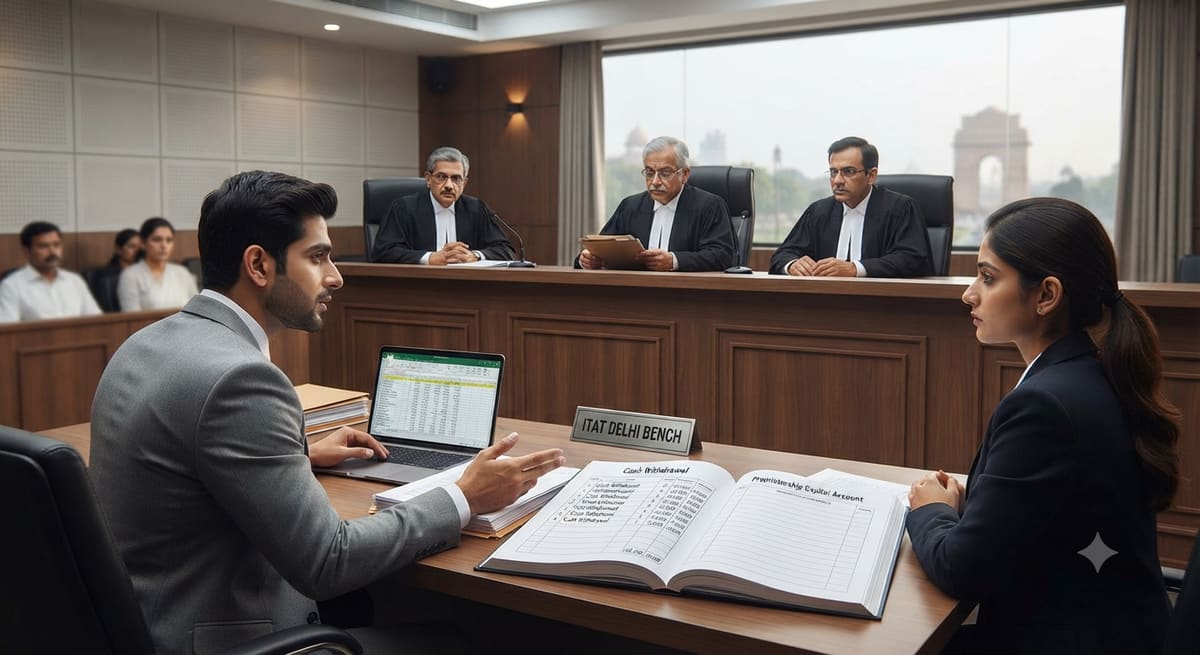
The Income Tax Appellate Tribunal Delhi has clarified that cash withdrawals from a proprietorship’s capital account shortly before a search operation, if documented and temporally proximate, can establish a credible source under Section 69A of the Income Tax Act, reversing arbitrary additions based on presumption.
Background & Facts
The Dispute
The dispute arose from the assessment of Rahul Tandon, proprietor of M/s 1114/s Catering Care, for the assessment year 2022-23. On 05.07.2021, the Air Intelligence Unit intercepted him and Nand Kishore while traveling to Goa with Rs. 18,00,000 in cash. Both admitted Rs. 9,00,000 belonged to each. As no credible source was provided, a search was conducted under Section 132 of the Income Tax Act, 1961, and the cash was seized as unexplained money.
Key Facts
The assessee claimed the Rs. 9,00,000 was intended for stamp duty payment on a property transaction through M/s Seaview Infratech LLP
He stated the funds were withdrawn from the capital account of his proprietorship firm, M/s 1114/s Catering Care
Ledger accounts were submitted showing cash withdrawals but no supporting vouchers or bank statements were provided during initial proceedings
The Assessing Officer (AO) added Rs. 9,00,000 under Section 69A, treating it as unexplained income
The Commissioner of Income Tax (Appeals) [CIT(A)] sustained the addition on 27.11.2025
Before the Tribunal, the assessee produced complete bank statements and capital account ledgers for M/s 1114/s Catering Care
The ledgers showed cumulative cash withdrawals of Rs. 9,00,000 between 28.06.2021 and 02.07.2021, in daily installments of Rs. 1,00,000 to Rs. 2,00,000
The search and seizure occurred on 05.07.2021, three days after the final withdrawal
Procedural History
05.07.2021: Cash seized during search under Section 132
27.11.2025: Order of CIT(A) sustaining addition of Rs. 9,00,000 under Section 69A
12.01.2026: I.T.A. No. 802/DEL/2026 filed before ITAT Delhi
22.06.2026: Hearing conducted before ITAT Delhi
15.07.2026: Judgment pronounced
Relief Sought
The appellant sought deletion of the addition of Rs. 9,00,000 under Section 69A, arguing that the source of cash had been established through documented withdrawals from his proprietorship capital account.
The Legal Issue
The central question was whether Section 69A of the Income Tax Act, 1961 permits an addition of unexplained cash merely on the basis of non-submission of vouchers, when the assessee has demonstrated a clear, contemporaneous withdrawal pattern from a legitimate business capital account within days of the search.
Arguments Presented
For the Appellant
The appellant’s counsel argued that the entire Rs. 9,00,000 was withdrawn from the capital account of the proprietorship firm between 28.06.2021 and 02.07.2021, as evidenced by bank statements and ledger entries. He emphasized that the timing of withdrawals - immediately preceding the search - was consistent with the stated purpose of stamp duty payment. He contended that the authorities below erred in rejecting documentary evidence solely due to absence of vouchers, which are not mandatory under the Act. He relied on CIT v. Smt. Sushila Devi and CIT v. M/s. R.K. Industries to argue that source need not be proven beyond all doubt, only with reasonable probability.
For the Respondent
The Department’s representative relied on the findings of the AO and CIT(A), arguing that the absence of vouchers, bank challans, or property transaction documents rendered the explanation speculative. He contended that Section 69A applies when the source of cash is not satisfactorily explained, and that mere ledger entries without corroborative evidence are insufficient. He cited CIT v. Smt. Sushila Devi to argue that the burden remains on the assessee to prove the source with credible documentation.
The Court's Analysis
The Tribunal examined the timeline and documentary trail with precision. It noted that the cash withdrawals occurred in a concentrated period - within seven days - immediately before the search, and that the amounts matched the seized sum exactly. The Tribunal observed that the assessee had not merely asserted the source but had produced verifiable ledger entries and bank statements corroborating the withdrawals.
"We find that the entire amount of Rs. 9 lacs was withdrawn by the assessee just within a week prior to the search on assessee from the capital account of the assessee in its proprietorship business, therefore, we do not find any infirmity in the statement and evidences brought on record by the Ld. Counsel for the assessee."
The Tribunal held that the authorities below erred in applying a rigid standard requiring vouchers, which are not statutorily mandated under Section 69A. It emphasized that the law requires a reasonable explanation, not perfection in documentation. The Tribunal distinguished this case from those where cash is untraceable or where explanations are vague or inconsistent. Here, the withdrawal pattern was specific, quantified, and temporally linked to the seized cash. The Tribunal further noted that the assessee’s explanation was not self-serving but supported by objective records.
The Verdict
The appeal was allowed. The Tribunal set aside the order of the CIT(A) dated 27.11.2025 and deleted the addition of Rs. 9,00,000 under Section 69A. The Tribunal directed that the assessment be reopened to reflect the deletion and that any tax, interest, or penalty already paid on this amount be refunded within 60 days of the order.
What This Means For Similar Cases
Documentary Evidence of Withdrawals Can Displace Presumption
Practitioners may now rely on capital account ledgers and bank statements to establish source of cash, even without vouchers, if the withdrawal pattern is consistent and proximate to the search
The burden shifts to the Department to disprove the plausibility of the source, not merely to demand perfect documentation
Timing Is Critical in Section 69A Cases
Withdrawals occurring within days of a search operation strengthen the credibility of the explanation
A gap of more than 10-15 days between withdrawal and seizure may weaken the argument
The Tribunal’s focus on the seven-day window sets a new benchmark for temporal proximity
Vouchers Are Not Mandatory Under Section 69A
The judgment clarifies that Section 69A does not require production of vouchers, receipts, or bank challans as a precondition for accepting source
Ledgers, bank statements, and business records are sufficient if they demonstrate a clear, verifiable trail
Practitioners should prioritize submission of account books and bank records over chasing missing vouchers