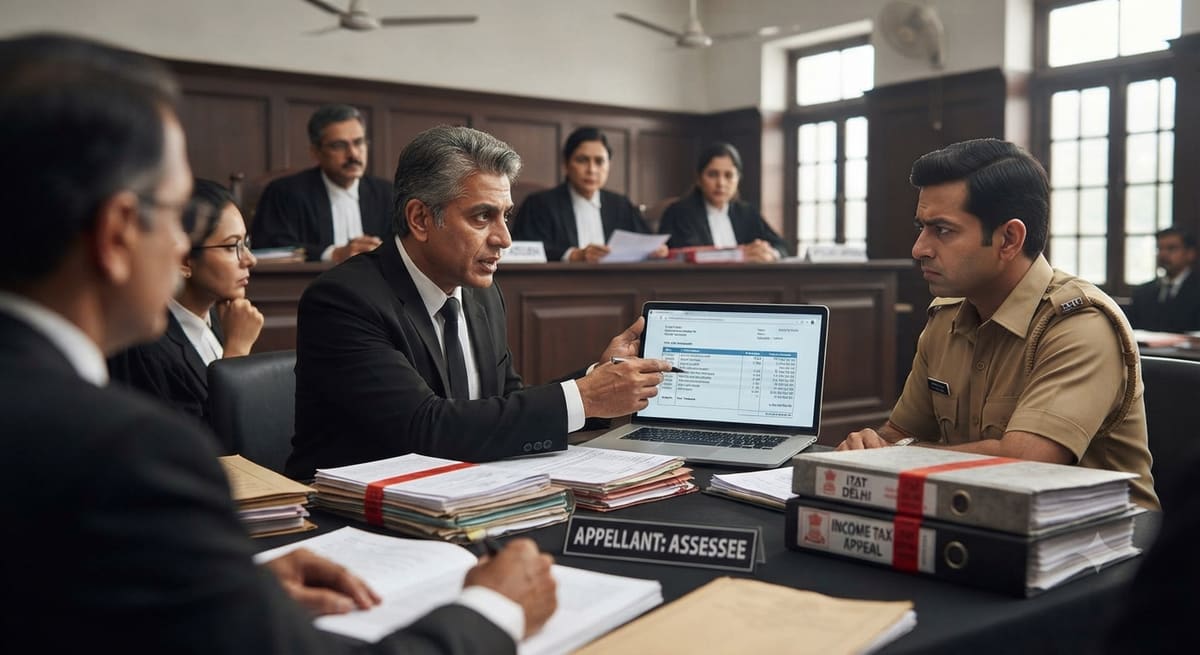
The Income Tax Appellate Tribunal (ITAT), Delhi, has delivered a significant ruling on the interpretation of Section 69C of the Income Tax Act, 1961, concerning unexplained expenditure. The Tribunal held that additions under this provision cannot be sustained merely on the basis of seized documents unless direct evidence establishes the assessee's liability. The judgment underscores the importance of corroborative evidence and procedural fairness in tax assessments, particularly in search and seizure cases.
Background & Facts
The Dispute
The appellant, Naresh Kumar Tomer, a director in M/s Gopi Constech Pvt. Ltd., was subjected to a search and seizure operation under Section 132 of the Income Tax Act on 16.06.2017 at his residential premises. During the assessment proceedings for the Assessment Year 2017-18, the Assessing Officer (AO) referred to a seized document, Annexure A-1, which contained handwritten entries of cash payments. The AO treated these entries as unexplained expenditure under Section 69C and made an addition of Rs. 61,67,368 to the assessee's income.
Key Facts
- The search was conducted on 16.06.2017 under Section 132 of the Act.
- Annexure A-1, a seized document, contained handwritten entries of cash payments.
- The AO calculated the total unexplained expenditure as Rs. 61,67,368 based on these entries.
- The assessee contended that the entries pertained to M/s Gopi Constech Pvt. Ltd. and were duly accounted for in the company's books.
- The AO rejected the assessee's submissions for lack of documentary evidence during the assessment proceedings.
Procedural History
- 09.12.2019: AO passed assessment order under Section 153A r.w.s 143(3) of the Act, making an addition of Rs. 61,67,368 as unexplained expenditure.
- 28.08.2025: The Ld. CIT(A)-3, Noida (First Appellate Authority) partially upheld the addition, reducing it to Rs. 25,03,968 on the ground that certain entries could not be corroborated with the ledger accounts of M/s Gopi Constech Pvt. Ltd.
- 28.03.2025: The assessee filed an appeal before the ITAT, Delhi, challenging the partial addition.
The Parties' Positions
For the Appellant
- The assessee argued that the entries in Annexure A-1 pertained to M/s Gopi Constech Pvt. Ltd. and were duly reflected in the company's books of accounts.
- The assessee submitted that the AO had erroneously added an extra zero to certain figures during the assessment proceedings, inflating the total amount.
- Reliance was placed on judicial precedents, including Shankar Khandasari Sugar Mills v. CIT and Smt. Prabhavati S. Shah v. CIT, to argue that the appellate authority should consider clarificatory evidence even if belatedly submitted.
For the Respondent
- The AO contended that the assessee failed to provide documentary evidence during the assessment proceedings to substantiate the claim that the entries pertained to M/s Gopi Constech Pvt. Ltd.
- The AO argued that certain entries in Annexure A-1 did not match the ledger accounts provided by the assessee, justifying the partial addition of Rs. 25,03,968.
- The AO relied on Section 292C of the Act, which presumes the truthfulness of the contents of seized documents unless rebutted.
Relief Sought
The appellant sought the deletion of the entire addition of Rs. 61,67,368, arguing that the transactions were duly accounted for in the books of M/s Gopi Constech Pvt. Ltd. and that the AO had erroneously inflated the figures.
The Legal Issue
The central question before the ITAT was whether the addition under Section 69C of the Income Tax Act could be sustained solely on the basis of seized documents without direct corroborative evidence, particularly when the assessee claimed that the entries pertained to a third party (M/s Gopi Constech Pvt. Ltd.) and were duly accounted for in its books.
Arguments Presented
For the Appellant
- The assessee relied on Shankar Khandasari Sugar Mills v. CIT (59 Taxman 405), wherein the Karnataka High Court held that the appellate authority should consider clarificatory evidence, even if belatedly submitted, to test the fairness of the AO's estimate.
- The assessee also cited Smt. Prabhavati S. Shah v. CIT ([1998] 100 Taxman 404), where the Bombay High Court emphasized the wide powers of the appellate authority to admit additional evidence under Section 250(4) and (5) of the Act.
- The assessee argued that the AO had erroneously inflated certain figures in Annexure A-1, leading to an incorrect calculation of unexplained expenditure.
For the Respondent
- The AO contended that the assessee failed to provide documentary evidence during the assessment proceedings to substantiate the claim that the entries pertained to M/s Gopi Constech Pvt. Ltd.
- The AO relied on Section 292C of the Act, which presumes the truthfulness of the contents of seized documents unless rebutted by the assessee.
- The AO argued that certain entries in Annexure A-1 did not match the ledger accounts provided by the assessee, justifying the partial addition.
The Court's Analysis
The ITAT critically examined the submissions of both parties and the remand report submitted by the AO. The Tribunal observed that the AO had accepted the assessee's contention that certain entries pertained to M/s Gopi Constech Pvt. Ltd. and were duly accounted for in its books. However, the Ld. CIT(A) partially upheld the addition on the ground that some entries could not be corroborated with the ledger accounts.
The Tribunal noted that the Ld. CIT(A) had erred in sustaining the partial addition without referring to direct evidence. The ITAT emphasized that the same set of evidence and remand report could not logically form the basis for both granting relief and denying it to some extent. The Tribunal relied on the principles laid down in Shankar Khandasari Sugar Mills v. CIT and Smt. Prabhavati S. Shah v. CIT, holding that the appellate authority should adopt a liberal approach in considering clarificatory evidence, particularly when the assessee had substantiated its claim with ledger accounts.
"The appellate authority should have accepted the material produced by the assessee as clarificatory in nature and considered the same to test the fairness and propriety of the estimate of income made by the Income-tax Officer. Though it was belated production of very relevant material, no prejudice (in its legal sense) would have resulted to the Revenue by considering the material produced by the assessee... In the absence of any prejudice to the Revenue, and the basis of the tax under the Act being to levy tax, as far as possible, on the real income, the approach should be liberal in applying the procedural provisions of the Act. An appeal is but a continuation of the original proceeding and what the Income-tax Officer could have done, the appellate authority also could do."
The Tribunal further observed that the Ld. CIT(A) had failed to exercise its powers under Section 250(4) and (5) of the Act to admit and consider additional evidence, which it was duty-bound to do in the interest of justice.
The Verdict
The ITAT allowed the assessee's appeal in full and deleted the entire addition of Rs. 25,03,968 sustained by the Ld. CIT(A). The Tribunal held that the assessee had sufficiently substantiated its claim that the entries in Annexure A-1 pertained to M/s Gopi Constech Pvt. Ltd. and were duly accounted for in its books. The impugned addition was set aside, and the assessee was granted full relief.
What This Means For Similar Cases
Unexplained Expenditure Requires Direct Corroboration
- The judgment reinforces that additions under Section 69C cannot be sustained merely on the basis of seized documents unless direct evidence establishes the assessee's liability.
- Taxpayers can rely on this judgment to argue that the AO and appellate authorities must consider clarificatory evidence, even if belatedly submitted, to ensure that assessments are based on real income.
Appellate Authority Must Exercise Quasi-Judicial Powers Liberally
- The ITAT's ruling underscores that the appellate authority's powers under Section 250(4) and (5) of the Act are coterminous with those of the AO. The appellate authority is duty-bound to admit and consider additional evidence if it aids in determining the correct taxable income.
- Practitioners should cite this judgment to argue that the appellate authority cannot arbitrarily refuse to consider additional evidence, particularly when the assessee has substantiated its claim with documentary proof.
Seized Documents Are Not Conclusive Without Rebuttal Opportunity
- While Section 292C of the Act presumes the truthfulness of seized documents, this judgment clarifies that such presumption is rebuttable. Assessees must be given a fair opportunity to explain the entries and provide corroborative evidence.
- Taxpayers can use this judgment to challenge additions based solely on seized documents without affording them an opportunity to rebut the presumption or explain the entries.