The Income Tax Appellate Tribunal, Bangalore, has clarified that substantial cash deposits in a bank account cannot be treated as unexplained income merely because the Assessing Officer finds it improbable for an individual to hold large cash balances. Where the assessee provides audited financial statements, detailed cash-flow records, and bank statements corroborating the source of deposits as prior withdrawals, the Revenue must produce contrary evidence to sustain an addition under Section 69A. This judgment reinforces the primacy of documented evidence over speculative disbelief.
Background & Facts
The Dispute
The appellant, Sri Anand Chirania, an individual engaged in mutual fund trading and investment activities, faced an addition of ₹1,13,26,000 under Section 69A of the Income Tax Act, 1961, for the assessment year 2017-18. The addition arose from cash deposits of ₹1,29,55,000 made in his bank accounts during the financial year 2016-17, which the Assessing Officer (AO) treated as unexplained income after allowing a credit of ₹16,29,000 for cash withdrawals made during the same year.
Key Facts
- The assessee filed his return of income on 02.12.2017 declaring total income of ₹30,41,830 from business and other sources.
- The return was selected for limited scrutiny on 10.08.2018 under Section 143(2) due to large cash deposits and immovable property transactions.
- Notices under Section 142(1) were issued and responded to by the assessee.
- The assessee submitted audited balance sheets for FY 2014-15, 2015-16, and 2016-17, showing cash-in-hand balances of:
- ₹86,17,713 as on 31.03.2015
- ₹1,22,86,438 as on 31.03.2016
- ₹18,87,438 as on 31.03.2017
- A detailed cash-flow statement was furnished, showing:
- Cash withdrawals during FY 2014-15: ₹85,31,500
- Cash withdrawals during FY 2015-16: ₹46,29,004
- Cash withdrawals during FY 2016-17: ₹40,19,004
- Cash deposits during FY 2016-17: ₹1,29,80,004
- The assessee also submitted day-to-day cash books and bank statements from Axis Bank and ICICI Bank.
- The AO ignored these documents and disbelieved the explanation on the ground that holding such large cash balances was "unreasonable" for an individual without substantial cash-based business.
Procedural History
- 02.12.2017: Income tax return filed for AY 2017-18
- 10.08.2018: Notice under Section 143(2) issued
- 26.11.2019: Assessment order passed by AO under Section 143(3), adding ₹1,13,26,000 as unexplained cash deposits
- 02.09.2025: CIT(A) dismissed the appeal, upholding the addition
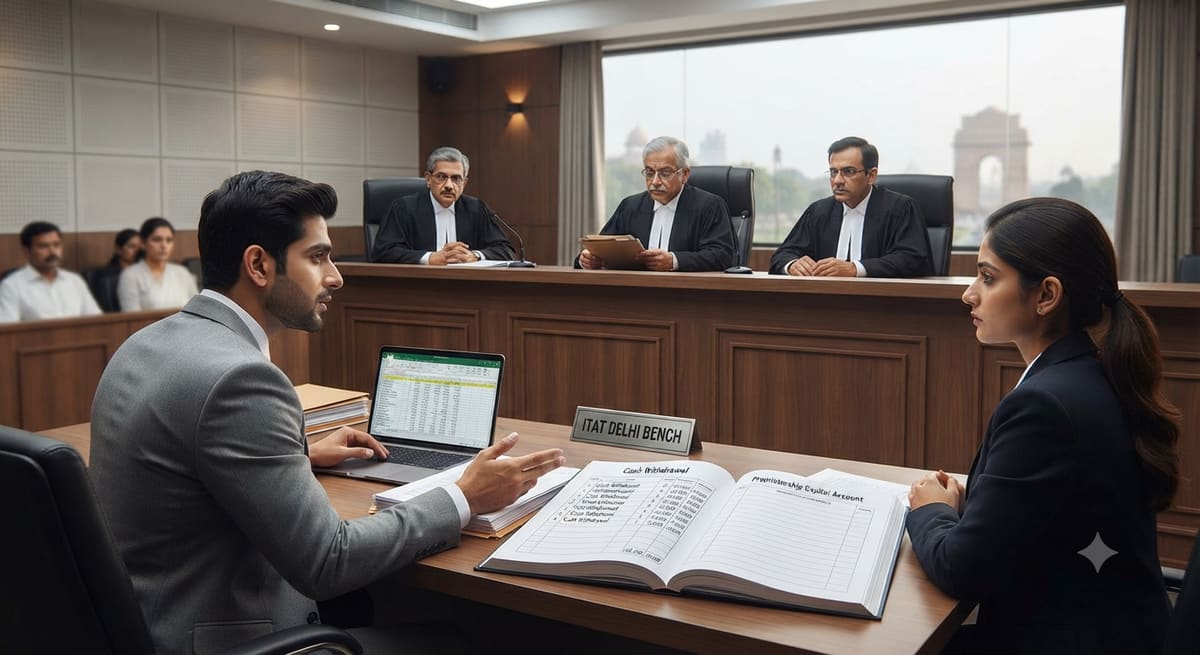
- 26.03.2026: Hearing before ITAT Bangalore
- 15.06.2026: Judgment pronounced by ITAT Bangalore
Relief Sought
The appellant sought deletion of the addition of ₹1,13,26,000 under Section 69A read with Section 115BBE, arguing that the source of deposits was adequately explained through audited books, cash-flow statements, and bank records.
The Legal Issue
The central question was whether Section 69A of the Income Tax Act permits an addition for unexplained cash deposits when the assessee has provided audited balance sheets, cash-flow statements, and bank records demonstrating that the deposits originated from prior cash withdrawals, and the Revenue has not produced any evidence to rebut the source.
Arguments Presented
For the Appellant
The appellant’s counsel submitted that the cash deposits were fully explained as originating from cash-in-hand balances carried forward from previous years, as reflected in audited balance sheets and supported by bank statements. He relied on the cash-flow statement showing cumulative withdrawals exceeding deposits, and cited judicial precedents including S. R. Venkata Ratnam v. Commissioner of Income Tax (1981) 6 Taxmann 263 (Karnataka), CIT v. Kulwant Rai (2007) 163 Taxman 585 (Delhi), and a prior coordinate bench decision in ITA No. 2668/Bang/2019. He argued that once the source is disclosed through documentary evidence, the burden shifts to the Revenue to prove the deposits were from undisclosed sources. The AO’s reliance on conjecture - that holding large cash balances was "unreasonable" - was legally unsustainable.
For the Respondent
The departmental representative supported the AO’s order, contending that the assessee failed to explain how the cash was retained for nearly two years without utilization. He argued that mere accounting entries in balance sheets were insufficient to discharge the burden under Section 69A, and that the Supreme Court’s decision in Sumati Dayal v. CIT (214 ITR 801) required the explanation to be tested on the basis of human probabilities, which the assessee’s explanation failed to satisfy.
The Court's Analysis
The Tribunal observed that the assessee had not merely made a verbal claim but had furnished comprehensive documentary evidence - audited balance sheets, cash-flow statements, and bank statements - all of which were consistent and mutually corroborative. The opening cash balance of ₹1,22,86,438 as on 01.04.2016, combined with cash withdrawals of ₹40,19,004 during FY 2016-17 and additional cash receipts of ₹2,10,000, resulted in total cash availability of ₹1,65,15,438, against which deposits of ₹1,29,80,004 were made. The Tribunal emphasized that the Revenue had not challenged the authenticity of the audited accounts, nor had it produced any evidence to show that the cash was utilized elsewhere or that the records were fabricated.
"The addition was sustained only on conjectures and surmises. Neither the Assessing Officer nor the learned CIT(A) has given any reason for disbelieving the assessee's annual accounts, which were supported by bank statements from three banks."
The Tribunal distinguished Sumati Dayal by noting that the case involved a lack of documentary support, whereas here, the source was fully documented. It held that the AO’s reliance on the improbability of holding large cash balances was a subjective assumption, not a legal ground for addition. The Tribunal reiterated that Section 69A requires a positive finding of unexplained income, not a negative inference based on disbelief. The coordinate bench decision in ITA No. 2668/Bang/2019, on identical facts, had already held that such deposits must be deleted when supported by cash-flow records.
The Verdict
The appeal was partly allowed. The ITAT Bangalore deleted the addition of ₹1,13,26,000 made under Section 69A read with Section 115BBE. All connected grounds relating to the addition were allowed. The order of the CIT(A) dated 02.09.2025 was set aside, and the assessment order dated 26.11.2019 was modified accordingly. The Tribunal directed the Assessing Officer to give effect to this decision in the assessment records.
What This Means For Similar Cases
Documentary Evidence Trumps Speculative Disbelief
- Practitioners must insist that additions under Section 69A require positive evidence of undisclosed income, not mere disbelief in the assessee’s explanation.
- Audited balance sheets, cash-flow statements, and bank statements form a prima facie case for explaining cash deposits.
- If the Revenue does not dispute the authenticity of these documents, the addition cannot be sustained.
Cash-Flow Statements Are Legally Valid Proof of Source
- Cash-flow statements showing cumulative withdrawals exceeding deposits are admissible and must be evaluated holistically.
- The Tribunal recognized that cash-in-hand balances carried forward from prior years can legitimately fund subsequent deposits.
- The burden shifts to the Revenue to prove the cash was used for other purposes or was fictitious.
Precedents on Identical Facts Are Binding
-
Coordinate bench decisions on identical facts must be followed unless distinguished on material grounds.
-
The ITAT’s reliance on S. R. Venkata Ratnam and CIT v. Kulwant Rai reinforces that once the source is disclosed through documents, the Revenue must investigate further - not presume.
-
Practitioners should cite this judgment when opposing additions based on "unreasonable cash holding" arguments.
-
Taxpayers should maintain audited books and cash-flow records even if not legally mandated, as they are critical for defending against unexplained income notices.