The Uttarakhand State Consumer Disputes Redressal Commission has clarified that insurers cannot deny claims merely by invoking broad policy exclusions like 'hilly area use' without proving actual violation. This ruling reinforces the principle that repudiation must be grounded in concrete evidence of breach, not speculative assumptions.
Background & Facts
The Dispute
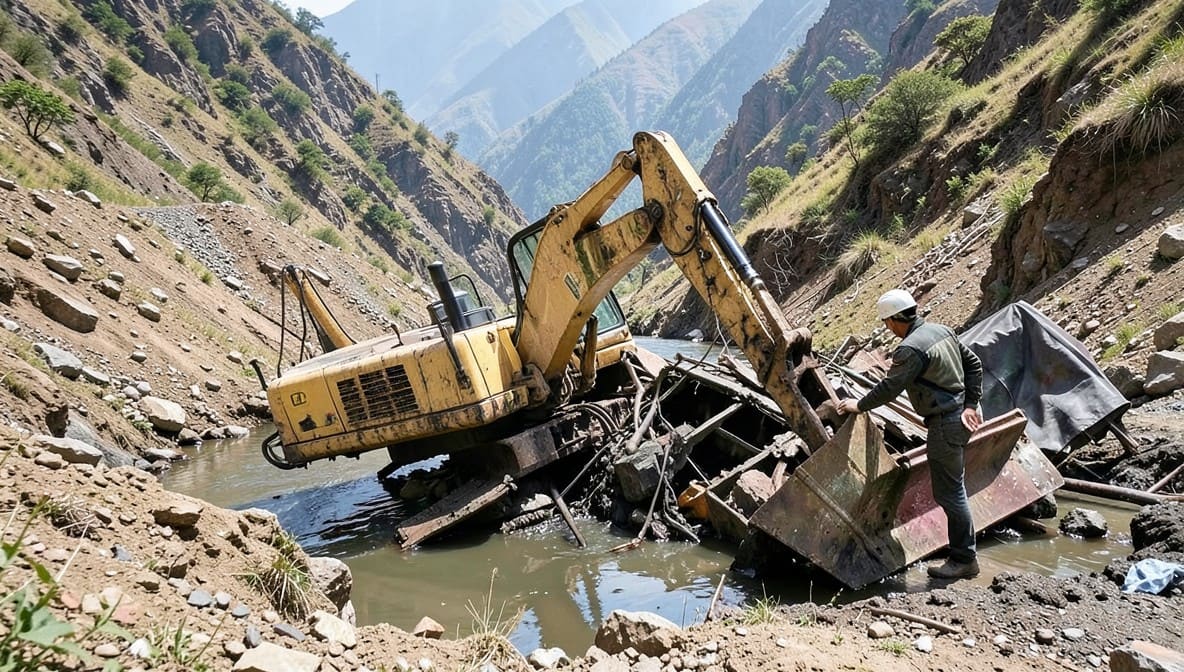
The appellant, Sh. Suryapal Singh Rawat, purchased a JCB 3DX Backhoe Loader (registration No. UK10-5618) on finance from Tata Capital Finance Services Limited and insured it with Bajaj Allianz General Insurance Company Limited for a sum insured of Rs. 22,50,000 for the period 28.03.2013 to 27.03.2014. The machine was registered in Uttarkashi and deployed for slip cleaning work on the Rajgarhi Motor Road near Village Bhani under a contract awarded by the Public Works Department, Barkot, dated 25.06.2013.
Key Facts
- The insurance policy schedule contained a warranty clause: "Warranted Indian machine and Equipment not to be used in Hilly areas / Underground works / mines / quarry / dams / bridges / Hydel projects and works in water."
- The policy's comments clause stated: "Location: Insured project / contract / work site anywhere in India. Current Location - Village & P.O. Khawli Sera, Purola, Uttarkashi - 249171."
- On 18.08.2013 at approximately 7:00 p.m., a boulder fell from a hill and caused the machine to plunge into a 200-300 feet deep gorge, resulting in total damage.
- The appellant lodged an FIR with Police Station Barkot and immediately intimated both the financier and the insurer.
- The insurance company appointed surveyor Sh. Rajeev Kr. Gupta on 22.08.2013, who visited the site on 23.08.2013 and confirmed total loss.
- The surveyor directed the appellant to retrieve the machine at his own cost, which he did, incurring Rs. 1,50,000 in rental expenses.
- The appellant submitted a repair estimate of Rs. 17,00,000 on 10.09.2013 and formally claimed the insured amount via letter dated 13.10.2013 through the financier.
- The insurer repudiated the claim on 22.01.2014, citing use in hilly areas as a policy violation.
- The claim file was reopened on 26.04.2014 and 13.05.2014, with requests for additional documents.
- A final repudiation letter dated 05.07.2014 cited non-submission of documents as the reason, without mentioning hilly area use.
- The final survey report by Sh. Tarun Rai Arora (dated 17.02.2014) assessed loss at Rs. 11,75,105 on RIV basis but referenced annexures (including revised estimates of Rs. 22.63 lacs and Rs. 26.58 lacs) not produced by the insurer.
Procedural History
- 18.08.2013: Accident occurred at Village Bhani, Rajgarhi Motor Road
- 22.08.2013: Surveyor appointed by insurer
- 23.08.2013: Surveyor visited accident site
- 13.10.2013: Claim submitted with all documents via financier
- 22.01.2014: First repudiation letter issued (citing hilly area use)
- 26.04.2014 & 13.05.2014: Insurer reopens claim and requests additional documents
- 05.07.2014: Final repudiation letter issued (citing non-submission of documents)
- 04.07.2016: Consumer complaint filed before District Consumer Disputes Redressal Commission, Uttarkashi (Complaint No. 20 of 2016)
- 08.07.2022: District Commission dismissed complaint without addressing merits, relying on limitation and policy exclusion
- 10.08.2022: Appeal filed before State Commission
- 20.04.2026: Final hearing held
- 29.04.2026: Judgment pronounced
The Parties' Positions
For the Appellant: Argued that the machine was used for public road maintenance under a government contract, not in prohibited zones like mines or hydel projects. The policy's "hilly areas" exclusion was vague and not violated. All documents were submitted on 13.10.2013. The insurer’s subsequent repudiation on document grounds was inconsistent and belated.
For the Respondent (Insurer): Contended that the machine was used in a hilly area, which fell under the policy’s exclusion clause. The claim was repudiated on this ground initially and later on non-submission of documents. The complaint was barred by limitation.
Relief Sought
The appellant sought: (1) payment of Rs. 17,00,000 as compensation for total loss of the machine; (2) interest at 7% per annum from the date of filing the complaint (04.07.2016); (3) Rs. 10,000 as litigation expenses; and (4) reimbursement of Rs. 1,50,000 spent on retrieval and storage.
The Legal Issue
The central question was whether an insurer can repudiate a claim solely on the ground that the insured equipment was used in a "hilly area," when the policy does not define "hilly area" and the use was for legitimate public infrastructure work under a government contract, and whether a subsequent repudiation on document grounds can validate an initial invalid denial.
Arguments Presented
For the Appellant
The appellant relied on the policy’s own comment clause stating "Location: Insured project / contract / work site anywhere in India," which included the work site in Uttarkashi. He argued that the exclusion clause was not triggered because the machine was not used in mines, quarries, dams, or hydel projects - the specific prohibited activities listed. He cited Indian National Insurance Co. Ltd. v. Smt. Sushila Devi to establish that exclusions must be strictly construed against the insurer. He further argued that the insurer’s reopening of the claim and subsequent repudiation on document grounds amounted to waiver of the initial ground, and that the documents were submitted on 13.10.2013, as acknowledged by the insurer’s own correspondence.
For the Respondent
The insurer contended that the policy’s warranty clause explicitly prohibited use in hilly areas, and the accident occurred in a hilly region of Uttarkashi. It argued that the appellant failed to submit documents such as the original purchase invoice, maintenance records, and proof of compliance with safety norms. It also claimed the complaint was filed beyond the two-year limitation period under Section 24A of the Consumer Protection Act, 1986.
The Court's Analysis
The Commission first addressed limitation. It noted that while the insurer and District Commission incorrectly cited 22.06.2014 as the repudiation date, the actual final repudiation occurred on 05.07.2014. Since the complaint was filed on 04.07.2016, it was well within the two-year limitation period.
The Commission then examined the insurer’s reliance on the "hilly areas" exclusion. It observed that the policy’s warranty clause listed specific prohibited uses - "underground works / mines / quarry / dams / bridges / hydel projects and works in water" - but did not define "hilly areas" as a standalone prohibited activity. The machine was used for road slip cleaning under a government contract, not for mining or construction of dams or bridges. The Commission held:
"It does not lie in the mouth of the insurance company to say that the insured machine / vehicle was not to be used in hilly areas / underground works / mines / quarry / dams / bridges / hydel projects works in water."
The Commission further noted that the insurer’s own survey report referenced revised repair estimates of Rs. 22.63 lacs and Rs. 26.58 lacs, which were not produced in evidence. The insurer’s failure to submit annexures to its survey report was deemed malafide. The Commission accepted the appellant’s claim of Rs. 17,00,000 as reasonable, given the policy sum insured of Rs. 22,50,000 and the insurer’s own surveyor’s reference to higher estimates.
Crucially, the Commission held that the insurer’s second repudiation on 05.07.2014 - citing non-submission of documents - did not mention the hilly area ground. This constituted a waiver of the initial ground and an admission that it was unjustified. The insurer’s written statement failed to contest the appellant’s assertion that documents were submitted on 13.10.2013.
The Verdict
The appeal was allowed. The impugned order dated 08.07.2022 was set aside. The consumer complaint was allowed. Bajaj Allianz General Insurance Company Limited was directed to pay Rs. 17,00,000 as compensation to the appellant, together with interest at 7% per annum from 04.07.2016 until actual payment, and Rs. 10,000 as litigation expenses. The insurer was also directed to reimburse Rs. 1,50,000 spent on retrieval and storage of the machine.
What This Means For Similar Cases
Policy Exclusions Must Be Specific and Proven
- Practitioners must challenge insurers who invoke broad exclusions like "hilly areas" without linking them to specific prohibited activities listed in the policy.
- The burden shifts to the insurer to prove actual use in a prohibited category, not merely location.
Waiver Through Inconsistent Repudiation Grounds
- If an insurer initially denies a claim on one ground and later repudiates on a different ground without reiterating the first, the initial ground is deemed waived.
- This principle applies even if the second ground is also invalid - the inconsistency itself undermines the insurer’s credibility.
Documentary Evidence and Survey Reports Must Be Complete
- Insurers cannot rely on incomplete survey reports or withhold annexures to justify denial.
- Courts will infer malafide conduct when key documents referenced in reports are not produced.
- Claimants should preserve all estimates, correspondence, and survey references to counter selective evidence.
Limitation Period Tied to Final Repudiation
- The limitation clock starts from the final repudiation, not the first.
- If an insurer reopens a claim and issues a new denial, the new date governs limitation - even if the initial denial was invalid.
Compensation Based on Reasonable Estimate, Not Just Survey Value
- When an insurer’s surveyor references higher repair estimates but fails to produce them, the claimant’s reasonable estimate (supported by context) may be accepted.
- The sum insured remains a key benchmark for assessing reasonableness of claim amount.