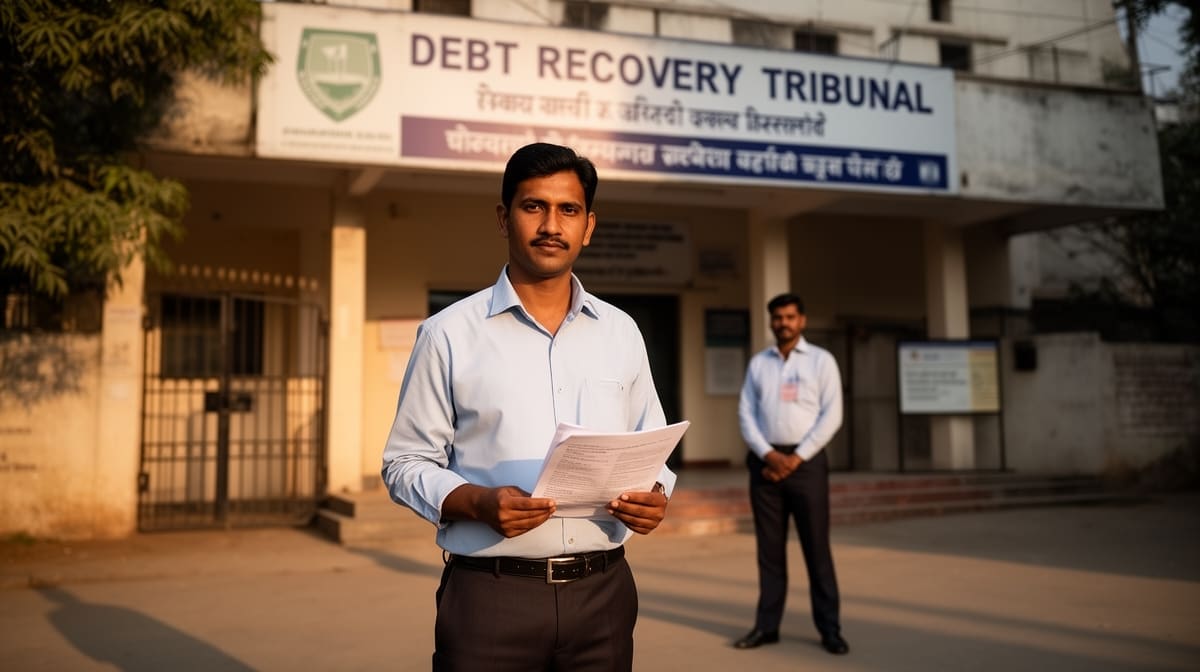
The Madhya Pradesh High Court held that a writ court lacks jurisdiction to issue directions expediting SARFAESI recovery proceedings when the statute itself provides a specific remedy via the Appellate Tribunal under Section 17(6). Invoking Article 226 to bypass this statutory mechanism is impermissible, and the aggrieved party must first exhaust the remedy of approaching the Appellate Tribunal for expeditious disposal.
Background & Facts
The Dispute
The appellants, M/S Kailash Singh Jitendra Singh Bhilware through its proprietor Mr Kailash Singh Bhilware and others, are borrowers who availed a loan facility originally granted by RBL Bank Limited, which was later assigned to the respondent, Pegasus Assets Reconstruction Private Limited. The respondent initiated recovery proceedings under the SARFAESI Act before the Debts Recovery Tribunal (DRT), Jabalpur, by filing Securitisation Application No. 772/2022 (S.A. No.772/2022). The appellants challenged these proceedings, raising various legal issues before the DRT.
Key Facts
- On 06.06.2023, the respondent obtained an order under Section 14 of the SARFAESI Act from the District Magistrate.
- On 05.07.2023, the DRT passed an interim order directing the appellants to deposit a sum of Rs.1,25,00,000.
- The order of the District Magistrate was stayed pending the disposal of a second appeal.
- Aggrieved by the continued pendency of S.A. No.772/2022, the respondent filed Writ Petition No. 23663/2026 before the High Court, seeking a direction to the DRT to expedite the proceedings.
- The Writ Court, by order dated 15.07.2026, directed the DRT to proceed with S.A. No.772/2022 as expeditiously as possible, preferably within three months from the date of receipt of the certified copy of that order.
- The appellants preferred the present writ appeal (W.A. No.2604/2026) contending that the Writ Court exceeded its jurisdiction.
Procedural History
- 06.06.2023: Respondent’s Section 14 SARFAESI order from the District Magistrate.
- 05.07.2023: DRT interim order for deposit of Rs.1,25,00,000.
- 15.07.2026: Writ Court’s order directing expedited disposal of S.A. No.772/2022.
- 14.08.2026: Appeal reserved for judgment.
- 16.09.2026: Judgment pronounced.
Parties' Positions
For the Appellant/Petitioner: It was submitted that the power to expedite proceedings vests exclusively with the DRT under Section 17(6) of the SARFAESI Act, and the Writ Court had no authority to issue such a direction under Article 226. For the Respondent/State: It was contended that the relief sought was innocuous, no illegality was committed, public money was involved, and reliance was placed on the Supreme Court decision in Indian Overseas Bank v. M/s Radhey Infra Solutions (Pvt.) Ltd. & Ors., SLP(C) No.21255/2025 dated 07.10.2025.
Relief Sought
The appellants sought to set aside the Writ Court’s order dated 15.07.2026 and to be permitted to pursue remedies under Section 17(6) of the SARFAESI Act. The respondent sought affirmation of the Writ Court’s direction and costs.
The Legal Issue
The central question was whether the High Court, under Article 226 of the Constitution, could issue a direction to the Debts Recovery Tribunal to expedite SARFAESI recovery proceedings when the statute provides a specific remedial mechanism under Section 17(6) for approaching the Appellate Tribunal. Relatedly, the Court had to determine if the Writ Court exceeded its jurisdiction by bypassing the statutory remedy and whether public interest could justify such judicial intervention.
Arguments Presented
For the Appellant/Petitioner
The appellants argued that Section 17(6) of the SARFAESI Act creates a distinct remedy whereby any party aggrieved by the DRT’s failure to dispose of an application within four months may approach the Appellate Tribunal for an order directing expeditious disposal. They contended that the Writ Court’s direction to the DRT to expedite proceedings amounted to exercising a power not conferred upon it, thereby exceeding its jurisdiction. They emphasized that the statutory scheme intends the Appellate Tribunal, not the High Court, to supervise the DRT’s expeditious functioning.
For the Respondent/State
The respondent maintained that the relief sought was merely procedural and caused no prejudice, especially given the involvement of public money. It relied on the Supreme Court’s observation in Indian Overseas Bank v. M/s Radhey Infra Solutions (Pvt.) Ltd. & Ors. that the DRT must comply with the statutory mandate under Section 17(5) to dispose of applications within sixty days, extendable to four months. The respondent asserted that the Writ Court’s direction was in aid of statutory compliance and did not violate any provision of the SARFAESI Act.
The Court's Analysis
The Court began by noting that the SARFAESI Act contains a complete code for the expeditious disposal of applications under Section 17(1). Sub-section (5) requires the DRT to deal with such applications as expeditiously as possible and to dispose of them within sixty days, extendable with recorded reasons, provided the total pendency does not exceed four months from the date of application. Sub-section (6) expressly provides that if the DRT fails to dispose of the application within the four-month period, any party may approach the Appellate Tribunal in the prescribed form for an order directing the DRT to expedite disposal, and the Appellate Tribunal may pass such an order.
The Court observed that the remedy under Section 17(6) is specific and exclusive. It held that the Writ Court, by directing the DRT to expedite proceedings, effectively circumvented this statutory mechanism. The Court emphasized that the Appellate Tribunal possesses the expertise to appreciate the intricacies of applications under Section 17(1), a competence not available to a single Judge of the High Court. This legislative design is precisely why Sub-section (6) was enacted.
Turning to the respondent’s reliance on Indian Overseas Bank v. M/s Radhey Infra Solutions (Pvt.) Ltd. & Ors., the Court distinguished that decision as being limited to Section 17(5) only. The Supreme Court in that case had not considered the applicability of Section 17(6), and thus the precedent was of no assistance to the respondent.
The Court also addressed the argument concerning public money. While acknowledging the concern raised by the Writ Court, it held that public money is involved in virtually every DRT proceeding, and therefore the involvement of public funds cannot justify bypassing the statutory remedy. The Court reiterated that substantive justice under Article 226 must be exercised in conformity with the statutory framework, not in opposition to it.
Finally, the Court concluded that the Writ Court’s order dated 15.07.2026 was issued without jurisdiction and must be set aside. The respondent was left at liberty to avail the remedy under Section 17(6) by approaching the Appellate Tribunal.
"Thus, it is apparent from the aforesaid provisions that a specific provision/mechanism has been provided for expeditious disposal of the application filed under Section 17(1) of the SARFAESI Act, and the remedy is also provided if the case is not decided within the time prescribed i.e., four months, however, without taking recourse of the said remedy as provided under Section 17(6), the respondent filed the petition seeking the relief as aforesaid."
The Verdict
The appellants succeeded. The Court set aside the impugned order of the Writ Court dated 15.07.2026 and held that the Writ Court lacked jurisdiction to direct the DRT to expedite SARFAESI proceedings. It declared that the respondent remains free to approach the Appellate Tribunal under Section 17(6) of the SARFAESI Act for an order directing expeditious disposal of S.A. No.772/2022. The Court further directed the DRT, Dehradun, to take note of the statutory mandate under Section 17(5) and act accordingly without further delay. All pending applications before the DRT were ordered to stand disposed of. No costs were awarded.
What This Means For Similar Cases
Statutory Remedy Must Be Exhausted
Parties must first avail the remedy under Section 17(6) of SARFAESI before seeking judicial intervention under Article 226. Bypassing the Appellate Tribunal invites jurisdictional objections.
High Court Cannot Substitute the Appellate Tribunal
The expertise required to assess applications under Section 17(1) resides with the Appellate Tribunal; a High Court cannot assume that role under the guise of expeditious disposal.
Public Interest Does Not Override Statutory Procedure
The mere involvement of public money does not permit a court to ignore the specific remedial scheme laid down by Parliament; substantive justice must be pursued within the statutory framework.