The Bombay High Court has reaffirmed a well-established principle in financial jurisprudence: where a statutory remedy is available under the Securitisation and Reconstruction of Financial Assets and Enforcement of Security Interest Act, 2002, writ jurisdiction under Article 226 of the Constitution cannot be invoked as a substitute. This judgment reinforces the procedural discipline required in debt recovery matters and clarifies the limits of judicial intervention.
Background & Facts
The Dispute
The petitioners, M/s. Prishija Energy Private Limited and others, are borrowers who had defaulted on loan obligations to Respondent No. 1, Saraswat Co-operative Bank Limited. In response to the default, the bank initiated proceedings under the Securitisation and Reconstruction of Financial Assets and Enforcement of Security Interest Act, 2002 (SARFAESI Act). On 05.12.2024, a Competent Magistrate passed an order under Section 14 of the SARFAESI Act, authorizing the bank to take possession of the secured assets.
Key Facts
- The petitioners had availed credit facilities from Saraswat Co-operative Bank Limited under a loan agreement
- Default occurred in repayment obligations, triggering enforcement proceedings
- The bank issued a notice under Section 13(2) of the SARFAESI Act demanding repayment
- The petitioners failed to discharge the dues or raise a valid objection within the stipulated period
- On 05.12.2024, the Competent Magistrate passed an order under Section 14, permitting the bank to take possession of the secured assets
- The petitioners did not file an application under Section 17 of the SARFAESI Act before the Debts Recovery Tribunal (DRT)
Procedural History
- 05.12.2024: Order passed by Competent Magistrate under Section 14 of the SARFAESI Act
- 07.01.2025: Writ Petition No. 6095 of 2026 filed before the Bombay High Court challenging the Section 14 order
- 07.05.2026: Hearing concluded before the Division Bench of Justices Manish Pitale and Farhan P. Dubash
Relief Sought
The petitioners sought quashing of the Magistrate’s order dated 05.12.2024 passed under Section 14 of the SARFAESI Act, and a direction to restrain the bank from taking possession of the secured assets.
The Legal Issue
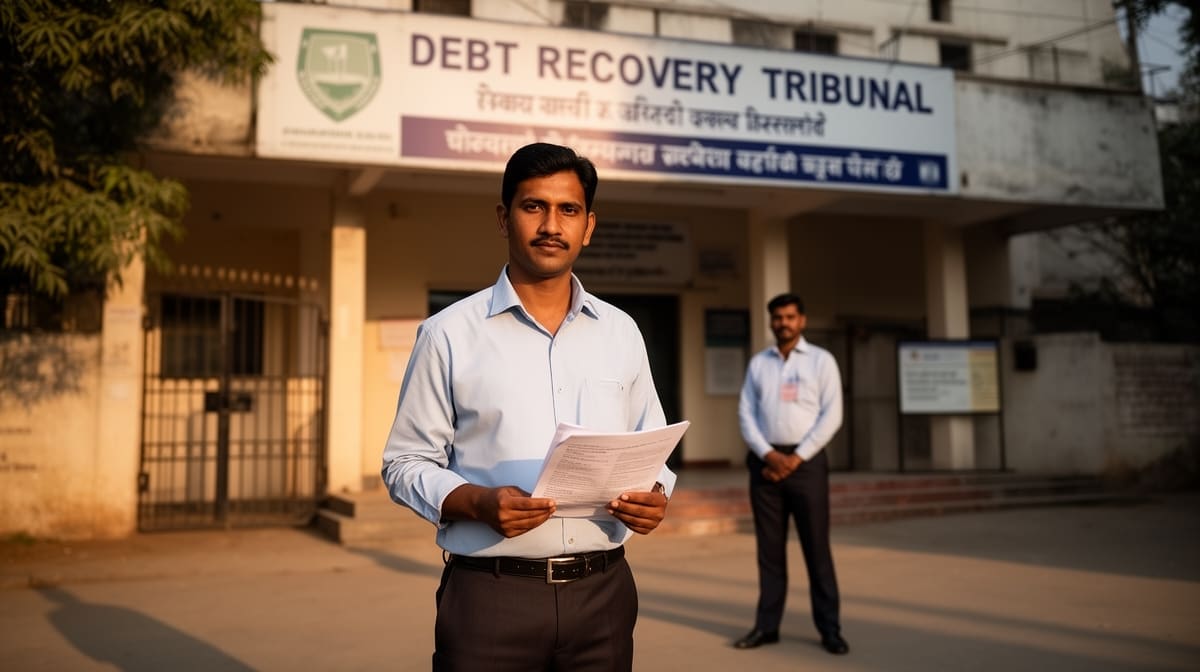
The central question was whether the High Court can entertain a writ petition under Article 226 of the Constitution challenging an order passed under Section 14 of the SARFAESI Act, when an effective statutory remedy is available under Section 17 before the Debts Recovery Tribunal.
Arguments Presented
For the Petitioner
The petitioners contended that the Magistrate’s order under Section 14 was arbitrary and procedurally flawed, and that the bank had not complied with the mandatory requirements of notice and opportunity of hearing. They argued that the writ petition was maintainable as a matter of constitutional remedy to prevent abuse of power.
For the Respondent
The respondents relied on settled Supreme Court precedent that the SARFAESI Act provides a comprehensive and exclusive statutory mechanism for resolution of disputes between secured creditors and borrowers. They emphasized that Section 17 of the Act grants borrowers a specific, time-bound remedy before the DRT, which is both efficacious and adequate.
The Court's Analysis
The Court examined the evolution of judicial stance on the maintainability of writ petitions under Article 226 in matters governed by the SARFAESI Act. It noted that the Supreme Court in United Bank of India v. Satyawati Tandon and others (2010) 8 SCC 110 had unequivocally held that the availability of a statutory remedy under Section 17 of the SARFAESI Act ousts the jurisdiction of the High Court under Article 226.
"More than a decade back, this Court had expressed serious concern despite its repeated pronouncements in regard to the High Courts ignoring the availability of statutory remedies under the RDBFI Act and the SARFAESI Act and exercise of jurisdiction under Article 226 of the Constitution. Even after, the decision of this Court in Satyawati Tandon, it appears that the High Courts have continued to exercise its writ jurisdiction ignoring the statutory remedies under the RDBFI Act and the SARFAESI Act."
The Court observed that the Supreme Court’s recent reaffirmation in Celir LLP v. Bafna Motors (Mumbai) Private Limited and others (2024) 2 SCC 1 underscores the persistent disregard for this principle. It held that the remedy under Section 17 is not merely alternative but exclusive, and that the DRT is statutorily empowered to examine the legality, propriety, and procedural compliance of actions taken under Sections 13 and 14.
The Court further noted that the petitioners had not approached the DRT despite having over a month between the Magistrate’s order and the filing of the writ petition. The absence of any attempt to exhaust the statutory remedy rendered the writ petition an abuse of process.
The Verdict
The writ petition was dismissed. The petitioners are at liberty to approach the Debts Recovery Tribunal under Section 17 of the SARFAESI Act within the statutory limitation period. No costs were awarded.
What This Means For Similar Cases
Statutory Remedies Are Exclusive
- Practitioners must advise borrowers to file applications under Section 17 of the SARFAESI Act before the DRT before considering any writ petition
- Filing a writ petition without exhausting the Section 17 remedy will result in immediate dismissal
- Courts will not entertain challenges to Section 14 orders unless the statutory remedy has been invoked and exhausted
Writ Jurisdiction Is Not a Substitute for Statutory Appeals
- The doctrine of alternative remedy is not discretionary but mandatory in financial enforcement cases
- High Courts will not entertain petitions that bypass the DRT, even if the borrower alleges procedural irregularities
- Any challenge to possession orders must first be ventilated before the DRT, which has the expertise and statutory mandate to adjudicate such disputes
Procedural Discipline Is Non-Negotiable
- Borrowers must act promptly: Section 17 applications must be filed within 45 days of the impugned action
- Delay in approaching the DRT may result in dismissal on limitation grounds
- Legal strategy must prioritize statutory forums over constitutional remedies in SARFAESI matters