The Karnataka High Court has clarified that an insurer cannot be held liable for compensation arising from the death of a gratuitous passenger in a goods vehicle, even where the deceased was carrying goods, if the policy explicitly excludes such coverage. This ruling reinforces the principle that policy conditions govern insurer liability under the Motor Vehicles Act, and that violations of those conditions shift liability squarely to the vehicle owner.
Background & Facts
The Dispute
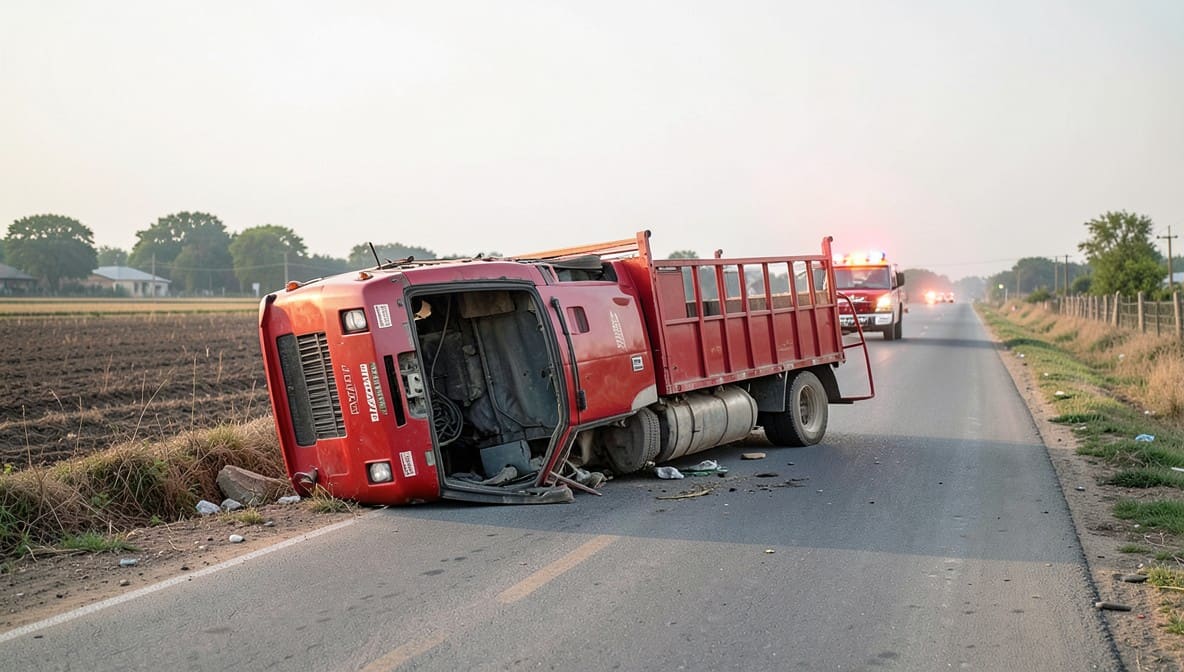
The dispute arose from a fatal road accident on 27.12.2008 involving truck KA-25-A-9396, owned by Bharath Roadlines, a partnership firm. The deceased, Sri Beerappa Khanapur, a coolie, was traveling in the truck when it overturned due to the driver’s negligence, resulting in his death. His legal heirs - his wife Sakkubai, son Laxmappa, and father Shiddavva - filed a claim petition under Section 166 of the Motor Vehicles Act, 1988, seeking compensation of Rs.22,75,000 from the owner and its insurer, New India Assurance Co. Ltd. (Policy No.670700/31/07/01/00008727, valid from 27.02.2008 to 26.02.2009).
Key Facts
- The deceased was traveling in the truck along with 10 bags of fertilizer, which were unloaded near his land before the accident.
- The truck was a goods carriage vehicle, not a passenger vehicle.
- The insurer’s policy explicitly excluded coverage for gratuitous passengers.
- No documentary evidence (purchase receipt, invoice, or transport permit) was produced to establish the deceased as the owner or consignee of the goods.
- The claimants’ sole witnesses were PW-1 (deceased’s wife) and PW-2 (a companion traveler).
- PW-1 admitted she had no personal knowledge of how many fertilizer bags the deceased had purchased.
- PW-2, who lodged the accident complaint (Ex.P2), admitted he had no personal knowledge of the fertilizer purchase and did not mention the goods in his police statement.
- Ex.P2, the police complaint, stated that the deceased and PW-2 were traveling to attend a ritual (Yellamavasye) and were picked up by the truck driver en route.
- The deceased’s journey as a goods carrier ended upon unloading the fertilizer bags near his land.
Procedural History
- 27.12.2008: Road accident occurred; deceased died on spot.
- 05.01.2009: Claim petition filed before MACT-VIII, Badami (MVC No.245/2009).
- 02.05.2011: MACT held deceased was a gratuitous passenger; awarded Rs.3,56,000 plus 6% interest from date of petition; directed owner to pay, absolving insurer.
- 16.03.2026: Appeal heard and reserved by Karnataka High Court.
- 01.06.2026: Judgment delivered by Justice B. Muralidhara Pai.
The Parties' Positions
- Appellant (Owner): Argued that the deceased was transporting goods and thus not a gratuitous passenger; insurer should be liable under the pay and recover principle.
- Respondents (Legal Heirs): Contended the deceased was carrying goods and insurer should be liable; sought modification to hold both owner and insurer jointly liable.
- Respondent 4 (Insurer): Maintained that even if goods were carried, the deceased was not the owner of the goods; as a gratuitous passenger, his death was excluded under policy terms.
Relief Sought
The appellant sought to set aside the MACT award dated 02.05.2011 and direct the insurer to satisfy the compensation award. The claimants sought modification to hold the insurer jointly liable. The insurer sought dismissal of the appeal and confirmation of the MACT order.
The Legal Issue
The central question was whether the deceased, who had unloaded his fertilizer bags prior to the accident, could be classified as a gratuitous passenger under the insurer’s policy, thereby absolving the insurer of liability under the pay and recover principle.
Arguments Presented
For the Appellant/Petitioner
The appellant’s counsel argued that the deceased was transporting fertilizer bags and thus fell within the category of a goods owner traveling in the vehicle. He relied on Smt. Ushakiran Shridhar Shinde v. Arunkumar Kisanlal Kalal to contend that police records cannot be used to contradict oral testimony. He further argued that the MACT erred in ignoring the factual context of the journey and misapplied the concept of gratuitous passenger.
For the Respondent/State
The insurer’s counsel contended that the deceased’s journey as a goods carrier ended upon unloading the fertilizer. Thereafter, his continued travel was purely incidental and without consideration, making him a gratuitous passenger. He cited Amudhavally v. HDFC Ergo General Insurance Co. Ltd. (2025 INSC 1219) to establish that carrying a gratuitous passenger in a goods vehicle constitutes a fundamental breach of policy conditions, absolving the insurer. He also relied on Basavaraj v. Smt. Yallavva to argue that where the claimant does not challenge the finding of gratuitous passenger status, the owner cannot invoke pay and recover.
The Court's Analysis
The Court undertook a meticulous review of the evidence and found that the testimony of PW-1 and PW-2 was inconsistent and unsupported by documentary proof. PW-1’s lack of personal knowledge and PW-2’s admission that he did not mention the fertilizer bags in his police complaint rendered their evidence unreliable. The Court emphasized that Ex.P2 - the police complaint - explicitly stated the deceased was traveling to attend a ritual and was picked up by the driver, with no mention of goods transport.
"The deceased’s purported journey of the deceased in the offending vehicle as the owner of the goods terminated upon unloading the fertilizer bags near his land. His subsequent travel in the offending vehicle from the place of unloading cannot be treated as his travel in the capacity of the owner of the goods."
The Court further held that the insurer’s policy, which excluded coverage for gratuitous passengers, was not violated merely because goods were present in the vehicle. The critical factor was the deceased’s status at the time of the accident. Since he had already unloaded the goods and was traveling without any commercial interest, he was a gratuitous passenger.
The Court applied the precedent in Amudhavally v. HDFC Ergo to affirm that such a situation constitutes a fundamental breach of policy conditions. It also relied on Basavaraj v. Yallavva to hold that the owner, having not challenged the MACT’s finding of gratuitous passenger status, could not now seek to shift liability to the insurer under the pay and recover principle. The Court noted that the owner was a firm, and recovery from it would not be impracticable.
The Verdict
The appeal was dismissed. The judgment and award dated 02.05.2011 of the MACT-VIII, Badami, was confirmed. The owner of the truck, Bharath Roadlines, is directed to pay compensation of Rs.3,56,000 together with interest at 6% per annum from the date of the petition (05.01.2009) until realization. The insurer, New India Assurance Co. Ltd., is absolved of liability. The registry is directed to transmit any deposited amount to the MACT along with the trial record.
What This Means For Similar Cases
Gratuitous Passenger Status Is Determined by Conduct, Not Presence of Goods
- Practitioners must establish the claimant’s status at the precise moment of the accident, not merely the presence of goods in the vehicle.
- Unloading goods before the accident terminates any claim to being a goods owner or consignee.
- Oral testimony unsupported by documents or contemporaneous records will be discounted.
Insurer Liability Is Strictly Tied to Policy Terms
- Policies excluding gratuitous passengers are enforceable under Section 147 of the Motor Vehicles Act.
- The pay and recover principle cannot be invoked if the claimant’s own evidence establishes gratuitous passenger status and the claimant does not challenge the finding.
- Insurers may rely on Amudhavally to resist claims where the deceased was not a paying or commercial passenger.
Burden of Proof Lies with Claimants to Establish Commercial Status
- Claimants must produce documentary evidence (invoices, waybills, receipts) to prove ownership or consignment of goods.
- Absent such proof, courts will default to the classification of gratuitous passenger.
- Police complaints, if inconsistent with testimony, will be treated as authoritative contemporaneous records.