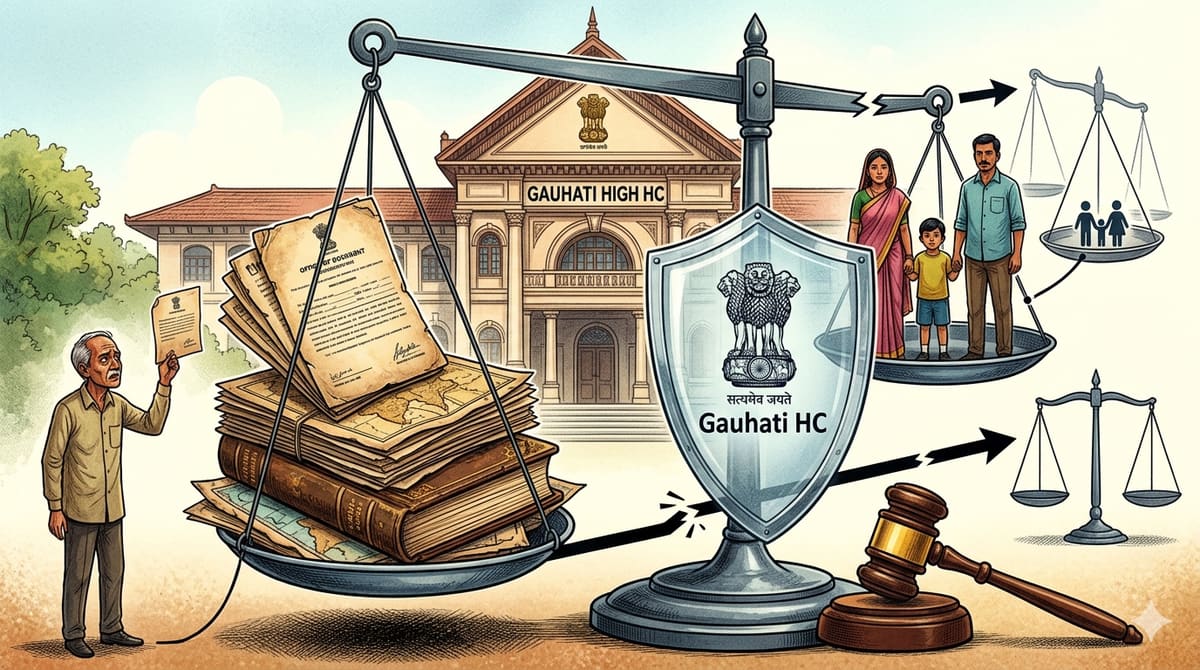
The Gauhati High Court's judgment in Musstt. Hajira Khatun v. Union of India reaffirms the stringent evidentiary standards for proving citizenship before Foreigners Tribunals in Assam. The court upheld the Tribunal's finding that inconsistent testimony and documentary discrepancies regarding ancestral linkage are fatal to a citizenship claim, reinforcing that the burden of proof lies squarely on the proceedee under Section 9 of the Foreigners Act, 1946.
Background & Facts
The Dispute
The petitioner, Musstt. Hajira Khatun @ Musstt. Hajira Begum, challenged an order dated 30.07.2016 passed by the Foreigners Tribunal No. 10, Doboka, Nagaon, which declared her a foreigner who had illegally entered India after 25.03.1971. The reference to the Tribunal was initiated by police authorities who suspected her citizenship status during an inquiry.
Key Facts
- The petitioner claimed Indian citizenship by birth, asserting that her father's name appeared in the voters lists of 1966 and 1970
- In her written statement and evidence-on-affidavit, she identified Md. Asab Ali (1966 voters list, serial No. 194) as her father
- During cross-examination, she contradicted herself by stating that Md. Asab Ali was her uncle (Khura), not her father
- She claimed Ahmed Ali as her father in the 1970 voters list (serial No. 197), but the list actually named Amad Ali
- She submitted an affidavit clarifying that Ahmed Ali and Asab Ali were the same person, but the Tribunal discarded it under Section 3 of the Indian Evidence Act for lacking evidentiary value
- She exhibited a Gaonburah certificate (Exhibit-4) linking her to Ahmod Ali, but the certificate contained a disclaimer stating it could only be used as supporting evidence if accompanied by legacy data or other admissible documents
Procedural History
- Inquiry by police: Suspicion of foreign nationality triggered reference to Foreigners Tribunal
- FT(D) Case No. 213/2015: Registered before Foreigners Tribunal No. 10, Doboka, Nagaon
- 30.07.2016: Tribunal answered the reference in the affirmative, declaring the petitioner a foreigner
- WP(C)/1009/2017: Writ petition filed before Gauhati High Court challenging the Tribunal's order
- 19.05.2026: Judgment reserved
- 27.05.2026: Judgment pronounced, dismissing the writ petition
Relief Sought
The petitioner sought quashing of the Tribunal's order dated 30.07.2016 and a declaration of her Indian citizenship by birth.
The Legal Issue
The central question was whether the petitioner had successfully discharged her burden of proving Indian citizenship under Section 9 of the Foreigners Act, 1946, by establishing consistent and admissible linkage evidence with an ancestor who was an Indian citizen prior to 25.03.1971.
Arguments Presented
For the Petitioner
- The petitioner is a bona fide citizen of India by birth and was wrongly declared a foreigner
- Discrepancies in voters lists are common mistakes and should not be held fatal to her claim
- The Gaonburah certificate should be accepted as supporting evidence of her linkage to her father
For the Respondent
- The petitioner's testimony suffered from material discrepancies regarding her father's identity
- The voters lists of 1966 and 1970 referred to two different individuals, making it impossible to establish linkage
- The Gaonburah certificate was rightly discarded due to its disclaimer, which limited its evidentiary value
- The petitioner failed to establish linkage with any Indian citizen ancestor prior to 25.03.1971 through proper documentary evidence
The Court's Analysis
The High Court examined the evidentiary standards governing citizenship claims before Foreigners Tribunals in Assam, emphasizing the following principles:
-
Burden of Proof: Under Section 9 of the Foreigners Act, 1946, the burden lies on the proceedee to prove that she is not a foreign national. This includes establishing linkage with an Indian citizen ancestor prior to 25.03.1971.
-
Consistency in Evidence: The court highlighted the fatal discrepancies in the petitioner's testimony. While she initially claimed Md. Asab Ali as her father in her written statement and affidavit, she later stated during cross-examination that he was her uncle. Such inconsistencies undermine the credibility of her claim.
-
Documentary Evidence: The court noted that the name appearing in the 1970 voters list was Amad Ali, not Ahmed Ali as claimed by the petitioner. The assumption that Ahmed Ali and Amad Ali were the same person could not be automatically accepted, especially in a matter as critical as citizenship.
"It cannot be automatically assumed that Ahmed Ali and Amad Ali are one and the same person on a matter as vital as link evidence for the purpose of establishing citizenship."
-
Evidentiary Value of Affidavits: The Tribunal rightly discarded the petitioner's affidavit attempting to reconcile the discrepancies, as Section 3 of the Indian Evidence Act does not confer evidentiary value on such clarifications.
-
Gaonburah Certificate: The Gaonburah certificate (Exhibit-4) was not accepted as conclusive evidence due to its disclaimer, which stated that it could only be used as supporting evidence if accompanied by legacy data or other admissible documents. The court held that the certificate, standing alone, did not establish the requisite linkage.
-
Scope of Certiorari Jurisdiction: The High Court reiterated that under Article 226 of the Constitution, its role is limited to examining whether the Tribunal's order suffers from any legal infirmity. Since the Tribunal's findings were based on a proper appreciation of evidence and legal principles, no interference was warranted.
The Verdict
The writ petition was dismissed. The High Court upheld and confirmed the order dated 30.07.2016 passed by the Foreigners Tribunal No. 10, Doboka, Nagaon, declaring the petitioner a foreigner. The consequential steps directed in the impugned order shall follow, and the interim order passed on 23.02.2017 stands vacated.
What This Means For Similar Cases
Linkage Evidence Must Be Consistent and Documentary
- Practitioners must ensure that ancestral linkage evidence is consistent across all submissions, including written statements, affidavits, and cross-examinations
- Discrepancies in names or relationships (e.g., father vs. uncle) will be treated as fatal to the claim, as they undermine credibility
- Voters lists alone are insufficient unless corroborated by other admissible documents
Affidavits and Clarifications Have Limited Evidentiary Value
- Affidavits attempting to reconcile discrepancies (e.g., clarifying that two different names refer to the same person) will not be accepted under Section 3 of the Indian Evidence Act unless supported by independent evidence
- Gaonburah certificates or similar documents must be accompanied by legacy data or other admissible evidence to establish linkage; disclaimers limiting their evidentiary value will be strictly enforced
Burden of Proof Lies Squarely on the Proceedee
- The burden under Section 9 of the Foreigners Act, 1946 is non-negotiable: the proceedee must prove citizenship, not the state
- Documentary evidence is essential to discharge this burden; oral testimony alone, especially if inconsistent, will not suffice
- Pre-1971 linkage must be established beyond doubt, and any ambiguity will be resolved against the proceedee