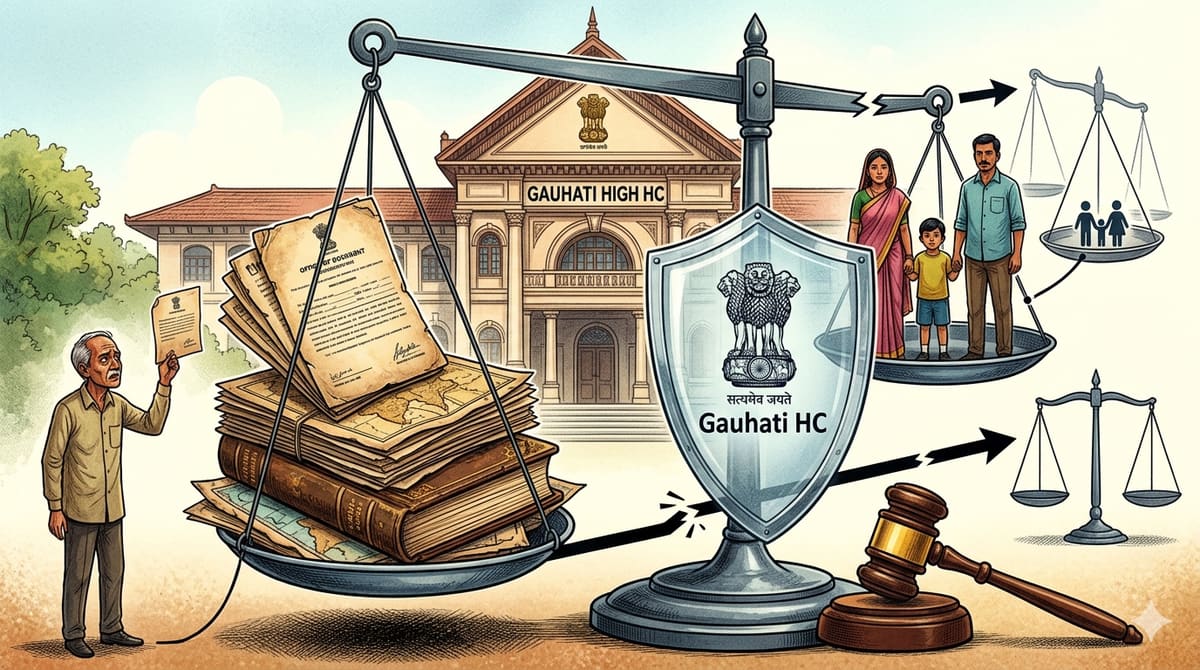
The Gauhati High Court has reaffirmed that under the Foreigners Act, 1946, the burden of proving citizenship rests exclusively on the proceedee, and that family members cannot be declared foreigners without a separate, specific reference. This judgment clarifies procedural safeguards in citizenship determination proceedings under the National Register of Citizens framework in Assam.
Background & Facts
The Dispute
The petitioner, Maya Das, daughter of Nibaran Chandra Das, was declared a foreigner post 25.03.1971 by the Foreigners Tribunal No. 4, Silchar, in FT Case No. 105/2015. The reference against her was initiated by the Superintendent of Police (B), Cachar, under Section 9 of the Foreigners Act, 1946. Along with her, her five children - Diju Das, Pintu Das, Mukta Das, Sukta Das, and Bijoya Das - were also declared foreigners in the same order, despite no separate reference being initiated against them.
Key Facts
The petitioner filed a written statement on 11.01.2016, submitting multiple documents to establish her citizenship.
Documentary evidence submitted included:
Ext-1: Xerox copy of school certificate in the name of Maya Das (not countersigned by authority)
Ext-2: Xerox copy of NRC 1966 listing Nibaran Chandra Das as father
Ext-3: Certified copy of 1965 voter list showing Nibaran Chandra Das
Ext-4: Certified copy of 2013 voter list showing Nikunja Das and Naru Das as sons of Nibaran Das
Ext-5: Affidavit of Nibaran Das
Ext-6: Certified copy of 1997 voter list showing Maya Das as wife of Dilu Das
Ext-7: Voter ID card in name of Maya Das
Ext-8: Marriage certificate
Ext-9 to 9(4): Birth certificates of her five children
The petitioner appeared as DW1 and testified about her lineage, marriage, and children.
CW1, Secretary of Syedbond Gaon Panchayat, testified that the certificate dated 27.06.2015 (Ext-8) was issued solely to establish her marriage to Dilu Das, not to prove citizenship or lineage.
No contemporaneous record or authenticated document directly linked Maya Das to Nibaran Chandra Das as his daughter.
No independent reference was filed against any of her children.
Procedural History
24.05.2019: Foreigners Tribunal No. 4, Silchar, declared Maya Das and her five children as foreigners post 25.03.1971.
10.02.2020: Gauhati High Court ordered requisition of Tribunal records.
27.04.2026: Oral arguments heard before Justices Sanjay Kumar Medhi and Shamima Jahan.
30.04.2026: Judgment delivered.
The Parties' Positions
For the Petitioner (Maya Das)
Argued that documentary evidence, including voter lists, NRC entries, and birth certificates, collectively established her lineage to Nibaran Chandra Das.
Contended that the Tribunal erred in rejecting her evidence without rebuttal from the State.
Relied on the Gaon Panchayat certificate as proof of identity and family linkage.
For the Respondents (Union of India, State of Assam, NRC, ECI)
Emphasized that Section 9 of the Foreigners Act, 1946 places an absolute, non-shifting burden on the proceedee to prove citizenship.
Argued that the documents submitted were unauthenticated, lacked contemporaneous corroboration, and did not establish a verifiable link to a citizen ancestor.
Cited Rupajan Begum v. Union of India to assert that Gaon Panchayat certificates are only supporting documents for linkage, not proof of citizenship.
Stated that oral testimony alone, without documentary corroboration, is insufficient under Bijoy Das v. UOI.
Highlighted that no separate reference was initiated against the children, making their declaration illegal.
Relief Sought
The petitioner sought quashing of the Foreigners Tribunal’s order dated 24.05.2019, particularly the declaration of her five children as foreigners, and a direction to recognize her as an Indian citizen based on the documents submitted.
The Legal Issue
The central questions were: (1) Whether the petitioner discharged the burden of proof under Section 9 of the Foreigners Act, 1946 to establish her citizenship; and (2) Whether the declaration of her children as foreigners without a separate reference violates established legal principles.
Arguments Presented
For the Petitioner
The petitioner’s counsel argued that the cumulative weight of documents - 1965 voter list, NRC 1966, 1997 voter list, marriage certificate, and birth certificates - established a credible chain of lineage to Nibaran Chandra Das. He contended that the Tribunal failed to appreciate the evidentiary value of these documents and that the absence of rebuttal evidence should have worked in her favor. He relied on Rupajan Begum to argue that Gaon Panchayat certificates, while not conclusive, are admissible as corroborative evidence when supported by legacy data.
For the Respondent
The State’s counsel countered that Section 9 of the Foreigners Act overrides the Indian Evidence Act, placing an absolute burden on the proceedee. He argued that none of the documents were authenticated by the issuing authorities, and the school certificate lacked compliance with Section 66 of the Evidence Act. He cited Romila Khatun to stress that documentary proof requires verification of both authenticity and content. He further emphasized that Bijoy Das mandates corroboration of oral testimony with contemporaneous records, which was absent. Crucially, he pointed out that no separate reference was filed against the children, rendering their inclusion in the order illegal under Sudhir Kr. Roy v. UOI.
The Court's Analysis
The Court began by affirming the settled legal position under Section 9 of the Foreigners Act, 1946: the burden of proving citizenship lies exclusively on the proceedee and never shifts, irrespective of the Evidence Act. The Court cited Fateh Mohd. v. Delhi Administration and Ghaus Mohammad v. Union of India to reinforce that this burden is absolute and non-negotiable.
"The burden of proving that a person is not a foreigner is upon such a person."
The Court then examined the documents submitted by the petitioner. It found that while the 1965 voter list and NRC entry named Nibaran Chandra Das, none of the documents bearing the petitioner’s name contained a verifiable link to him. The school certificate was unauthenticated; the Gaon Panchayat certificate was explicitly admitted by its issuer to be for marriage proof only; and the birth certificates of the children did not establish lineage to a citizen ancestor.
The Court relied on Romila Khatun and Rupajan Begum to hold that documents must be proved not just in form but in substance. The Gaon Panchayat certificate, while admissible, could not serve as a standalone proof of citizenship or lineage. The Court also cited Bijoy Das v. UOI to conclude that oral testimony, without documentary corroboration, is insufficient.
On the critical issue of the children’s declaration, the Court referred to Sudhir Kr. Roy v. UOI, holding that:
"Until a specific reference is initiated against an individual, no orders of declaration as foreigner of such persons can be made by any Foreigners Tribunal."
The Court found no legal basis to declare the five children as foreigners merely because their mother was declared one. The Tribunal had acted beyond its jurisdiction by including them without a separate proceeding.
The Court further emphasized that under Article 226, its jurisdiction is supervisory, not appellate. It cannot reappreciate evidence unless there is a patent illegality or violation of natural justice. No such infirmity was found in the Tribunal’s assessment of the petitioner’s case. However, the inclusion of the children constituted a clear legal error.
The Verdict
The writ petition was partially allowed. The Foreigners Tribunal’s order dated 24.05.2019 declaring Maya Das a foreigner was upheld. However, the declaration of her five children - Diju Das, Pintu Das, Mukta Das, Sukta Das, and Bijoya Das - as foreigners was set aside. The Court directed the Foreigners Tribunal to return the records with a copy of this order. The petitioner is not barred from filing an application under the Citizenship Amendment Act, 2019, and such application shall be considered in accordance with law.
What This Means For Similar Cases
Burden of Proof Is Absolute and Non-Shifting
Practitioners must advise clients that under Section 9 of the Foreigners Act, 1946, no presumption of citizenship exists.
Mere possession of voter ID, school certificates, or birth certificates is insufficient without authenticated linkage to a pre-1971 citizen.
Documentary evidence must be proven through contemporaneous records, not personal affidavits or unverified copies.
Family Members Cannot Be Declared Foreigners by Association
No Foreigners Tribunal may declare a family member a foreigner without a separate, specific reference initiated against that individual.
Any order including dependents without individual reference is void ab initio and subject to immediate quashing.
Legal teams must challenge such inclusions at the Tribunal stage and seek immediate writ relief if overlooked.
Gaon Panchayat Certificates Are Not Citizenship Proof
Gaon Panchayat certificates are only admissible as supporting documents to establish linkage, not as proof of citizenship.
Their evidentiary value is contingent on verification of both the document’s authenticity and the truth of its contents.
Practitioners must ensure that any such certificate is accompanied by legacy data (e.g., NRC, voter list) and that the issuing authority is prepared to testify.