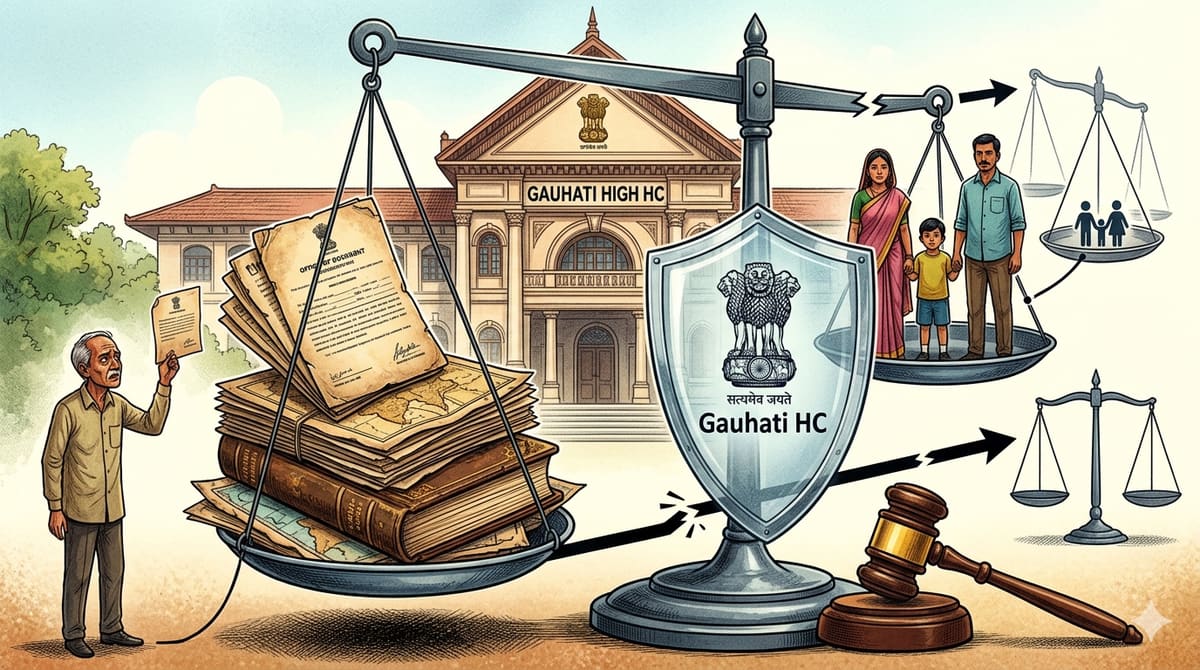
The Gauhati High Court’s dismissal of the writ petition underscores a critical doctrinal boundary in Indian citizenship law: mere familial connection through a mother, even when supported by oral testimony and post-1971 documents, cannot substitute for verifiable, documentary evidence linking an individual to a paternal ancestor present in India before 25 March 1971. This judgment reinforces the stringent evidentiary standards under the Foreigners Act, 1946, and clarifies the limits of circumstantial proof in exclusion proceedings.
Background & Facts
The Dispute
The petitioner, Ali Akbar, was declared a Foreigner by Foreigners’ Tribunal No. 8, Tezpur, on the grounds that he failed to establish his lineage to an Indian citizen prior to the cut-off date of 25 March 1971. The Tribunal’s opinion was triggered by a reference from the Superintendent of Police (B), Sonitpur, which raised doubts about his nationality under the Foreigners Act, 1946.
Procedural History
- 13 June 2018: Tribunal case registered as F.T. (8) Case No. 3640/18
- 2018 - 2019: Petitioner submitted 15 documents and deposed as DW-1, alongside seven other witnesses
- 27 March 2019: Tribunal issued opinion declaring petitioner a Foreigner
- 2019: Writ petition filed before Gauhati High Court challenging the Tribunal’s order
- 6 March 2026: Judgment delivered by Justices Kalyan Rai Surana and Anjan Moni Kalita
Relief Sought
The petitioner sought quashing of the Tribunal’s opinion, arguing that he had established sufficient lineage through his mother and maternal grandfather to prove Indian citizenship by birth.
The Legal Issue
The central question was whether Section 9 of the Foreigners Act, 1946 permits a person to establish citizenship through maternal lineage alone, when no documentary evidence links them to a paternal ancestor present in India before 25 March 1971.
Arguments Presented
For the Petitioner
The petitioner’s counsel argued that the petitioner’s maternal grandfather, Intaj Ali, appeared in electoral rolls from 1965 to 1975, establishing pre-cut-off presence in India. He contended that through his mother, Nechabi Khatun, the petitioner was entitled to claim citizenship by descent. Reliance was placed on oral testimony from Gaonburas, Gaon Panchayat records, and the 1949 registered sale deed of Intaj Ali as sufficient to establish lineage. The counsel emphasized that the petitioner’s father died before 1971, making it impossible to produce voter lists bearing his name.
For the Respondent
The Standing Counsel for the Foreigners Tribunal argued that the petitioner failed to meet the burden under Section 9 of the Foreigners Act, which places the onus on the alleged Foreigner to prove citizenship. The counsel stressed that oral evidence, uncorroborated certificates, and post-1971 documents cannot substitute for direct, verifiable documentary proof of paternal lineage. The Tribunal’s rejection of the marriage link certificate and Gaonbura affidavits was upheld as legally sound, given the absence of independent corroboration.
The Court's Analysis
The Court undertook a meticulous review of each document submitted by the petitioner and evaluated its probative value under the doctrine of documentary primacy in citizenship matters. It held that while the existence of Intaj Ali as a pre-1971 resident was established through electoral rolls and a registered sale deed, no document proved that Nechabi Khatun was his daughter. The Gaon Panchayat certificate claiming this relationship was deemed inadmissible because it was based solely on the petitioner’s mother’s self-declaration, without any independent verification.
"There is no document to show Nechabi Khatun to be the daughter of Intaj Ali. Though a certificate was issued... it was based on a Gaon Burha’s certificate, which is not on record."
The Court similarly rejected the petitioner’s attempt to link himself to his paternal grandfather, Adam Kha, through a 1961 sale deed. Although the deed was not invalidated for lack of witnesses, the Court found no evidence connecting Adam Kha to Abdul Jalil (the petitioner’s father), or to the petitioner himself. The depositions of Gaonburas confirmed the petitioner’s residence and parentage but did not establish ancestral lineage prior to 1971.
The Court emphasized that citizenship by descent under the Foreigners Act requires a direct, documented chain of lineage to a pre-1971 ancestor, and that oral testimony, even from village officials, cannot fill evidentiary gaps where documentary proof is absent. The Court distinguished this case from those where maternal lineage was accepted, noting that those involved clear, contemporaneous records linking mother to father or grandfather.
The Verdict
The petitioner’s writ petition was dismissed. The Court held that citizenship cannot be established through maternal lineage alone without documentary proof of the mother’s own lineage to a pre-1971 Indian ancestor. The Tribunal’s opinion was upheld as legally sound and free from infirmity.
What This Means For Similar Cases
Documentary Evidence Is Non-Negotiable
- Practitioners must prioritize obtaining original, contemporaneous documents - voter lists, land records, NRC entries - over affidavits or oral testimony
- Gaonbura certificates and marriage link certificates are admissible only if independently verifiable and not based on self-declaration
- Post-1971 documents (e.g., voter ID, revenue receipts) are irrelevant for proving pre-cut-off citizenship
Maternal Lineage Requires Independent Corroboration
- A mother’s citizenship cannot be presumed; her own lineage to a pre-1971 ancestor must be proven with documents
- Oral testimony from relatives (e.g., maternal uncles) cannot substitute for documentary proof of parentage
- In cases where paternal records are unavailable due to death, the burden remains on the petitioner to establish maternal lineage with equal rigor
Burden of Proof Remains on the Petitioner
- The Section 9 burden under the Foreigners Act is not shifted by emotional or humanitarian considerations
- Courts will not relax evidentiary standards even when the petitioner is a long-term resident or has lived in India for decades
- Legal strategy must focus on reconstructing pre-1971 documentation, not on narrative appeals