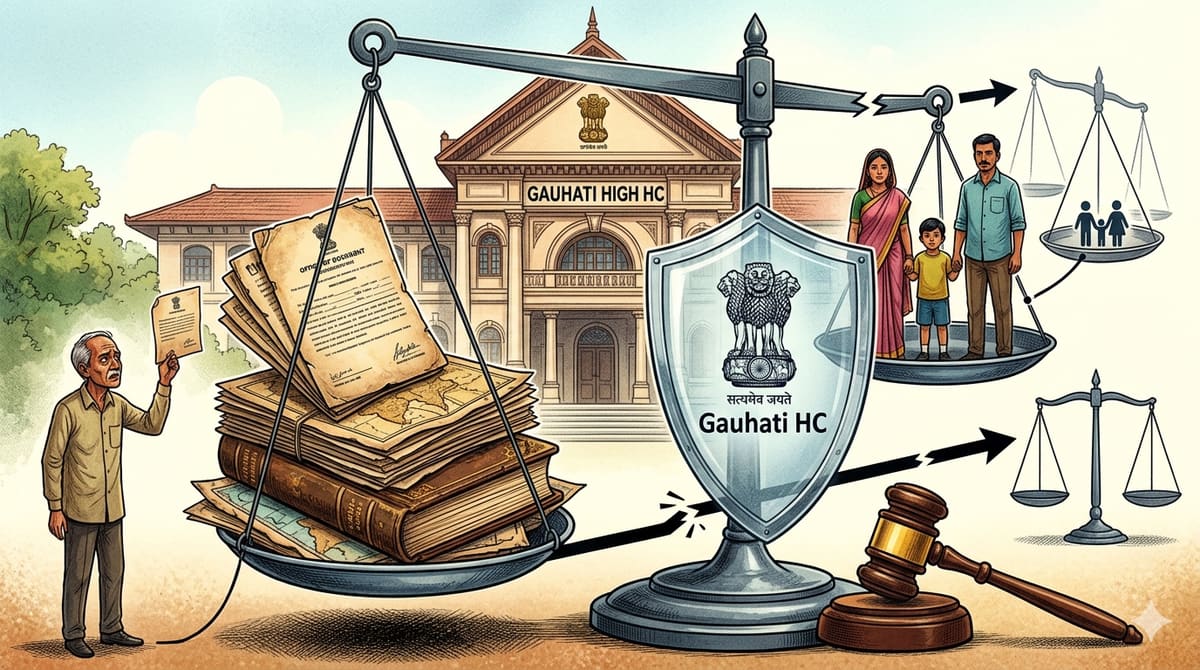
The Gauhati High Court has reaffirmed that Foreigners’ Tribunals must provide reasoned, document-based adjudication in citizenship cases, and cannot dismiss claims based on technical gaps without addressing substantive evidence. This judgment underscores the constitutional obligation to ensure procedural fairness under Article 226, particularly when individuals face the grave consequence of being declared foreigners.
Background & Facts
The Dispute
The petitioner, Sahidul Islam, was declared a foreigner by Foreigners’ Tribunal No. 3, Kamrup (M), in its order dated 14.05.2019 in FT Case No. 395/2017. The Tribunal relied on the absence of continuous voter records between 1970 and 1989, and the alleged inconsistency in the spelling of his grandfather’s name, to conclude that he failed to prove lineage under Section 6A(2) of the Citizenship Act, 1955.
Key Facts
- The petitioner was born in 1969 in village Garemari Pathar, Barpeta, Assam
- His grandfather, Late Danesh Ali (also recorded as Danes Ali, Dagesh), was enrolled as a voter in Palhaji village under Barpeta LAC in 1966 (Exhibit-1) and 1970 (Exhibit-2)
- His father, Hormoz Ali (also recorded as Hurmuz Ali, Hormuz Ali), was listed as a voter in Garemari Pathar in 1989 (Exhibit-3), aged 30, with father’s name recorded as Dagesh
- The petitioner’s name first appeared in the voters’ list of 2005 (Exhibit-6), listed as son of Hormoz Ali
- The petitioner produced certified copies of jamabandi (land revenue record) for Patta No. 175 covering 1958 - 65, showing Danesh Ali as owner and Hormoz Ali as joint owner (Exhibit-11)
- Two Gaonburhas from Palhaji and Garemari Pathar issued certificates confirming the petitioner’s residence and lineage (Exhibits-12 and 13)
- The petitioner’s father, Hormoz Ali, testified as DW-2 and stated one brother was alive; the petitioner, DW-1, stated all uncles had died - a contradiction noted by the Tribunal
- The petitioner submitted an affidavit (Exhibit-15) explaining name variations (Danesh/Danes/Dagesh; Hormoz/Hurmuz) as due to illiteracy and clerical errors in electoral rolls
- The petitioner’s EPIC (2013) and voter lists up to 2017 (Exhibits-7, 9, 10, 11) corroborated his identity and lineage
Procedural History
- 1958 - 1965: Land record (jamabandi) created under Patta No. 175, naming Danesh Ali as owner
- 1966: Danesh Ali enrolled as voter in Palhaji village (Exhibit-1)
- 1970: Danesh Ali’s name appears again in voter list (Exhibit-2)
- 1989: Hormoz Ali appears as voter in Garemari Pathar, father’s name recorded as Dagesh (Exhibit-3)
- 1997: Hormoz Ali appears again in voter list, wife Pawan Nessa also listed (Exhibit-4)
- 2005: Sahidul Islam appears as voter, son of Hormoz Ali (Exhibit-6)
- 2017: Sahidul Islam’s name appears in voter list (Exhibit-9)
- 2017: Gaonburhas issued certificates (15.09.2017 and 17.09.2017)
- 2017: Certified jamabandi copy issued (15.07.2017)
- 2017: Foreigners’ Tribunal proceedings initiated via Jorabat OP Case No. 3199/2008
- 14.05.2019: Tribunal declares petitioner a foreigner without addressing documentary evidence
- 29.04.2026: Gauhati High Court delivers judgment
The Parties' Positions
For the Petitioner
- Argued that the jamabandi (Exhibit-11) and voter lists (1966 - 2017) collectively establish lineage
- Contended that name variations are common in rural electoral records due to illiteracy and clerical errors
- Submitted that the Tribunal ignored the affidavit (Exhibit-15) explaining discrepancies
- Asserted that Palhaji and Garemari Pathar are adjoining villages under the same police station and mouza
- Stated that the Tribunal failed to consider the Gaonburha’s certificates despite their corroborative value
For the Respondents
- Argued that the 19-year gap (1970 - 1989) in voter records breaks the chain of continuous residence
- Contended that the name change from Danesh Ali to Dagesh in 1989 invalidates linkage
- Stated that the jamabandi does not prove inheritance but only joint ownership (Ankhidar Sutre)
- Claimed that the Gaonburha’s certificate from Palhaji cannot validate a resident of Garemari Pathar
- Highlighted the contradiction between DW-1 and DW-2 regarding surviving uncles as undermining credibility
Relief Sought
The petitioner sought quashing of the Tribunal’s order dated 14.05.2019, and remand for fresh adjudication with proper consideration of all documentary evidence.
The Legal Issue
The central question was whether a Foreigners’ Tribunal may reject a petitioner’s claim of citizenship by ignoring documentary evidence linking lineage - including land records and voter lists - without recording reasoned findings, and whether such an order is susceptible to writ jurisdiction under Article 226 of the Constitution.
Arguments Presented
For the Petitioner
The petitioner’s counsel relied on Central Council for Research in Ayurvedic Sciences v. Bikartan Das (2023) to argue that a writ court cannot reappreciate evidence but must intervene when a tribunal’s order is perverse, non-reasoned, or ignores material evidence. It was submitted that the jamabandi (Exhibit-11) directly links the petitioner’s father to his grandfather, and the voter lists from 1966 to 2017 form a continuous, albeit imperfect, trail. The affidavit (Exhibit-15) explaining name variations was a critical piece of evidence that the Tribunal failed to address. The contradiction between the two witnesses was minor and did not invalidate the entire body of documentary proof.
For the Respondent
The State and Tribunal counsel contended that Section 6A(2) of the Citizenship Act requires continuous residence and linkage through verifiable records. They argued that the gap between 1970 and 1989, the change in village name, and the spelling inconsistency in the grandfather’s name rendered the evidence insufficient. They maintained that oral testimony from Gaonburhas, uncorroborated by contemporaneous records, cannot substitute for statutory proof. The contradiction in witness statements, they argued, cast doubt on the entire claim.
The Court's Analysis
The Court emphasized that while a writ court under Article 226 cannot act as an appellate body, it is empowered to intervene when an inferior tribunal’s order is palpably erroneous or devoid of reasoning. The Tribunal’s order was found to be cryptic and conclusory, failing to engage with the petitioner’s documentary evidence.
"It was incumbent upon the Tribunal to record reasons while discarding the documentary evidence linking the petitioner to his father, and his father to his grandfather."
The Court noted that the jamabandi (Exhibit-11) from 1958 - 65 explicitly names Danesh Ali as owner and Hormoz Ali as joint owner - a direct link between the grandfather and father. The Tribunal dismissed this without explaining why a land record showing joint ownership could not serve as proof of lineage. Similarly, the Tribunal ignored the affidavit (Exhibit-15) explaining name variations - a common phenomenon in rural electoral records, as acknowledged by the Court.
The Court further observed that the Tribunal’s reliance on the 19-year gap between 1970 and 1989 was misplaced. The Citizenship Act does not mandate continuous voter registration; it requires proof of residence and lineage. The voter lists from 1966, 1970, 1989, 1997, and 2005, when read together with the jamabandi and affidavits, form a coherent narrative. The fact that the grandfather’s name appears as Dagesh in 1989, while recorded as Danesh in 1966, was not addressed - despite the petitioner’s affidavit explaining it as a phonetic or clerical error.
The Court also rejected the Tribunal’s reasoning that a Gaonburha from Palhaji could not certify a resident of Garemari Pathar. The two villages are adjoining, under the same police station and mouza, and the Gaonburha’s testimony was corroborated by the land records and voter lists.
"The legal formulations cannot be enforced divorced from the realities of the fact situation of the case. While administering law, it is to be tempered with equity..."
The Court concluded that the Tribunal’s failure to engage with the evidence rendered its order legally unsustainable. The writ court cannot substitute its own view, but it can remand for a fresh hearing where all evidence is properly evaluated.
The Verdict
The judgment and order dated 14.05.2019 passed by the Foreigners’ Tribunal No. 3, Kamrup (M), in FT Case No. 395/2017, is set aside. The petitioner, Sahidul Islam, is directed to appear before the Tribunal on or before 05.06.2026, with a certified copy of this order, to present his case afresh. The Tribunal shall re-examine all documentary evidence, including Exhibits-11 (jamabandi) and-15 (affidavit), and record detailed reasons for acceptance or rejection. The Tribunal’s records shall be returned expeditiously.
What This Means For Similar Cases
Reasoned Orders Are Non-Negotiable
- Practitioners must insist that Foreigners’ Tribunals explicitly address each piece of documentary evidence - land records, voter lists, affidavits - and explain why they are accepted or rejected
- Cryptic orders dismissing claims without reasoning are vulnerable to writ jurisdiction under Article 226
- Tribunals cannot rely on technical gaps alone; they must assess the cumulative weight of evidence
Documentary Evidence Trumps Oral Contradictions
- Minor inconsistencies between witnesses (e.g., number of surviving uncles) do not invalidate a body of corroborative documents
- Affidavits explaining name variations due to illiteracy or clerical error are admissible and must be considered
- Land records (jamabandi) showing joint ownership or inheritance are valid linkage documents under Section 6A(2)
Equity Must Inform Legal Formalities
- Courts must recognize the realities of rural documentation - name spellings, village boundaries, and record-keeping gaps
- The burden of proof is not absolute; the tribunal must evaluate evidence in context, not in isolation
- Writ courts will intervene where procedural fairness is compromised, even if the petitioner’s case is imperfect