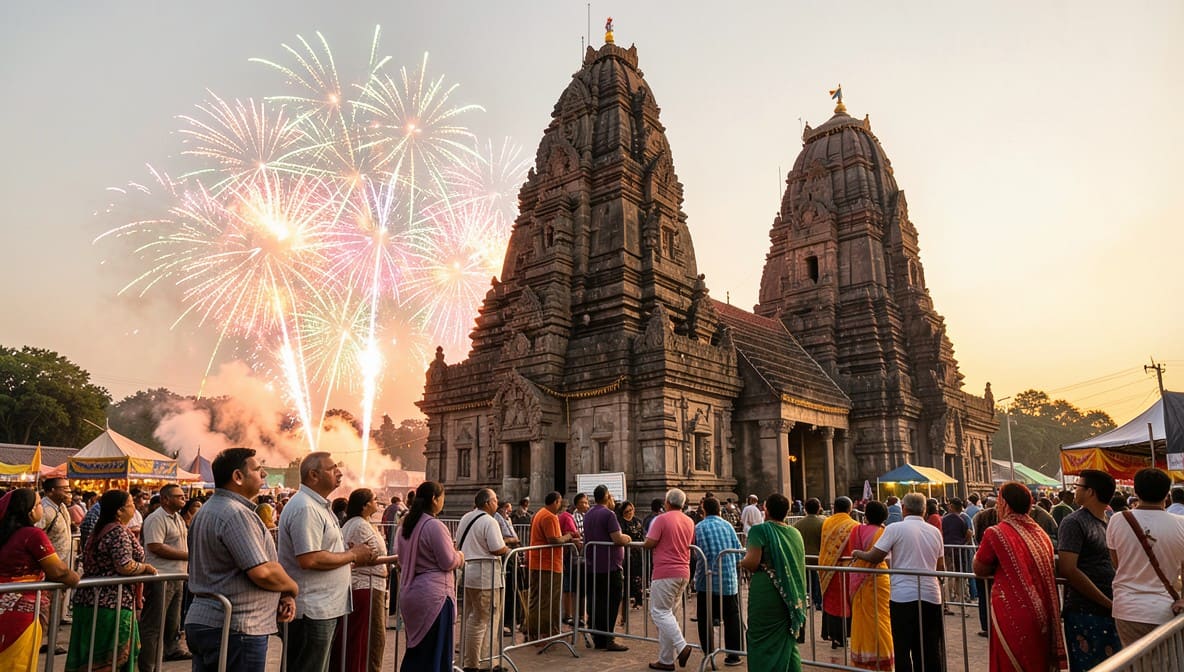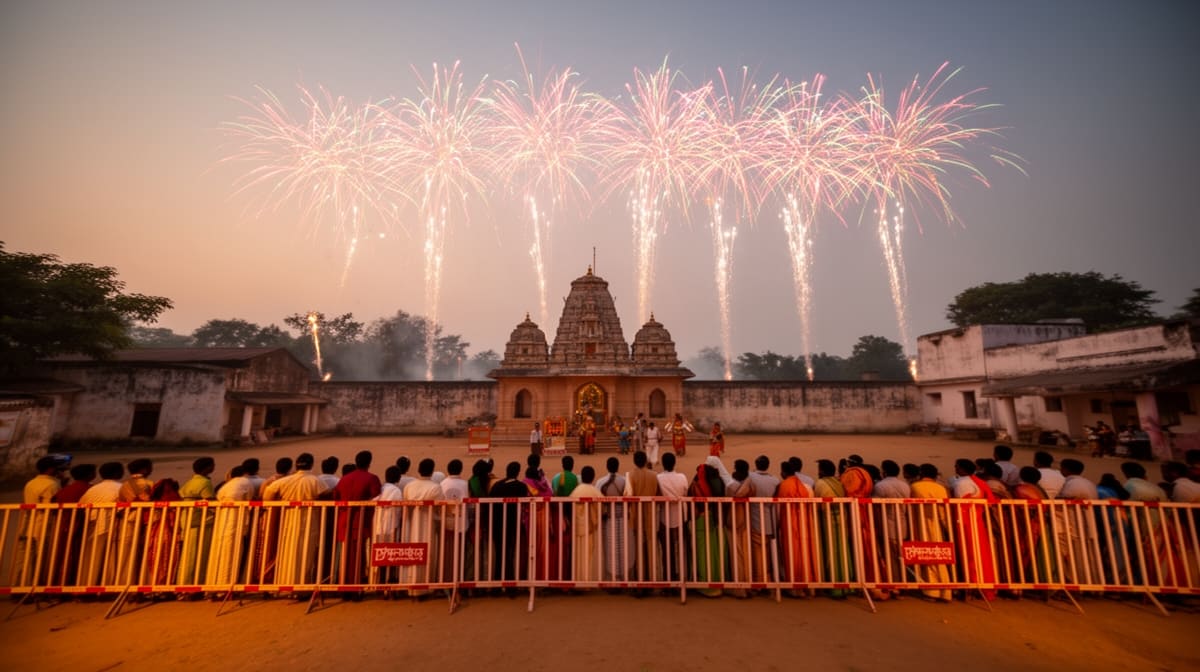
The Kerala High Court has reaffirmed that administrative denials of cultural festival permissions must be grounded in practical safety assessments, not rigid or speculative objections. In granting relief to a petitioner seeking to conduct a traditional fireworks display, the Court emphasized that regulatory conditions must be proportionate, feasible, and based on verifiable facts - not hypothetical risks.
Background & Facts
The Dispute
The petitioner, V. Sureshkumar, sought permission to conduct a fireworks display during the Sree Rudhiramahakalikavu (Uthralikavu) Pooram festival, a culturally significant event in Thrissur. His application under Form AE-6 was rejected by the Additional District Magistrate (3rd respondent) through Ext.P8, citing four objections: absence of N.O.Cs from residents within 200 meters, insufficient 100-meter distance between spectators and display site, risk of explosives crossing the railway track, and potential crowd congestion near the track.
Procedural History
- 4 December 2025: Petitioner submitted application for fireworks display with supporting documents including licenses, safety plans, and preliminary N.O.Cs.
- 9 February 2026: Additional District Magistrate issued Ext.P8 denying permission on the four grounds.
- 17 February 2026: Writ petition filed before the Kerala High Court, with petitioner submitting fresh N.O.Cs, revised sketches, and a Tahsildar’s report confirming barricade work had commenced.
Relief Sought
The petitioner sought quashing of Ext.P8 and a direction to issue permission for the fireworks display, subject to reasonable and enforceable safety conditions.
The Legal Issue
The central question was whether an administrative authority may deny a cultural fireworks permit based on speculative or unverified safety concerns, or whether such denials must be grounded in demonstrable, practical, and proportionate risk assessments under the Explosives Act and associated rules.
Arguments Presented
For the Petitioner
Counsel argued that all objections were either resolved or based on technical misinterpretations. He produced fresh N.O.Cs from residents within 200 meters, demonstrated through revised sketches that a 100-meter buffer could be achieved by shifting the display line westward, and clarified that explosives could be stored in a godown on the eastern side of the railway track, eliminating the need to cross it. He cited State of Kerala v. Sree Narayana Guru Dharma Paripalana Yogam to emphasize the constitutional right to cultural expression under Article 21. The Tahsildar’s report confirmed barricade construction had begun, undermining the claim of non-compliance.
For the Respondent
The State, through the Government Pleader, maintained that the objections were valid under the Petroleum and Explosives Safety Organisation (PESO) guidelines. It cited the 2012 accident near the railway track as precedent for caution and argued that even minor deviations from prescribed distances posed unacceptable risks. It contended that administrative discretion under Rule 12 of the Explosives Rules, 2008, permitted refusal where safety could not be guaranteed beyond doubt.
The Court's Analysis
The Court rejected the notion that safety concerns alone justify blanket denials without considering feasible mitigations. It held that administrative discretion must be exercised reasonably and not arbitrarily, particularly when fundamental rights to cultural expression are engaged. The Court noted that the petitioner had already obtained all requisite licenses under Form LE1, LE3, and LE11A, demonstrating compliance with statutory prerequisites.
"The objections raised are either resolved by the petitioner’s submissions or are based on assumptions that can be easily rectified through minor, practical adjustments."
The Court found the 100-meter distance objection moot, as the revised sketch and Tahsildar’s report confirmed barricades would ensure compliance. The railway crossing concern was addressed by the petitioner’s proposal to store explosives in the eastern godown or transport them solely by road - both viable alternatives. The Court also accepted the proposed time shift from 9:30 pm to 9:45 pm, noting that only two trains operate during that window and that speed restrictions were already in place post-2012.
The Court emphasized that safety regulations must be interpreted to enable, not obstruct, legitimate cultural practices, provided adequate safeguards are implemented. It distinguished the present case from prior rulings where permits were denied due to complete absence of safety plans, noting that here, the petitioner had submitted comprehensive emergency and disaster management plans.
The Verdict
The petitioner succeeded. The Court set aside Ext.P8 and directed the Additional District Magistrate to issue permission for the fireworks display, subject to five specific, enforceable conditions designed to ensure safety without imposing unreasonable burdens.
What This Means For Similar Cases
Reasonable Conditions Trump Absolute Prohibitions
- Practitioners must challenge blanket denials of cultural event permits where petitioners have submitted feasible safety plans.
- Authorities cannot rely on hypothetical risks; they must demonstrate why proposed mitigations are inadequate.
- Courts will intervene where conditions are disproportionate to the actual risk, especially when fundamental rights are involved.
Procedural Compliance Is Not a Shield for Inaction
- Obtaining statutory licenses (LE1, LE3, etc.) establishes prima facie eligibility; denial must be justified with specific, evidence-based reasoning.
- Post-application submissions (like fresh N.O.Cs or revised sketches) must be considered before final refusal.
- Administrative silence or delay in reviewing updated submissions may constitute arbitrariness under Article 14.
Cultural Expression Is Protected Under Article 21
- Traditional festivals involving fireworks are protected under the right to life and personal liberty, as part of cultural identity.
- Authorities must balance safety with cultural rights; outright bans are impermissible unless no reasonable accommodation is possible.
- Courts will favor solutions that enable events with safeguards, rather than deny them outright.