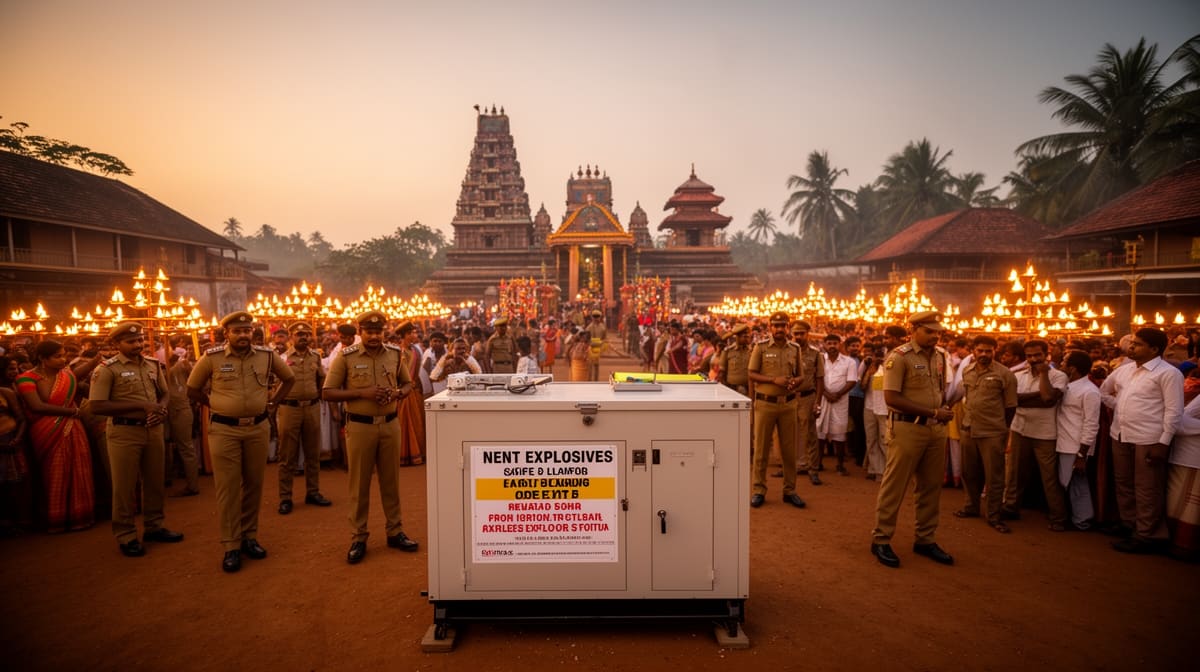
The Kerala High Court has clarified a critical regulatory ambiguity in fireworks safety protocols, affirming that temporary religious events need not rely on permanent explosive storage facilities. This judgment resolves longstanding confusion among event organizers and district authorities, reinforcing that proportionality and practicality must guide enforcement of safety norms.
Background & Facts
The Dispute
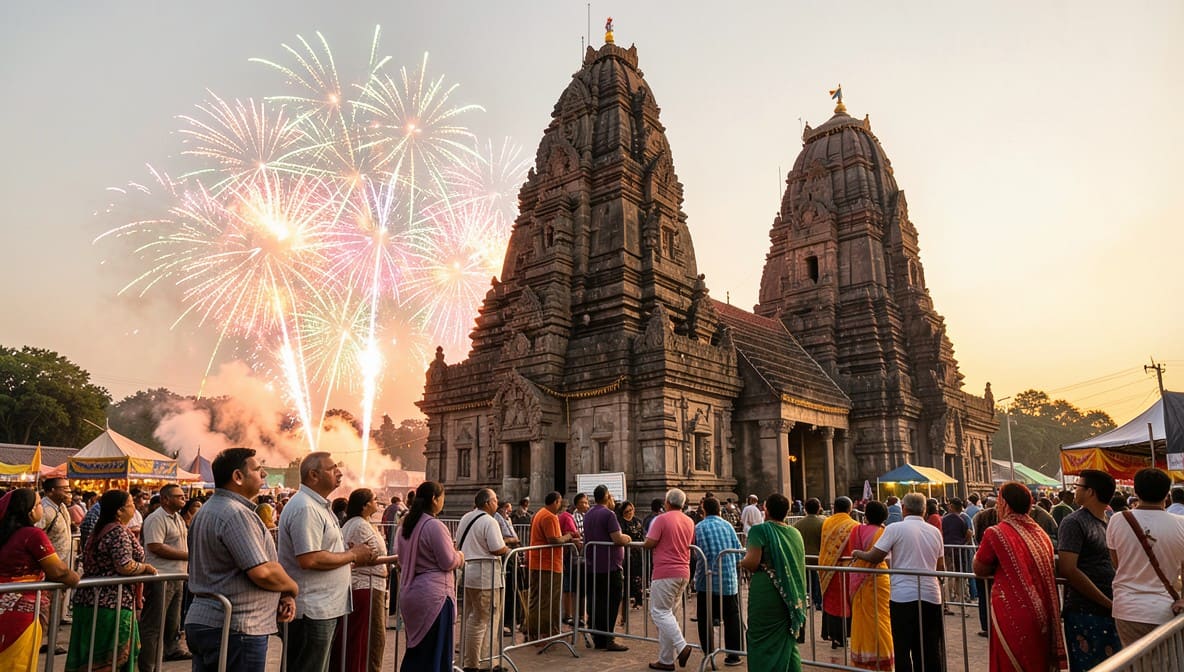
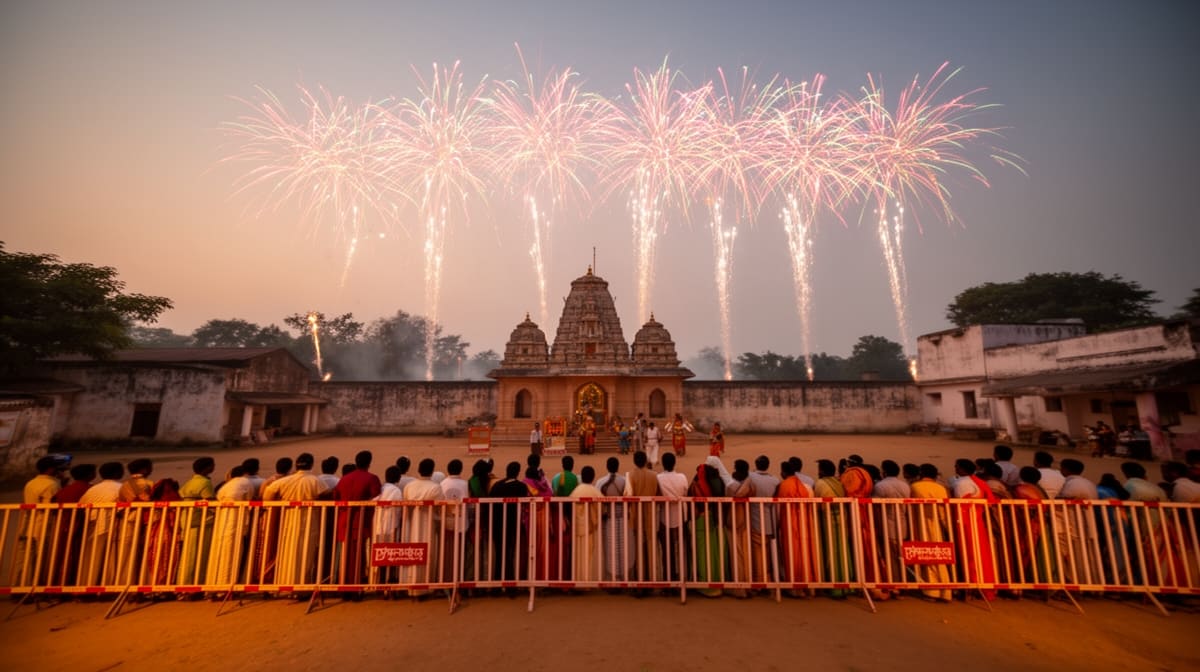
The petitioner, Raveendran C., sought permission to conduct a fireworks display during the annual festival of the Sri Elavuthukkal Bhagavathy Temple in Palakkad. The application was rejected by the District Collector under Ext.P8 on two grounds: absence of a permanent magazine for storing explosives, and failure to submit samples for chemical testing. The petitioner, holding valid licenses as a fireworks display operator and assistant, had submitted comprehensive safety documentation including an onsite emergency plan, site plan, insurance policy, and prior judicial precedents supporting the use of portable magazines.
Procedural History
- 16 February 2026: District Collector issued Ext.P8 denying permission citing non-compliance with permanent magazine requirement.
- 17 February 2026: Writ petition filed before the Kerala High Court challenging Ext.P8 as arbitrary and contrary to established judicial precedent.
- Same day: Court heard arguments and delivered judgment, allowing the petition with specific conditions.
Relief Sought
The petitioner sought quashing of Ext.P8 and immediate grant of permission for the fireworks display scheduled for 20 February 2026, subject to compliance with safety norms. He also sought recognition of portable magazines as legally sufficient for temporary events.
The Legal Issue
The central question was whether Section 10 of the Explosives Rules, 2008 mandates a permanent magazine for temporary fireworks displays during religious festivals, or whether a portable magazine satisfies regulatory requirements when the storage duration is limited and controlled.
Arguments Presented
For the Petitioner
The petitioner’s counsel relied on multiple judgments from the same court - W.P(C) No.5261/2020, WPC No.2012/2026, and WPC No.22997/2024 - which had uniformly held that permanent magazines are not required for short-term, festival-based fireworks. They emphasized that PESO guidelines permit portable storage units for temporary events, provided safety distances and handling protocols are followed. The petitioner also cited his valid licenses and compliance with all other safety conditions as proof of due diligence.
For the Respondent
The State, through the Government Pleader, contended that Rule 10(1) of the Explosives Rules, 2008, requires storage in a "magazine" without specifying temporary or permanent, and that district authorities must err on the side of caution. They argued that the absence of a permanent structure posed a public safety risk, even if the event was religious and well-planned.
The Court's Analysis
The Court examined the text and intent of the Explosives Rules, 2008, and found that the term "magazine" is not inherently synonymous with "permanent structure." It noted that PESO’s operational guidelines explicitly recognize portable magazines for temporary displays, particularly in rural and temple-based festivals where permanent infrastructure is impractical. The Court reviewed its own prior judgments and held that the District Collector’s reliance on a permanent magazine as a mandatory condition was legally unsustainable.
"The requirement of a permanent magazine has been obliterated by this Court in various judgments, holding that a portable magazine would suffice for events like the present one, which requires storage only for a temporary purpose."
The Court further observed that the petitioner had submitted all other required documents - including an emergency plan, insurance, and site plan - and that the second ground (chemical testing) was procedural and easily remediable. The Court emphasized that regulatory compliance must be balanced with cultural rights and practical feasibility, especially when public safety is not compromised.
The Verdict
The petitioner won. The Court held that a portable magazine is legally sufficient for temporary fireworks displays during religious festivals, and that denial of permission on the basis of a permanent magazine requirement is arbitrary. Permission was granted subject to submission of explosive samples for testing and a cap of 15 kg of explosives.
What This Means For Similar Cases
Portable Magazines Are Legally Valid
- Practitioners representing temple committees or event organizers can now cite this judgment to challenge denials based on permanent magazine requirements.
- District authorities must accept PESO-approved portable storage units if accompanied by safety plans and licensed operators.
Procedural Conditions Must Be Reasonable and Remediable
- Authorities cannot use technicalities like chemical testing as absolute barriers; they must provide clear timelines and pathways for compliance.
- Courts will intervene if conditions are imposed without feasibility or due process.
Cultural Events Are Not Exempt from Safety, But Must Be Reasonably Accommodated
-
Religious festivals are not exempt from explosives regulation, but the law must adapt to context.
-
Authorities must distinguish between high-risk commercial displays and low-volume, community-based religious events.
-
Actionable Takeaway: Always submit Form LE-1 and LE-11A licenses, emergency plans, and insurance. If denied on magazine grounds, immediately cite this judgment and PESO guidelines on portable storage.
-
Pro Tip: Request written clarification from PESO on acceptable portable magazine models before filing applications to preempt objections.