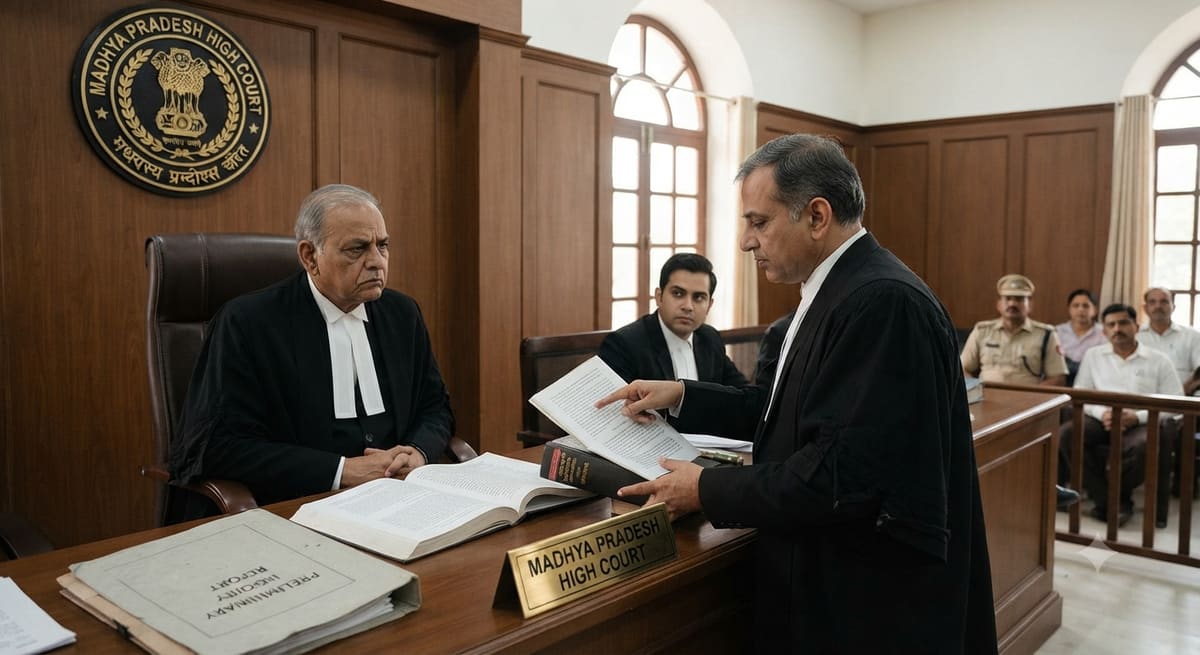
The Madhya Pradesh High Court has reaffirmed the legal framework governing FIR registration, dismissing writ petitions that sought to quash a police compliance report and compel FIR registration. The Court held that when a preliminary inquiry does not disclose a cognizable offence, the police are justified in refusing to register an FIR, in strict adherence to the principles laid down in Lalita Kumari v. Govt. of U.P. This judgment underscores the limited scope of judicial review in matters of police investigation and the statutory remedies available to aggrieved complainants.
Background & Facts
The Dispute
The petitioners, residents of District Jhabua, Madhya Pradesh, alleged a violent attack by an unlawful assembly of 50-60 individuals led by Sarpanch Deep Singh and others on 14.03.2025. The incident occurred during the "Gal Festival" in village Naganwat, where the petitioners claimed their sons were abused and threatened. Later that evening, the accused persons allegedly launched a pre-meditated attack on the petitioners' residences, armed with deadly weapons including lathis, taamis, teer-kamaans, kulhaadis, and firearms. During the attack, Dinesh (son of Petitioner No.1) was targeted, and one Rama S/o Pappu Gundiya sustained a bullet injury, succumbing to it later.
Key Facts
Incident Date: 14.03.2025, during the "Gal Festival" in village Naganwat
Accused Persons: Sarpanch Deep Singh, Rakesh, Diwas, Pappu, Dula, and their associates
Weapons Used: Lathis, taamis, teer-kamaans, kulhaadis, and firearms
Casualty: Rama S/o Pappu Gundiya died due to a bullet injury
Property Damage: Looting of household articles, ornaments, cash, domestic animals; destruction of two pick-up vehicles (GJ05 BY 2601 and MP-45-LA-0804) and four motorcycles (MP-45-MT-9521, MP-45-GD-6492, MP-45-MM-5436, and MP-45-MG-7522); vandalism including removal of roof sheets and arson on 29.04.2025
Police Response: Petitioners allege they were compelled to vacate their residences, detained at Police Station Meghnagar for two hours, shifted to Police Station Kakanwani, and falsely implicated in the murder of Rama
Procedural History
05.07.2025: Petitioners submitted written complaints to SDM and SP, Jhabua
21.07.2025: Complaints escalated to higher state authorities
16.07.2025: W.P. No. 25498/2025 filed; High Court directed preliminary enquiry and reasoned order within 60 days
10.09.2025: W.P. No. 30976/2025 filed due to non-compliance; strict compliance order issued
18.12.2025: Impugned compliance report submitted by police, concluding no cognizable offence was made out
28.03.2026: Contempt Petition No. 365/2026 filed during pendency of compliance report
09.07.2026: Present writ petitions (W.P. No. 8265/2026 and W.P. No. 8998/2026) reserved for orders
10.07.2026: Judgment delivered
The Parties' Positions
For the Petitioners:
Challenged the impugned compliance report dated 18.12.2025 as an "eyewash" and a colorable exercise of power
Contended that the police exceeded their jurisdiction by conducting a full-fledged trial and evaluating the defense of the accused
Asserted that refusal to register an FIR violates the binding dictum of Lalita Kumari v. Govt. of U.P., which mandates compulsory registration of an FIR when a cognizable offence is prima facie disclosed
Sought quashing of the compliance report, registration of an FIR, police protection, and initiation of preventive proceedings under Section 126 of the Bharatiya Nagarik Suraksha Sanhita, 2023 (BNSS)
For the Respondents/State:
Opposed the petition, contending that a preliminary inquiry was conducted in compliance with court directives
Found that no cognizable offence was made out against the accused persons named in the complaint
Justified the compliance report and decision not to register an FIR based on the preliminary inquiry findings
Relief Sought
The petitioners sought:
Quashing of the impugned compliance report dated 18.12.2025
A writ of mandamus directing the registration of an FIR against the accused persons
Adequate police protection
Direction to the Sub-Divisional Magistrate (SDM) to initiate preventive proceedings under Section 126 BNSS
The Legal Issue
The central question before the Court was whether the respondent police authorities violated the mandate of law by refusing to register an FIR, and whether the impugned compliance report dated 18.12.2025 warranted interference under Article 226 of the Constitution of India, in light of the principles established in Lalita Kumari v. Govt. of U.P.
Arguments Presented
For the Petitioners
Relied on Lalita Kumari v. Govt. of U.P. to argue that the registration of an FIR is mandatory under Section 154 of the Code of Criminal Procedure (CrPC) (or corresponding provision under BNSS) when a cognizable offence is disclosed
Contended that the police conducted a full-fledged trial instead of a preliminary inquiry, thereby exceeding their jurisdiction
Asserted that the compliance report was a colorable exercise of power to evade contempt proceedings
For the Respondents/State
Contended that the preliminary inquiry was conducted in strict compliance with the Court's earlier directives
Argued that the inquiry did not disclose a cognizable offence, justifying the refusal to register an FIR
Asserted that the police acted within the legal framework stipulated in Lalita Kumari, and their conclusions were based on the facts and circumstances of the case
The Court's Analysis
The Court delineated the scope of its jurisdiction under Article 226, emphasizing that it does not sit as an appellate authority over investigative findings or conduct a roving inquiry into disputed questions of fact. Judicial review is confined to examining whether statutory authorities have acted in accordance with the procedure established by law and binding precedents.
The Court relied extensively on the landmark judgment in Lalita Kumari v. Govt. of U.P., which crystallized the law regarding FIR registration and the scope of preliminary inquiries. Key principles from Lalita Kumari were reiterated:
"120.1. The registration of FIR is mandatory under Section 154 of the Code, if the information discloses commission of a cognizable offence and no preliminary inquiry is permissible in such a situation. 120.2. If the information received does not disclose a cognizable offence but indicates the necessity for an inquiry, a preliminary inquiry may be conducted only to ascertain whether cognizable offence is disclosed or not. 120.3. If the inquiry discloses the commission of a cognizable offence, the FIR must be registered. In cases where preliminary inquiry ends in closing the complaint, a copy of the entry of such closure must be supplied to the first informant forthwith and not later than one week. It must disclose reasons in brief for closing the complaint and not proceeding further."
The Court observed that the respondent police authorities conducted a preliminary inquiry pursuant to the Court's directions in W.P. No. 25498/2025 and W.P. No. 30976/2025. The inquiry was conducted to ascertain whether a cognizable offence was disclosed, particularly in the backdrop of a pre-existing murder investigation where the petitioners themselves were implicated.
The impugned compliance report dated 18.12.2025 concluded that no cognizable offence was made out against the accused persons based on the petitioners' complaint. The Court held that the mandate of compulsory registration of an FIR under Section 154 CrPC (or corresponding provision under BNSS) is triggered only when the information or preliminary inquiry unequivocally discloses the commission of a cognizable offence. Since the preliminary inquiry yielded a negative result, the police were legally justified in closing the complaint and submitting the compliance report.
The Court rejected the petitioners' contention that the police conducted a "full-fledged trial," holding that such a subjective assertion could not be conclusively adjudicated in writ proceedings without leading evidence. The police acted in conformity with the procedural safeguards and legal framework stipulated in Lalita Kumari.
The Verdict
The Court dismissed the writ petitions (W.P. No. 8265/2026 and W.P. No. 8998/2026), holding that:
The impugned compliance report dated 18.12.2025 did not suffer from any illegality, arbitrariness, or jurisdictional error
The respondents complied with the Court's earlier orders by conducting a preliminary inquiry and recording their conclusions
No writ of mandamus could be issued to compel the registration of an FIR when the preliminary inquiry did not disclose a cognizable offence
The petitioners were not remediless and could invoke alternative statutory remedies by filing a private complaint before the competent jurisdictional Magistrate under the relevant provisions of the BNSS
There was no order as to costs, and pending interlocutory applications, if any, stood disposed of accordingly.
What This Means For Similar Cases
Scope of Preliminary Inquiry Under Lalita Kumari
The judgment reaffirms that a preliminary inquiry is permissible under Lalita Kumari when the information received does not prima facie disclose a cognizable offence
The inquiry must be time-bound, generally not exceeding 15 days, and in exceptional cases, six weeks, with reasons for delay recorded in the General Diary
Practitioners must ensure that the purpose of the inquiry is strictly limited to ascertaining whether a cognizable offence is disclosed, and not to verify the veracity of the allegations
Judicial Review of Police Investigations
The High Court, under Article 226, does not conduct a roving inquiry into disputed questions of fact or sit as an appellate authority over investigative findings
Judicial review is confined to examining whether the police acted in accordance with procedure established by law and binding precedents
Courts will not interfere with the conclusions of a preliminary inquiry unless there is patent illegality, arbitrariness, or jurisdictional error
Remedies for Aggrieved Complainants
If a preliminary inquiry concludes that no cognizable offence is made out, the complainant is not remediless
The complainant may file a private complaint before the jurisdictional Magistrate under the relevant provisions of the BNSS
The complainant can lead evidence to substantiate their claims, and the Magistrate will independently evaluate the merits of the complaint
This judgment underscores the importance of alternative statutory remedies when the police refuse to register an FIR based on a preliminary inquiry