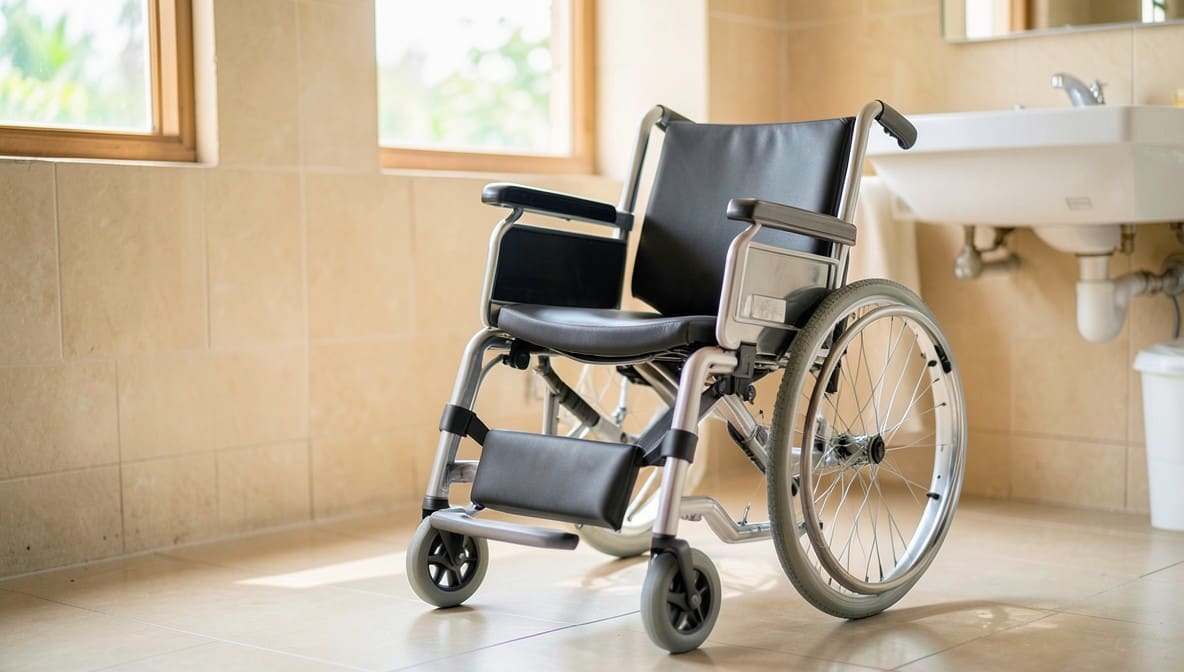
The Customs, Excise and Service Tax Appellate Tribunal, Chennai Regional Bench, has clarified that mobility aids designed for disabled persons retain their classification as wheelchairs under CTH 8713 even when equipped with additional toileting features, provided the essential character remains mobility. This ruling reinforces the principle that ancillary functionalities do not override the primary purpose of goods under customs tariff interpretation.
Background & Facts
The Dispute
The respondent, M/s. Karma Health Care Ltd., imported goods described as "wheel chair for use by physically disabled/handicapped persons (for toileting) with spare parts" and classified them under CTH 87139090, claiming exemption under Notification No. 12/2012-Cus. The Department of Customs initiated audit proceedings, contending that the goods were in fact commode chairs with wheels and should be classified under CTH 9402, thereby disqualifying them from the exemption.
Key Facts
- The imported goods are mobility aids designed for physically disabled persons
- The product includes a built-in toileting facility for convenience
- The product is equipped with wheels, adjustable backrest, and armrests
- Product catalogues and marketing materials describe it as a wheelchair with added toileting functionality
- The adjudicating authority assessed a duty demand of Rs. 1,74,639/- on the ground that the goods were classifiable under CTH 9402
- The Commissioner of Customs (Appeals-II) set aside the demand on 30.08.2015, holding that the essential character of the goods was mobility
- The Revenue filed the present appeal challenging this order
Procedural History
- Date of Import: Not specified in judgment, but proceedings initiated post-audit
- Date of Assessment Order: Not specified, but confirmed by adjudicating authority prior to appeal
- 30.08.2015: Commissioner of Customs (Appeals-II) passed Order-in-Appeal No. 710/2015 allowing exemption
- Date of Appeal Filing: Not specified, but appeal filed by Revenue thereafter
- 09.01.2026: Final hearing before CESTAT Chennai
- 10.04.2026: Final Order No. 40482/2026 issued by CESTAT
The Parties' Positions
For the Appellant (Revenue)
- Argued that the primary function of the goods is toileting, not mobility
- Contended that the presence of wheels is incidental and does not alter the essential character
- Relied on internet descriptions and product catalogues to assert the goods are commode chairs
- Asserted that CTH 9402 applies to medical furniture including specialized chairs with functional features
- Claimed that exemption under Notification 12/2012-Cus. should be restricted to pure wheelchairs without additional medical functionalities
For the Respondent (M/s. Karma Health Care Ltd.)
- Maintained that the product is fundamentally a wheelchair designed for mobility of disabled persons
- Argued that the toileting facility is an ancillary feature for convenience, not a primary function
- Cited the product’s design, wheel configuration, and intended use as evidence of its essential character
- Emphasized that the exemption notification does not exclude products with additional features
- Relied on the Commissioner (Appeals)’s finding that the goods resemble and function as wheelchairs
Relief Sought
The Revenue sought to set aside the Commissioner (Appeals)’s order dated 30.08.2015, restore the original demand of Rs. 1,74,639/-, and deny exemption under Notification No. 12/2012-Cus. The respondent, though not represented at final hearing, sought confirmation of the exemption and classification under CTH 87139090.
The Legal Issue
The central question was whether goods described as wheelchairs with an integrated toileting facility should be classified under CTH 87139090 as wheelchairs or under CTH 9402 as medical furniture, and whether such goods remain eligible for exemption under Notification No. 12/2012-Cus. despite the presence of additional features.
Arguments Presented
For the Appellant
The Revenue relied on the principle that classification must reflect the principal function of the goods. It argued that the toileting function was dominant, citing product descriptions and internet sources. It contended that CTH 9402 covers specialized medical chairs, and that the addition of wheels does not transform a commode chair into a wheelchair. It further asserted that exemption notifications must be interpreted narrowly and that extending the benefit to multifunctional devices would defeat the intent of the notification.
For the Respondent
The respondent’s position, as reflected in the Commissioner (Appeals)’s order, was that the essential character of the goods is mobility. It emphasized that the product is designed for physically disabled persons who require both mobility and toileting assistance, and that the toileting feature is an auxiliary convenience. It argued that the exemption notification does not contain any exclusion for products with additional features, and that classification must follow the essential character under Rule 3(b) of the General Rules for Interpretation.
The Court's Analysis
The Tribunal undertook a detailed analysis of the General Rules for Interpretation of the Customs Tariff, particularly Rules 1 and 3(b), which mandate classification based on the terms of the headings and the essential character of composite goods. It examined the HSN Explanatory Notes to Heading 8713, which explicitly include carriages for disabled persons, including wheelchairs, and clarify that additional features do not alter classification if the essential function remains mobility.
"The impugned goods, being mobility aids designed for physically disabled persons, are appropriately classifiable within this functional category."
The Tribunal rejected the Revenue’s reliance on internet descriptions, noting that intrinsic functional attributes must prevail over external marketing materials. It distinguished Heading 9402, which covers medical furniture with features like reclining, rotating, or elevating mechanisms designed for medical procedures - none of which were present in the impugned goods.
The Tribunal affirmed that the toileting facility is an ancillary convenience for severely disabled users and does not transform the product’s essential character. It cited the Supreme Court decisions in CCE vs Wood Craft Products Ltd. and CCE vs Acer India Ltd., which hold that classification must be based on essential character and principal function, and Collector of Central Excise vs Connaught Plaza Restaurant Pvt Ltd., which emphasizes common parlance understanding.
"The toileting facility, in the present case, is only an added convenience for severely disabled persons and does not change the essential nature of the product."
On the issue of exemption, the Tribunal held that Notification No. 12/2012-Cus. grants exemption to "wheelchairs and other carriages for disabled persons" without any restrictive conditions. It emphasized that exemption notifications, while to be interpreted strictly as to eligibility, cannot be narrowed by importing conditions not expressly stated. The Court concluded that once goods are correctly classified under CTH 8713, exemption follows as a matter of course.
The Verdict
The appeal filed by the Revenue was dismissed. The Tribunal upheld the Order-in-Appeal dated 30.08.2015, confirming that the impugned goods are classifiable under CTH 87139090 as wheelchairs and are eligible for exemption under Notification No. 12/2012-Cus. The demand of Rs. 1,74,639/- was set aside. The relief granted to the respondent stands confirmed.
What This Means For Similar Cases
Classification Turns on Essential Character, Not Ancillary Features
- Practitioners must assess the primary function of multifunctional goods, not secondary conveniences
- Products designed for mobility of disabled persons remain classifiable under CTH 8713 even with added medical or comfort features
- Marketing descriptions or internet sources cannot override intrinsic design and functional attributes
Exemption Notifications Must Be Interpreted Broadly Within Their Terms
- Exemptions under customs notifications cannot be denied by reading in restrictions not explicitly stated
- If goods fall squarely within the description of the exemption (e.g., "wheelchairs for disabled persons"), ancillary features do not disqualify them
- Revenue authorities must not impose de facto conditions beyond the literal language of the notification
Trade Understanding and Common Parlance Are Critical
- Classification must align with how goods are understood in trade and commerce
- Products marketed and used as wheelchairs by disabled persons should not be reclassified as furniture merely because they include additional utilities
- Tribunals will prioritize functional design over semantic or commercial labeling