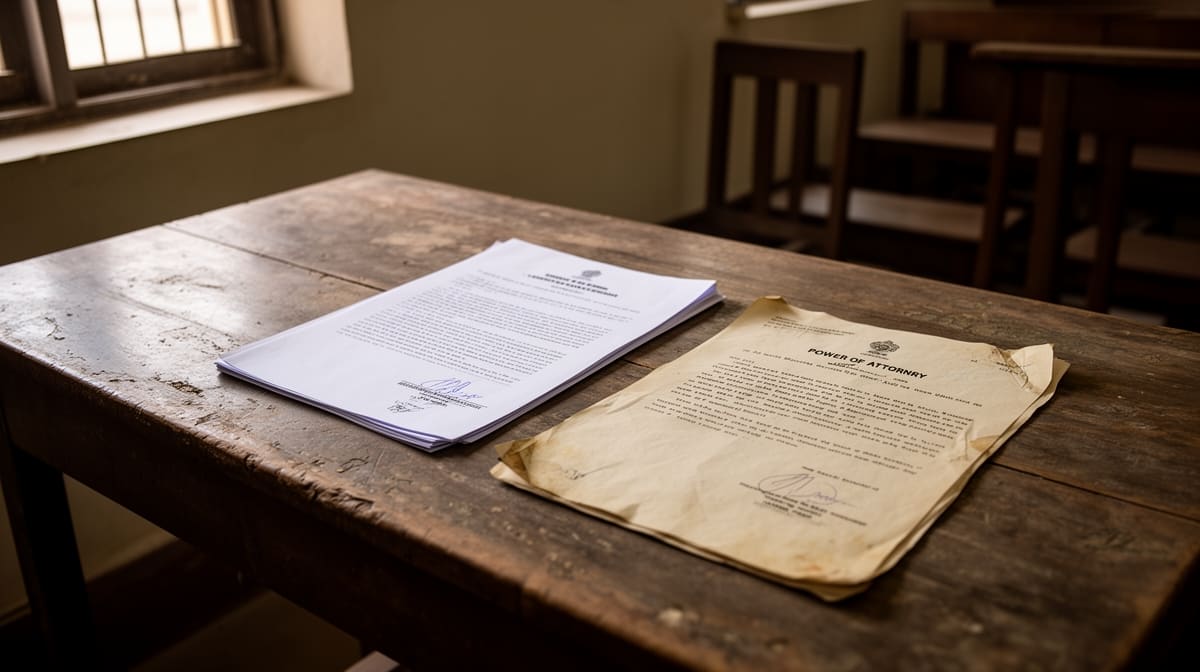
The Karnataka High Court has delivered a significant judgment reinforcing the doctrine of clean hands in litigation, dismissing writ appeals after finding that petitioners suppressed material facts and fraudulently tampered with court records to claim ownership of Railway property. The Court held that suppressio veri, expressio falsi - suppression of truth is equivalent to expression of falsehood - renders litigants ineligible for equitable relief, setting a strict precedent for procedural integrity in property disputes.
Background & Facts
The Dispute
The dispute centers on property bearing CTS No.1047 in Bengaluru, which has been in the possession of the South Western Railway since the British era. The respondents, Sri S. Vazeer Ahmed and Sri Amritlal P. Jain, claimed ownership of the property, alleging it was part of survey No.2 of Bilekalli Village. The Railway Department contested this claim, asserting that the property was acquired in 1880 for railway purposes and has remained under its possession without dispute until recent litigation.
Key Facts
- 1880: British Government acquired over 600 acres of land for railway purposes, including CTS No.1047.
- 1900: Compensation paid to landowners by the Maharaja of Mysore.
- 1948: Entire land handed over to Indian Railways via Gazette notification (Mysore Act No.LVII of 1948).
- 1994: Respondent No.1 (S. Vazeer Ahmed) filed OS No.10987 of 1994 seeking permanent injunction against Railways. The trial Court initially granted ex-parte injunction but later, on 18.09.1997, vacated it and held Railways as the lawful owner. The suit was dismissed for non-prosecution on 30.10.2002.
- 2002: Respondent No.1 executed an agreement of sale with Respondent No.2 (Amritlal P. Jain) for survey No.2 of Bilekalli Village.
- 2006: Respondent No.2 filed OS No.2977 of 2006 for specific performance of the 2002 agreement. The defendants were placed ex-parte, and the suit was decreed on 21.07.2007 for repayment of ₹3.00 crore with 6% interest.
- 2008: Respondent No.1, through a General Power of Attorney (GPA) holder (Mangilal Jain), filed Miscellaneous Petition No.924 of 2008 to set aside the ex-parte decree. The petition was allowed on 22.08.2009, restoring the suit.
- 2010: After restoration, the trial Court decreed the suit for specific performance on 25.10.2010, directing Respondent No.1 to execute the sale deed within three months.
- 2013: Respondent No.2 filed Execution Petition No.432 of 2013 to enforce the decree. The schedule of property in the execution petition was fraudulently altered to include the words "and part of CTS No.1047", which was not part of the original decree.
- 24.04.2014: The bailiff delivered possession of the property to Respondent No.2 based on the tampered execution petition. Respondent No.2 acknowledged receipt of possession in the mahazar (spot report).
- 2015: Respondents filed Writ Petition No.15283 of 2015 challenging the order of the Joint Director of Land Records, which had dismissed their claim to CTS No.1047.
Procedural History
- 1994-1997: OS No.10987 of 1994 filed by Respondent No.1; interim injunction vacated; suit dismissed for non-prosecution.
- 2006-2010: OS No.2977 of 2006 filed by Respondent No.2; ex-parte decree passed; later set aside and suit decreed for specific performance.
- 2013-2014: Execution Petition No.432 of 2013 filed; schedule tampered to include CTS No.1047; possession delivered to Respondent No.2.
- 13.03.2009: Joint Director of Land Records dismissed revision petition filed by Respondent No.1.
- 15.03.2011: High Court remanded the matter to Joint Director of Land Records for fresh enquiry.
- 23.02.2015: Joint Director of Land Records set aside the Enquiry Officer’s order, holding Railways as the owner of CTS No.1047.
- 25.04.2025: Learned Single Judge allowed Writ Petition No.15283 of 2015, which is impugned in these appeals.
Relief Sought
The appellants (State and Railway authorities) sought:
- Setting aside the order dated 25.04.2025 passed by the learned Single Judge in Writ Petition No.15283 of 2015.
- Dismissal of the writ petition on grounds of suppression of material facts and fraud on court.
- Costs to be borne by the respondents.
The Legal Issue
The central question was whether litigants who suppress material facts, tamper with court records, and mislead judicial authorities are entitled to equitable relief, particularly when the disputed property is under the lawful possession of a government entity (Railways) since the British era.
Arguments Presented
For the Appellants
- Fraud on Court: The respondents fraudulently altered the execution petition schedule to include "and part of CTS No.1047", which was not part of the original decree in OS No.2977 of 2006. This tampering was malafide and aimed at misleading the court.
- Suppression of Facts: The respondents suppressed critical facts