The Bombay High Court has reaffirmed that equitable remedies such as temporary injunctions cannot be granted where the applicant has suppressed material facts, particularly pending litigation that directly undermines their claim to title. This judgment underscores the non-negotiable requirement of candour in seeking equitable relief and sets a clear precedent for courts evaluating interim relief in property disputes.
Background & Facts
The Dispute
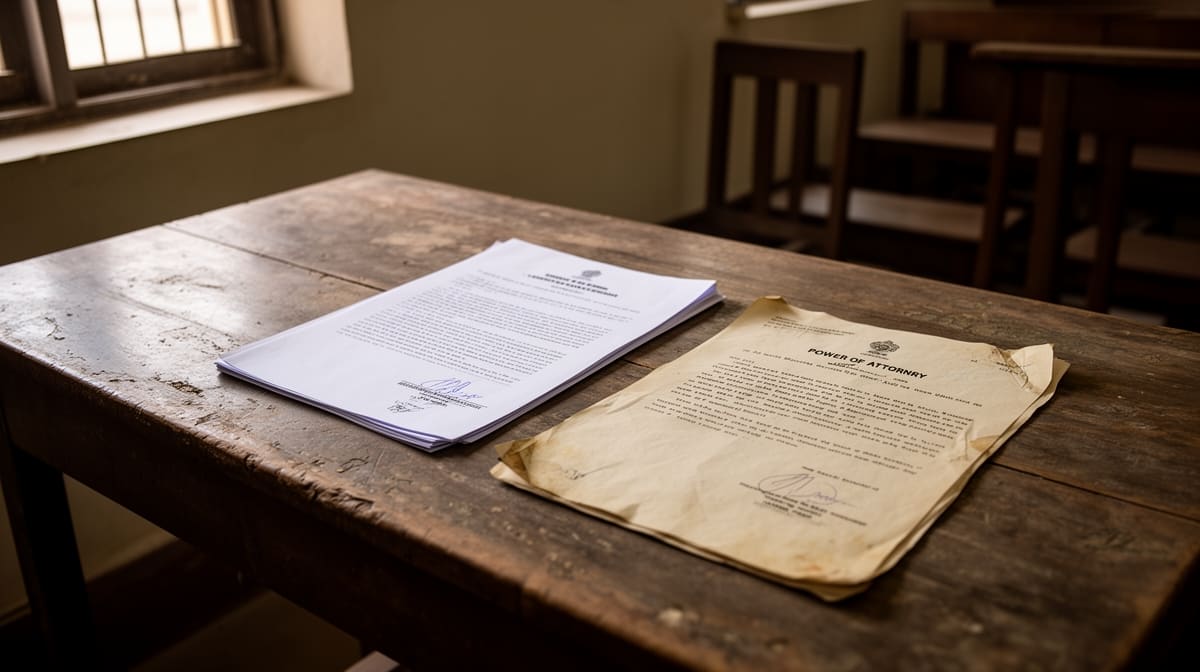
The petitioner, Mehboob Abdul Gafar Shaikh, claimed ownership of 48 R land in Pune through a registered Sale Deed dated 5 October 2010, executed by Shaikh Umar Latif Inamdar under an irrevocable Power of Attorney granted by Balu Talekar, the original owner. The respondents, M/s Raviraj Lunkad Infracon India LLP and associated entities, contested this claim, asserting prior title through registered Sale Deeds executed by Balu Talekar in favour of M/s Ashray Premises Private Limited, dating back to 2007 and 2008.
Procedural History
- 2002: Balu Talekar executed an irrevocable Power of Attorney in favour of Shaikh Umar Latif Inamdar.
- 2006: Balu Talekar entered into a Consent Decree with decree holders (Ramdas Khandve and Vikas Bhukan) in RCS No. 1696 of 2006, agreeing to execute Sale Deeds for portions of the larger property.
- 2008: Balu Talekar executed a Sale Deed for 70 R of the larger property in favour of M/s Ashray Premises, with decree holders as consenting parties.
- 2010: Petitioner obtained a registered Sale Deed for 48 R land from the Power of Attorney holder.
- 2014: Balu Talekar filed SCS No. 25 of 2014 seeking declaration that the 2010 Sale Deed was void.
- 2025: Petitioner filed suit for declaration of title and temporary injunction; trial court granted injunction on 24 March 2025.
- 2025: District Judge allowed appeal, set aside injunction, holding suppression of SCS No. 25 of 2014 and prior objections vitiated equitable claim.
- 2026: Petitioner filed Writ Petition under Article 227 challenging the District Judge’s order.
Relief Sought
The petitioner sought restoration of the temporary injunction granted by the trial court, arguing that the appellate court exceeded its jurisdiction by substituting its own view and misapprehending the nature of the Power of Attorney. The respondents contended that the petitioner had no clean hands and had concealed material facts, rendering him ineligible for equitable relief.
The Legal Issue
The central question was whether a party seeking a temporary injunction can be denied equitable relief under the doctrine of clean hands when they suppress the pendency of a prior suit challenging their title and fail to disclose prior objections raised by the opposing party.
Arguments Presented
For the Petitioner
The petitioner relied on Wander Ltd. v. Antox India P. Ltd. and Ramakant Ambalal Choksi v. Harish Ambalal Choksi to argue that appellate courts cannot interfere with discretionary orders granting injunctions unless the trial court’s decision is perverse or arbitrary. He contended that the trial court correctly appreciated the prima facie title based on the registered Sale Deed and mutation entry, and that the District Judge erred by reappreciating evidence. He further argued that the Power of Attorney, though not explicitly coupled with interest, was irrevocable by its terms and supported by consideration.
For the Respondent
The respondents relied on Seema Arshad Zaheer v. Municipal Corporation of Greater Mumbai and Rajendra Diwan v. Pradeep Kumar Ranibala to argue that suppression of SCS No. 25 of 2014 and the 2009 public notice objections constituted a deliberate concealment of material facts. They submitted that the Power of Attorney did not create any interest in the agent, and that the Sale Deed of 2008, executed pursuant to a consent decree, effectively divested Balu Talekar of title before the 2010 transaction. They emphasized that equitable relief cannot be granted to a party who enters into a transaction with full knowledge of adverse claims.
The Court's Analysis
The Court undertook a rigorous analysis of the doctrine of clean hands and the limits of supervisory jurisdiction under Article 227. It held that the trial court’s failure to consider the pendency of SCS No. 25 of 2014 and the prior objections raised in 2009 was not a mere oversight but a critical omission affecting the foundation of equitable relief.
"When such objection was raised, the Plaintiff can be said to have entered into the transaction at his own peril."
The Court emphasized that the Power of Attorney, despite being labelled "irrevocable," did not create any interest in the agent as required under Section 202 of the Indian Contract Act, 1872. The absence of any mention of delivery of possession or creation of interest rendered the agency revocable. The Court further noted that the Sale Deed of 2008, executed pursuant to a consent decree, was a legally valid instrument that prima facie extinguished Balu Talekar’s title.
The Court distinguished between appellate review and supervisory jurisdiction, holding that while the District Judge’s order was appealable, the High Court’s writ jurisdiction was invoked to correct a manifest failure to apply equitable principles. The suppression of SCS No. 25 of 2014 was not a technical irregularity but a fundamental breach of the duty of full disclosure, which is indispensable for equitable remedies.
The Court also rejected the petitioner’s reliance on mutation entry as conclusive proof of title, noting that mutation is merely an administrative record and does not confer ownership.
The Verdict
The petitioner’s writ petition was dismissed. The Court held that equitable relief cannot be granted to a party who suppresses material facts, particularly pending litigation challenging their title. The District Judge’s order setting aside the temporary injunction was upheld as legally sound and consistent with the doctrine of clean hands.
What This Means For Similar Cases
Suppression of Prior Litigation Defeats Injunction
- Practitioners must disclose all pending suits or proceedings affecting the title of the property sought to be protected by injunction.
- Failure to disclose such litigation, even if deemed "unrelated," will be treated as suppression and may result in denial of interim relief.
- Courts will not tolerate strategic silence when adverse claims are known.
Power of Attorney Alone Does Not Confer Title
- A Power of Attorney, even if labelled "irrevocable," does not create title unless coupled with an interest under Section 202 of the Contract Act.
- Merely relying on a registered Power of Attorney to transfer property is legally insufficient without proof of delivery of possession or creation of interest.
- Practitioners must advise clients to obtain registered conveyances, not POAs, for transfer of immovable property.
Mutation Entry Is Not Conclusive Proof of Ownership
- Mutation entries are administrative records and cannot substitute for title documents.
- Courts will look beyond mutation to examine the chain of title, especially where competing claims exist.
- In property disputes, the burden remains on the claimant to establish a prima facie title through registered instruments.