Supreme Court of India judgments

498 Supreme Court of India judgments explained in plain English: what was decided, the law applied and why it matters. Page 9 of 21.

MMDR Act & Constitutional Validity | SC Upholds Inclusion of DMF & NMET in Mineral Royalty Calculation : SC
Case Law Analysis
|Supreme Court of India

MMDR Act & Constitutional Validity | SC Upholds Inclusion of DMF & NMET in Mineral Royalty Calculation : SC

Supreme Court affirms legislative discretion in fiscal levies, ruling that royalty, District Mineral Foundation (DMF), and National Mineral Exploration Trust (NMET) contributions can be included in the 'sale value' for mineral royalty calculation under the MMDR Act. The judgment reinforces anti-evasion measures and validates subordinate legislation, impacting mining operators and state revenue frameworks.


Article 14 Arbitrariness | Refusal to Refund Unutilized FSI Premium Violates Constitutional Guarantee : SC
Case Law Analysis
|Supreme Court of India

Article 14 Arbitrariness | Refusal to Refund Unutilized FSI Premium Violates Constitutional Guarantee : SC

Supreme Court rules that denying refund of premium paid for unutilized Floor Space Index (FSI) is arbitrary and violates Article 14, directing refund of ₹27.41 lakh with 7% interest after deducting 10% administrative charges. The judgment reinforces that state actions under Development Control Regulations must align with constitutional guarantees of equality and non-arbitrariness, impacting property developers and urban planning authorities.

Natural Justice in Ex Parte Proceedings | Foreigners Tribunals Must Disclose Grounds & Provide Reasoned Orders Under Foreigners Act : SC
Case Law Analysis
|Supreme Court of India

Natural Justice in Ex Parte Proceedings | Foreigners Tribunals Must Disclose Grounds & Provide Reasoned Orders Under Foreigners Act : SC

Supreme Court sets aside ex parte orders of Foreigners Tribunals in Assam, ruling that declarations of foreigner status must comply with principles of natural justice-including disclosure of material grounds and reasoned conclusions. The judgment reinforces that procedural fairness is mandatory even in quasi-judicial proceedings affecting citizenship rights under the Foreigners Act, 1946 and 1964 Order.

Judicial Stay on Recruitment | Madrasah Appointments Void Without Court Permission Under Article 32 : SC
Case Law Analysis
|Supreme Court of India

Judicial Stay on Recruitment | Madrasah Appointments Void Without Court Permission Under Article 32 : SC

Supreme Court dismisses 49 writ petitions, ruling that appointments in West Bengal madrasahs made during a judicial stay are invalid unless expressly permitted by the Court. The judgment reinforces that recruitment notifications must be strictly followed, and any deviation violates constitutional safeguards under the Madrasah Service Commission Act.

Split Trials & Defective Investigation Do Not Vitiate Conviction If No Prejudice Caused : SC Acquits Husband After 25-Year Dowry Death Trial
Case Law Analysis
|Supreme Court of India

Split Trials & Defective Investigation Do Not Vitiate Conviction If No Prejudice Caused : SC Acquits Husband After 25-Year Dowry Death Trial

The Supreme Court ruled that procedural lapses like split trials and defective investigation do not automatically vitiate a conviction if no prejudice is caused to the accused. The judgment underscores the prosecution's burden to prove guilt beyond reasonable doubt and mandates equal judicial scrutiny of defense evidence, setting a precedent for fair trial standards in dowry death cases.

MMDR Act Section 15(3) | Statutory Royalty Revision Power Overrides Contractual Silence in Mining Leases : SC
Case Law Analysis
|Supreme Court of India

MMDR Act Section 15(3) | Statutory Royalty Revision Power Overrides Contractual Silence in Mining Leases : SC

The Supreme Court ruled that the State's power under Section 15(3) of the MMDR Act to revise royalty and dead rent prevails over mining lease deeds silent on revision. The 50% enhancement was upheld as non-arbitrary, and Chief Minister's approval satisfied Rules of Business compliance, setting a precedent for statutory authority over contractual terms.

Section 9(2) Presidency Towns Insolvency Act | Recovery Certificate Not a 'Decree or Order' for Insolvency Notice : SC
Case Law Analysis
|Supreme Court of India

Section 9(2) Presidency Towns Insolvency Act | Recovery Certificate Not a 'Decree or Order' for Insolvency Notice : SC

The Supreme Court ruled that a recovery certificate issued by the Debt Recovery Tribunal under the RDB Act does not qualify as a 'decree or order' under Section 9(2) of the Presidency Towns Insolvency Act, 1909. This strict interpretation bars creditors from initiating insolvency proceedings based solely on recovery certificates, reinforcing the need for a formal decree or order for insolvency notices.

Sections 25-1B(a) & 26 Arms Act | 'Conscious Possession' Requires Proof of Dominion & Knowledge: SC Acquits for Mere Recovery
Case Law Analysis
|Supreme Court of India

Sections 25-1B(a) & 26 Arms Act | 'Conscious Possession' Requires Proof of Dominion & Knowledge: SC Acquits for Mere Recovery

The Supreme Court reiterated that conviction under the Arms Act demands proof of 'conscious possession'-mere recovery of weapons without evidence of dominion or knowledge is insufficient. The ruling sets a critical precedent for extremist-related prosecutions, emphasizing the prosecution's burden to establish active control over seized arms.

Circumstantial Evidence Must Form Unbroken Chain for Murder Conviction : SC Acquits Under Section 302 IPC, Upholds Section 201 IPC for Body Disposal
Case Law Analysis
|Supreme Court of India

Circumstantial Evidence Must Form Unbroken Chain for Murder Conviction : SC Acquits Under Section 302 IPC, Upholds Section 201 IPC for Body Disposal

The Supreme Court reiterated that circumstantial evidence in murder cases must form a complete, unbroken chain pointing conclusively to guilt. While acquitting the accused under Section 302 IPC due to evidentiary gaps, the Court upheld their conviction under Section 201 IPC for destroying evidence, setting a critical precedent for criminal trials relying on indirect proof.

SEBI (Mutual Funds) Regulations | Absolute Compliance Mandatory Irrespective of Investor Gain : SC Upholds Penalties for Kotak AMC
Case Law Analysis
|Supreme Court of India

SEBI (Mutual Funds) Regulations | Absolute Compliance Mandatory Irrespective of Investor Gain : SC Upholds Penalties for Kotak AMC

The Supreme Court ruled that regulatory compliance under SEBI (Mutual Funds) Regulations, 1996 is non-negotiable, even if investors benefit from breaches. Penalties for Kotak Mahindra AMC and Trustee were upheld for lack of due diligence, unauthorized maturity extensions, and inadequate disclosures, reinforcing fiduciary duty over investor outcomes.

Section 5A Land Acquisition Act | Effective Opportunity of Hearing Mandatory, Not Mere Procedural Formality : SC
Case Law Analysis
|Supreme Court of India

Section 5A Land Acquisition Act | Effective Opportunity of Hearing Mandatory, Not Mere Procedural Formality : SC

The Supreme Court ruled that landowners cannot bypass Section 5A proceedings and later challenge acquisition on grounds of denied hearing. The opportunity of hearing must be substantive, not just ritualistic, and procedural compliance suffices only if objections lack merit. This reinforces natural justice principles in eminent domain cases, impacting landowners, government agencies, and administrative law practitioners.

Contractual Sanctity Upheld | Security Deposit Interest Payable Only on Delayed Refund Beyond Agreed Period : SC
Case Law Analysis
|Supreme Court of India

Contractual Sanctity Upheld | Security Deposit Interest Payable Only on Delayed Refund Beyond Agreed Period : SC

The Supreme Court ruled that security deposits under commercial contracts do not accrue interest unless refunded beyond the agreed period, reinforcing contractual sanctity while ensuring equitable relief for delayed refunds. This judgment clarifies the enforceability of explicit no-interest clauses in contracts, impacting contractors and government entities alike.

Retrospective Tax Exemption Withdrawal | No Penalty or Pre-Amendment Interest Under Karnataka Sales Tax Act : SC
Case Law Analysis
|Supreme Court of India

Retrospective Tax Exemption Withdrawal | No Penalty or Pre-Amendment Interest Under Karnataka Sales Tax Act : SC

Supreme Court rules that while retrospective withdrawal of tax exemptions is constitutionally valid, imposing penalties or interest for periods before the amendment violates fairness. The judgment protects dealers from retroactive financial burdens, setting a precedent for tax reassessment proceedings under the Karnataka Sales Tax Act.

Discretion in Promotion Assessments | CSIR Assessment Committee Not Bound by Mandatory Mark Averaging: SC
Case Law Analysis
|Supreme Court of India

Discretion in Promotion Assessments | CSIR Assessment Committee Not Bound by Mandatory Mark Averaging: SC

Supreme Court affirms that CSIR's Assessment Committee retains discretion to evaluate promotion suitability based on Work Reports and Performance Mapping Scores without rigid mark averaging. The ruling clarifies that administrative tribunals cannot impose mechanical scoring requirements on expert committees, reinforcing flexibility in service law assessments.

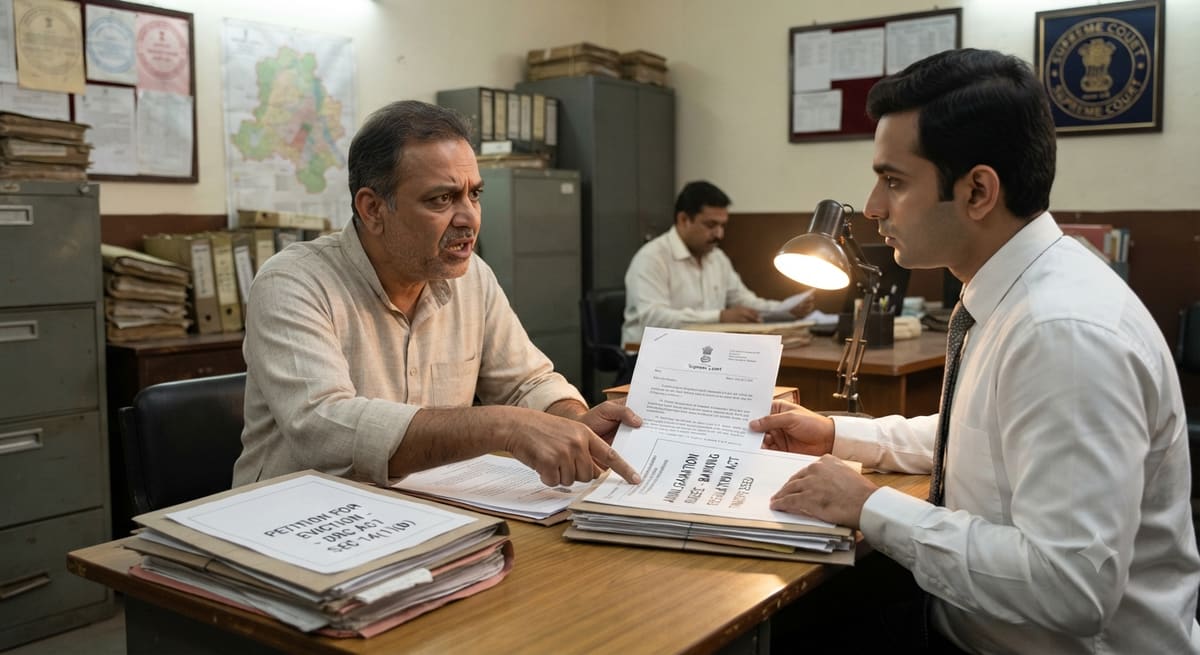
Section 14(1)(b) DRC Act | Amalgamation Under Banking Regulation Act Triggers Eviction Without Landlord Consent : SC
Case Law Analysis
|Supreme Court of India

Section 14(1)(b) DRC Act | Amalgamation Under Banking Regulation Act Triggers Eviction Without Landlord Consent : SC

The Supreme Court ruled that amalgamation of a tenant bank under Section 45(7) of the Banking Regulation Act, without the landlord's written consent, constitutes a ground for eviction under Section 14(1)(b) of the Delhi Rent Control Act. This holding applies regardless of the involuntary nature of the amalgamation, impacting tenancy rights and corporate restructuring in property disputes.

Commercial Courts Act | Strict Timelines for Document Production Non-Compliance Bars Piecemeal Evidence Submission : SC
Case Law Analysis
|Supreme Court of India

Commercial Courts Act | Strict Timelines for Document Production Non-Compliance Bars Piecemeal Evidence Submission : SC

The Supreme Court ruled that litigants cannot adopt a piecemeal approach to document production under the Commercial Courts Act, especially when documents were in their possession from the outset. Failure to adhere to prescribed timelines results in forfeiture of the right to submit additional evidence later, reinforcing procedural discipline in commercial disputes.

Section 48 Evidence Act | Strict Proof of Custom Mandatory; Agnatic Succession Prevails Over Concurrent Findings : SC
Case Law Analysis
|Supreme Court of India

Section 48 Evidence Act | Strict Proof of Custom Mandatory; Agnatic Succession Prevails Over Concurrent Findings : SC

The Supreme Court ruled that customary law, particularly agnatic succession among Oraon tribes, must be strictly proved under Section 48 of the Evidence Act. The judgment sets aside concurrent lower court findings, reinforcing that daughters have no inheritance rights under the custom and the nearest male agnate inherits in the absence of direct heirs. This ruling clarifies the burden of proof in tribal property disputes and limits appellate interference under Article 136.

Section 29 SFC Act | Auction Sale Under Financial Corporation's Statutory Power Must Be Fair but Not Subject to Dilatory Litigation : SC
Case Law Analysis
|Supreme Court of India

Section 29 SFC Act | Auction Sale Under Financial Corporation's Statutory Power Must Be Fair but Not Subject to Dilatory Litigation : SC

The Supreme Court ruled that while financial corporations must exercise their statutory power to auction properties fairly under Section 29 of the State Financial Corporations Act, borrowers cannot obstruct recovery through frivolous or delayed litigation. The auction sale is final unless vitiated by fraud or material irregularity, and persistent defaulters forfeit equitable relief.

RBI Caution List Cannot Include Advocates for Professional Negligence | SC Upholds Self-Regulation Under Advocates Act 1961 : SC
Case Law Analysis
|Supreme Court of India

RBI Caution List Cannot Include Advocates for Professional Negligence | SC Upholds Self-Regulation Under Advocates Act 1961 : SC

Supreme Court rules that RBI's Caution List cannot be used to blacklist advocates for professional negligence, reinforcing the Bar Council of India's exclusive disciplinary authority under the Advocates Act 1961. The judgment mandates institutional reforms, including Continuing Legal Education, to ensure accountability in the legal profession.

Section 63 Succession Act | Propounder Must Remove Suspicious Circumstances to Prove Valid Will Execution : SC
Case Law Analysis
|Supreme Court of India

Section 63 Succession Act | Propounder Must Remove Suspicious Circumstances to Prove Valid Will Execution : SC

The Supreme Court ruled that the propounder of a will must satisfactorily explain suspicious circumstances such as unnatural dispositions, incorrect recitals, or registration irregularities to establish its validity. Failure to do so shifts the burden of proof and risks rejection of the will, impacting succession disputes and property rights.

Zero Tolerance for AI-Generated Fake Precedents | SC Declares Judicial Reliance on Unverified AI Material Void Ab Initio : SC
Case Law Analysis
|Supreme Court of India

Zero Tolerance for AI-Generated Fake Precedents | SC Declares Judicial Reliance on Unverified AI Material Void Ab Initio : SC

Supreme Court sets a binding precedent by annulling NCLT and NCLAT rulings based on AI-generated non-existent case law, emphasizing human oversight as non-negotiable in adjudication. The judgment mandates strict verification of all AI-assisted legal research to prevent judicial misconduct and uphold the sanctity of legal precedents.