
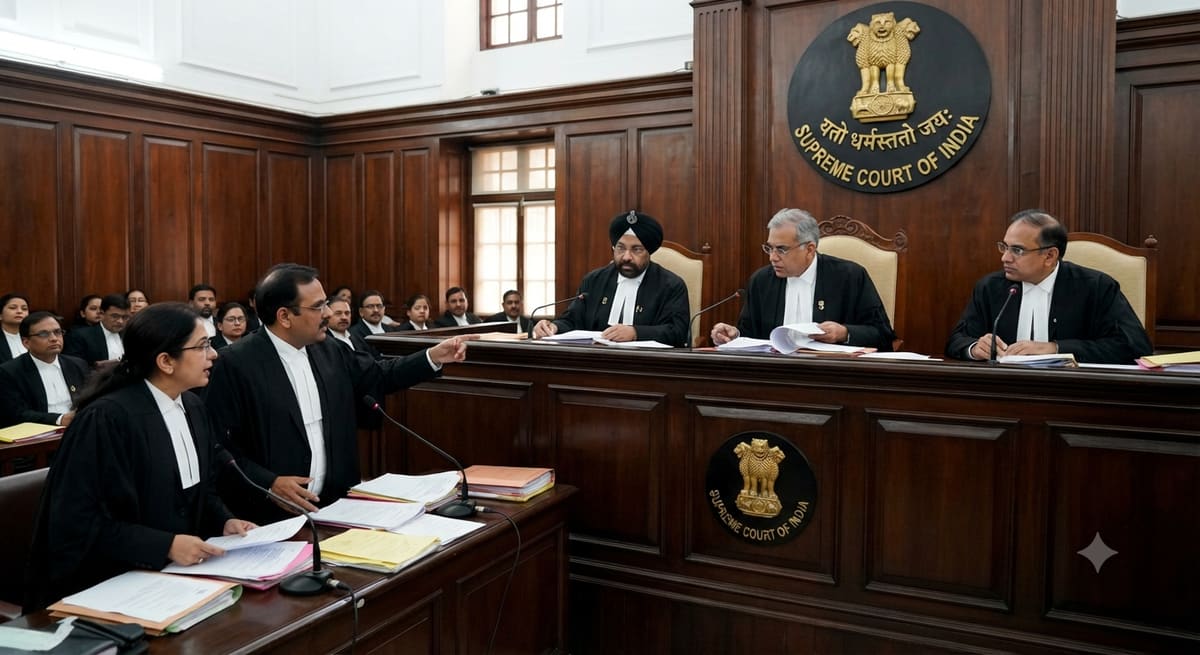
The Supreme Court, in a detailed judgment, has upheld the constitutional validity of the Explanation appended to Rule 38 of the Minerals (Other than Atomic and Hydrocarbons Energy Minerals) Concession Rules, 2016 and Rule 45(8)(a) of the Mineral Conservation and Development Rules, 2017. The Court held that the inclusion of payments made towards royalty, District Mineral Foundation (DMF), and National Mineral Exploration Trust (NMET) in the sale value for computing the average sale price (ASP) is not violative of Articles 14 and 19(1)(g) of the Constitution or Section 9 of the Mines and Minerals (Development and Regulation) Act, 1957. The judgment underscores the broad discretion of the legislature in fiscal matters and the validity of measures adopted to prevent evasion of revenue.
Background & Facts
The Dispute
The petitioners, Kirloskar Ferrous Industries Ltd. and another, challenged the constitutional validity of the Explanation appended to Rule 38 of the 2016 Rules and Rule 45(8)(a) of the 2017 Rules. These provisions mandate that while computing the sale value for determining the average sale price (ASP) under the Mines and Minerals (Development and Regulation) Act, 1957 (MMDR Act), no deduction shall be made for payments made towards royalty, DMF, and NMET. The petitioners contended that this results in a cascading effect, leading to royalty being levied on royalty, thereby increasing the effective rate of royalty beyond the statutorily prescribed 15% of ASP on ad valorem basis under Entry 24 of the Second Schedule to the MMDR Act.
Key Facts
The petitioners hold a mining lease in Karnataka for captive production of pig iron.
Royalty under Section 9 of the MMDR Act is levied at 15% of ASP for iron ore, as per Entry 24 of the Second Schedule.
DMF and NMET contributions are calculated as 10% and 2% of royalty, respectively.
Rule 42 of the 2016 Rules prescribes the method for computing ASP, which is based on the sale value as defined under Rule 38 and Rule 45(8)(a) of the 2017 Rules.
The Explanation to these rules mandates that royalty, DMF, and NMET payments shall not be deducted from the sale value, leading to their inclusion in the ASP.
The petitioners participated in an auction under the Mineral (Auction) Rules, 2015, where the auction premium was quoted as a percentage of the ASP. The inclusion of royalty, DMF, and NMET in the ASP allegedly resulted in double payment - once as part of the auction premium and again upon removal of minerals.
Procedural History
The dispute has traversed multiple judicial and administrative forums:
15.03.2015: Amendment to the MMDR Act introduced auction as the basis for allotment of mines.
17.09.2015: DMF Rules notified, requiring 10% of royalty as contribution to DMF.
27.03.2015: Auction Rules, 2015 notified, prescribing the method for computing auction premium as a percentage of ASP.
2016-2017: 2016 Rules and 2017 Rules notified, including the impugned Explanation.
25.05.2021: Ministry of Mines constituted a Committee to examine the cascading effect of royalty.
31.01.2022: Committee submitted its report, recommending amendments to exclude royalty, DMF, and NMET from ASP calculation.
25.05.2022: Public consultation notice issued by the Ministry of Mines proposing amendments to the MMDR Act.
2024: Petitioners filed Writ Petition (C) No. 715 of 2024 challenging the impugned rules.
07.11.2024: Supreme Court disposed of Writ Petition (C) No. 715 of 2024, granting liberty to the petitioners to challenge the final policy decision.
12.11.2024: Petitioners filed a representation seeking amendment of the rules.
24.01.2025: Petitioners filed I.A. No. 22190 of 2025 before the Supreme Court.
03.02.2025: Supreme Court directed the Union of India to file a report on progress.
21.02.2025: Union of India filed an affidavit stating the matter was pending before the Cabinet Secretariat.
28.02.2025: Supreme Court granted further time to the Union of India.
17.05.2025: Union of India filed an affidavit stating its decision not to amend the rules.
19.05.2025: Supreme Court granted liberty to the petitioners to file a fresh challenge.
Present Petition: Petitioners filed the current writ petition challenging the constitutional validity of the impugned rules.
Relief Sought
The petitioners sought:
A declaration that the Explanation to Rule 38 of the 2016 Rules and Rule 45(8)(a) of the 2017 Rules are ultra vires the Constitution and the MMDR Act.
Quashing of the impugned rules to the extent they include royalty, DMF, and NMET in the sale value for ASP calculation.
A direction to the Union of India to amend the rules to exclude royalty, DMF, and NMET from the ASP calculation.
The Legal Issue
The central question before the Court was whether the Explanation appended to Rule 38 of the 2016 Rules and Rule 45(8)(a) of the 2017 Rules, which mandate the inclusion of royalty, DMF, and NMET payments in the sale value for computing ASP





