
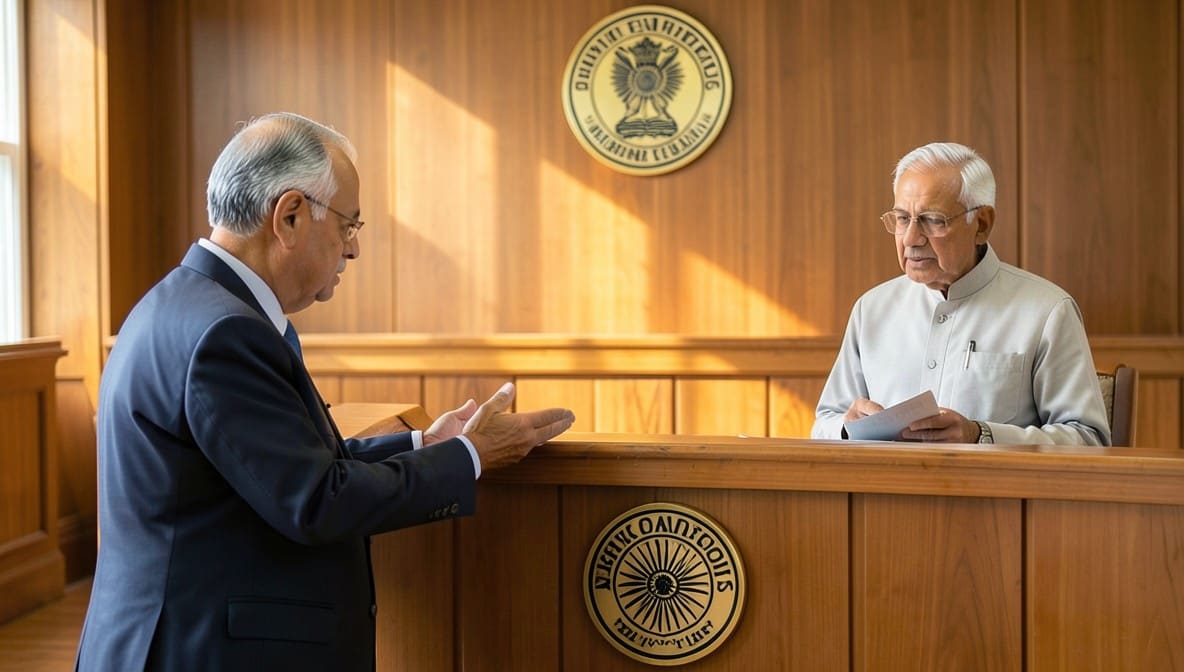
The Supreme Court has delivered a landmark judgment clarifying the boundaries between professional negligence and fraud, and reaffirming the exclusive disciplinary jurisdiction of Bar Councils over advocates. The Court held that banks and financial institutions cannot unilaterally include an advocate’s name in the Caution List maintained by the Indian Banks’ Association (IBA) for alleged negligence, as such action violates the statutory framework under the Advocates Act, 1961 and infringes the advocate’s fundamental right to practice under Article 19(1)(g) of the Constitution. The judgment underscores the principles of self-regulation, professional independence, and the need for accountability within the legal profession.
Background & Facts
The Dispute
The appellant, Ajay Vijh, an advocate enrolled in 1998, was empanelled with Canara Bank (respondent no. 2) from September 2010. The dispute arose from a legal opinion rendered by the appellant on 08.08.2015 regarding the title of immovable property offered as security for a credit facility of Rs. 2.00 crore. The Bank alleged that the appellant’s opinion was erroneous as it failed to account for prior sale transactions dated 31.10.2012, which had alienated a portion of the property. The Bank claimed this omission exposed it to financial risk.
Key Facts
- The appellant was engaged as panel counsel for Canara Bank from September 2010
- Legal opinion dated 08.08.2015 was based on a search certificate from the Sub-Registrar, Hapur
- Bank issued a show-cause notice on 27.07.2018, alleging negligence in title verification
- Appellant submitted a detailed explanation on 17.08.2018, asserting compliance with professional standards
- Bank removed the appellant from its panel on 31.01.2019 for alleged negligence
- Bank forwarded appellant’s name to IBA for inclusion in the Caution List
- Appellant’s name was included in the Caution List on 05.02.2020 with the remark: “Given Wrong Legal Opinion And Negligence in Conducting Search and Bank Was Exposed to Loss and Financial Risk”
- Appellant claims inclusion was effected without notice or opportunity of hearing
Procedural History
- 20.11.2023: High Court of Allahabad dismissed the writ petition (Civil Misc. Writ Petition No. 12074 of 2023) on the ground that IBA is not a “State” under Article 12
- 2026: Supreme Court granted leave to appeal (SLP (C) Diary No. 10787/2024)
- 07.07.2026: Supreme Court delivered the present judgment
The Parties' Positions
For the Appellant:
- Contended that inclusion in the Caution List violated Article 19(1)(g) and amounted to professional blacklisting
- Argued that allegations of negligence fall within the exclusive jurisdiction of Bar Councils under the Advocates Act, 1961
- Asserted that the Caution List mechanism was intended for fraud, not professional incompetence
For the Respondents (Bank & IBA):
- Justified inclusion in the Caution List under RBI guidelines for fraud prevention
- Argued that the action was an internal administrative measure confined to contractual relationships
- Contended that IBA is not a “State” under Article 12, rendering the writ petition non-maintainable
Relief Sought
The appellant sought:
- Quashing of the High Court’s order dated 20.11.2023
- Removal of his name from the Caution List maintained by IBA
- Declaration that inclusion in the Caution List for alleged negligence is illegal and unsustainable
The Legal Issue
The Supreme Court framed the following questions:
- Whether a writ petition under Article 226 challenging inclusion in the IBA Caution List is maintainable against a non-State entity?
- Whether inclusion of an advocate’s name in the Caution List is merely an administrative measure or affects constitutional and legal rights?
- Whether allegations of professional negligence fall within the exclusive disciplinary jurisdiction of Bar Councils under the Advocates Act, 1961?
Arguments Presented
For the Appellant
- Maintainability of Writ Petition: Relied on Andi Mukta Sadguru Shree Muktajee Vandas Swami Suvarna Jayanti Mahotsav Smarak Trust v. V.R. Rudani and Zee Telefilms Ltd. v. Union of India to argue that Article 226 extends to bodies discharging public functions, irrespective of their status under Article 12
- Nature of Caution List: Contended that the Caution List operates as an industry-wide adverse accreditation mechanism, affecting the appellant’s professional reputation and livelihood
- Exclusive Jurisdiction of Bar Councils: Argued that the Advocates Act, 1961 vests exclusive disciplinary jurisdiction in Bar Councils, and external agencies cannot adjudicate professional conduct
For the Respondents
- Non-Maintainability: Relied on Kishor S. Bhat v. Indian Banks’ Association to argue that IBA is not a “State” under Article 12, and the writ petition is not maintainable
- Regulatory Framework: Justified the Caution List under RBI circulars (Circular dated 16.03.2009, Frauds Classification and Reporting Directions, 2016, and Master Directions on Fraud Risk Management, 2024) as a fraud prevention measure
- Contractual Relationship: Argued that the Bank’s action was confined to its contractual relationship with the appellant and did not affect his legal rights
The Court's Analysis
Maintainability of Writ Petition under Article 226
The Court held that the High Court erred in dismissing the writ petition solely on the ground that IBA is not a “State” under Article 12. It observed:
“The appellant is not merely aggrieved by his de-empanelment by a Bank, which may well fall within the realm of a contractual relationship. His real grievance is against the inclusion of his name in the Caution List with remarks casting aspersions on his professional competence and integrity. Such action undoubtedly carries serious consequences as it has the potential to affect his standing as an advocate and his future professional engagements, particularly by financial institutions.”
The Court relied on Andi Mukta Sadguru and Zee Telefilms to hold that Article 226 extends to bodies discharging public functions, and the nature of the impugned action - affecting the appellant’s fundamental right under Article 19(1)(g) - rendered the writ petition maintainable. It distinguished Kishor S. Bhat on the ground that the present case involved a sector-wide adverse accreditation mechanism, not a private contractual dispute.
Scope and Object of Caution List
The Court examined the RBI circulars and held that the Caution List was intended to alert banks about fraudulent third-party entities, not professionals alleged to have committed negligence or errors of judgment. It observed:
“Fraud, by its very nature, imports an element of mens rea and deliberate intention and design to defraud. An erroneous legal opinion or an omission in the course of due diligence, absent any allegation of dishonest intent or deliberate facilitation of illegality, cannot be elevated to the level of fraud.”
The Court held that the inclusion of the appellant’s name in the Caution List for alleged negligence was unsustainable, as the RBI circulars did not authorise such action. It directed the respondents to remove the appellant’s name from the Caution List with immediate effect.
Professional Independence and Self-Regulation
The Court reaffirmed the principle of self-regulation under the Advocates Act, 1961, holding that allegations of professional misconduct fall within the exclusive jurisdiction of Bar Councils. It relied on Bar of Indian Lawyers v. D.K. Gandhi PS National Institute of Communicable Diseases to emphasise the unique nature of the legal profession:
“The legal profession is different from the other professions also for the reason that what the advocates do, affects not only an individual but the entire administration of justice, which is the foundation of the civilised society.”
The Court held that permitting banks or external agencies to adjudicate professional conduct would undermine the statutory framework and the independence of the Bar. It observed:
“Matters concerning the professional conduct of an advocate are within the exclusive province of the disciplinary authorities contemplated under the Advocates Act. The mechanism envisaged in the Caution List under the RBI circulars cannot be invoked to determine or punish alleged professional misconduct by advocates.”
Duty of BCI to Undertake Performance Audit
The Court noted concerns regarding the efficacy of the disciplinary mechanisms under the Advocates Act, 1961, including delays, pendency, and lack of transparency. It directed the Bar Council of India (BCI) to undertake a performance audit of its disciplinary jurisdiction, covering:
- Number of complaints instituted and disposed of annually
- Average and median disposal times
- Age-wise pendency of cases
- Regional variations in disposal patterns
- Adequacy of staffing and administrative support
- Nature of outcomes and sanctions imposed
The Court relied on Yash Developers v. Harihar Krupa Co-operative Housing Society Ltd. to emphasise the need for evidence-based reform and accountability in regulatory mechanisms.
Continuing Legal Education (CLE)
The Court highlighted the necessity of Continuing Legal Education (CLE) for advocates to maintain professional competence and ethical standards. It observed:
“Laws, as well as renewed knowledge of its subjects are ever evolving. Equally, the technique of persuasion-advocacy, as well as adjudicatory methods require simplification and refinement.”
The Court directed the BCI to consider establishing a National Legal Academy (NLA) for advocates, akin to the National Judicial Academy (NJA), to institutionalise post-enrolment learning and professional development.
The Verdict
The Supreme Court allowed the appeal, set aside the High Court’s order dated 20.11.2023, and declared that the inclusion of the appellant’s name in the Caution List was impermissible and without jurisdiction. It directed the respondents to remove the appellant’s name from the Caution List with immediate effect. The Court also directed the BCI to:
- Undertake a performance audit of its disciplinary mechanisms and file an affidavit of proposed actions by 31.08.2026
- Constitute a committee to explore the establishment of a National Legal Academy (NLA) for advocates
- List the matter on 31.08.2026 for further directions
What This Means For Similar Cases
Caution List Cannot Be Used for Professional Negligence
- The Caution List maintained by IBA under RBI guidelines is confined to cases involving fraud, dishonesty, or criminal misconduct
- Negligence or errors of professional judgment do not warrant inclusion in the Caution List
- Banks may disengage advocates for unsatisfactory services but cannot publicly declare them professionally incompetent without following due process under the Advocates Act, 1961
Exclusive Jurisdiction of Bar Councils
- Disciplinary jurisdiction over advocates lies exclusively with Bar Councils under the Advocates Act, 1961
- External agencies, including banks, cannot adjudicate professional conduct or impose consequential actions like blacklisting
- Parallel mechanisms outside the statutory framework are impermissible and violate the principle of self-regulation
Strengthening Disciplinary Mechanisms
- Performance audit of Bar Councils’ disciplinary processes is essential to address delays, pendency, and lack of transparency
- Continuing Legal Education (CLE) must be institutionalised to maintain professional competence and ethical standards
- National Legal Academy (NLA) can bridge the gap between urban and rural practitioners and ensure uniform access to legal developments





