Delhi High Court judgments

402 Delhi High Court judgments explained in plain English: what was decided, the law applied and why it matters. Page 10 of 17.

Section 48 & 49 Arbitration Act | Unenforceable Foreign Award Does Not Merge Cause of Action Under Order VII Rule 11 CPC : Delhi HC
Case Law Analysis
|Delhi High Court

Section 48 & 49 Arbitration Act | Unenforceable Foreign Award Does Not Merge Cause of Action Under Order VII Rule 11 CPC : Delhi HC

The Delhi High Court ruled that a foreign arbitral award, even if unenforceable under Sections 48 and 49 of the Arbitration Act, does not extinguish the underlying civil cause of action. This means plaintiffs may still pursue recovery through a fresh suit, preventing litigants from being trapped by unenforceable awards and preserving access to judicial remedies under the CPC.


Public Documents Prevail Over Academic Records for Date of Birth Correction | CBSE Must Align Class X Certificate with MCD Birth Certificate, Aadhaar, or Passport : Delhi HC
Case Law Analysis
|Delhi High Court

Public Documents Prevail Over Academic Records for Date of Birth Correction | CBSE Must Align Class X Certificate with MCD Birth Certificate, Aadhaar, or Passport : Delhi HC

The Delhi High Court has ruled that statutory public documents like birth certificates, Aadhaar, and passports take precedence over school records when correcting a student's date of birth on CBSE certificates. This sets a binding standard for educational boards nationwide, ensuring identity consistency across government systems and protecting individuals from administrative errors rooted in institutional negligence.

Section 392 IPC | Conduct Evidence Under Section 8 Evidence Act Sufficient for Robbery Conviction Despite Lack of CCTV or Forensic Proof : Delhi HC
Case Law Analysis
|Delhi High Court

Section 392 IPC | Conduct Evidence Under Section 8 Evidence Act Sufficient for Robbery Conviction Despite Lack of CCTV or Forensic Proof : Delhi HC

Delhi High Court upholds robbery conviction based on the accused's conduct-including exploitation of trust and recovery of stolen property-under Section 8 of the Evidence Act, even in the absence of CCTV, medical evidence, or fingerprint matches. The ruling reinforces that circumstantial evidence can suffice for conviction where the accused's behavior aligns with guilt.

Section 120B IPC | Facilitating Share Price Manipulation for QIP Constitutes Criminal Conspiracy : Delhi HC
Case Law Analysis
|Delhi High Court

Section 120B IPC | Facilitating Share Price Manipulation for QIP Constitutes Criminal Conspiracy : Delhi HC

Delhi High Court rules that involvement in artificial share price manipulation to enable a Qualified Institutional Placement (QIP), even without direct financial benefit, meets the threshold for criminal conspiracy under Section 120B IPC. Summoning is justified at the threshold stage if supported by circumstantial evidence and witness statements, reinforcing the broad scope of conspiracy liability in financial crimes.

Section 138 NI Act | Director Not Liable for Post-Liquidation Cheque Dishonour Absent Control Over Company Funds : Delhi HC
Case Law Analysis
|Delhi High Court

Section 138 NI Act | Director Not Liable for Post-Liquidation Cheque Dishonour Absent Control Over Company Funds : Delhi HC

Delhi High Court rules that a director cannot be held criminally liable under Section 138 of the Negotiable Instruments Act for cheque dishonour after the company enters provisional liquidation, as they lose control over bank accounts. The ruling clarifies the limits of director liability in insolvency scenarios, offering critical protection for directors facing post-liquidation cheque bounce complaints.

Clause A1 ICDS Tenders | Ownership of Industrial Plot Mandatory; Arbitration Award Not a Disqualifying 'Pending Dispute' : Delhi HC
Case Law Analysis
|Delhi High Court

Clause A1 ICDS Tenders | Ownership of Industrial Plot Mandatory; Arbitration Award Not a Disqualifying 'Pending Dispute' : Delhi HC

Delhi High Court clarifies that state-allotted industrial plots meet the ownership requirement under Clause A1 of ICDS tenders, while arbitration awards in a bidder's favor do not constitute a 'pending dispute' for disqualification. The ruling reinforces tender eligibility criteria under the National Food Security Act, impacting bidders in public nutrition procurement.

Section 111(g) TPA | Mere Dispute of Landlord’s Title Without Unequivocal Denial Does Not Trigger Forfeiture : Delhi HC
Case Law Analysis
|Delhi High Court

Section 111(g) TPA | Mere Dispute of Landlord’s Title Without Unequivocal Denial Does Not Trigger Forfeiture : Delhi HC

Delhi High Court clarifies that a tenant’s mere questioning of a landlord’s derivative title-without explicit denial of tenancy-does not constitute forfeiture under Section 111(g) of the Transfer of Property Act. The ruling reinforces tenant protections under Section 50 of the Delhi Rent Control Act, barring eviction unless the tenant outright repudiates the landlord’s title.

Consumer Protection Act | Completion Certificate Mandatory for Lawful Possession Handover: Delhi State Consumer Commission Holds Deficiency in Service
Case Law Analysis
|Delhi High Court

Consumer Protection Act | Completion Certificate Mandatory for Lawful Possession Handover: Delhi State Consumer Commission Holds Deficiency in Service

Delhi State Consumer Commission rules that developers failing to obtain completion and occupancy certificates commit deficiency in service under the Consumer Protection Act, entitling buyers to compensation. The ruling reinforces contractual obligations in real estate transactions and impacts homebuyers' rights to lawful possession.

Consumer Protection Act | Builder’s Failure to Deliver Possession Without Occupancy Certificate Constitutes Deficiency in Service Entitling Buyer to Refund & Committed Returns : Delhi State Consumer Commission
Case Law Analysis
|Delhi High Court

Consumer Protection Act | Builder’s Failure to Deliver Possession Without Occupancy Certificate Constitutes Deficiency in Service Entitling Buyer to Refund & Committed Returns : Delhi State Consumer Commission

The Delhi State Consumer Commission ruled that a builder’s refusal to hand over possession without statutory occupancy and completion certificates amounts to deficiency in service under the Consumer Protection Act. Buyers are entitled not only to a full refund of payments but also to the committed monthly returns promised in the agreement, setting a critical precedent for real estate accountability and buyer protection in Delhi-NCR.

Delay and Laches Bar Writ Relief for Non-Participating Bidders in Tender Challenges | Delhi HC Upholds Public Procurement Timelines : Delhi HC
Case Law Analysis
|Delhi High Court

Delay and Laches Bar Writ Relief for Non-Participating Bidders in Tender Challenges | Delhi HC Upholds Public Procurement Timelines : Delhi HC

The Delhi High Court ruled that non-participating bidders cannot challenge tender conditions after a significant delay, as it undermines public interest in timely procurement. The court emphasized that laches-unreasonable delay in seeking legal remedy-bars writ relief, even if tender conditions appear exclusionary or arbitrary.

Section 479 BNSS | Proviso to Section 45 PMLA Applies to All Women, Overriding Multiple Case Bars: Delhi HC
Case Law Analysis
|Delhi High Court

Section 479 BNSS | Proviso to Section 45 PMLA Applies to All Women, Overriding Multiple Case Bars: Delhi HC

The Delhi High Court held that the gender-based bail proviso under Section 45 of the PMLA is absolute for women, and Section 479 of the BNSS nullifies the cumulative effect of multiple cases in denying bail. This establishes a critical precedent: even when accused in several PMLA proceedings, a woman cannot be denied bail solely on the basis of multiplicity of cases, reinforcing gender equity in financial crime jurisprudence.

PoCSO Section 6 | Credible Child Testimony Alone Suffices for Conviction Even Without Hymen Rupture or Forensic Evidence: Delhi HC
Case Law Analysis
|Delhi High Court

PoCSO Section 6 | Credible Child Testimony Alone Suffices for Conviction Even Without Hymen Rupture or Forensic Evidence: Delhi HC

The Delhi High Court affirmed that a child victim's credible testimony is sufficient to prove penetrative sexual assault under Section 6 of the PoCSO Act, regardless of the absence of physical or forensic corroboration. This ruling reinforces the legal recognition of children's testimonial reliability and reduces undue reliance on outdated medical indicators, significantly impacting prosecution strategies in child sexual abuse cases.

Interest on Refund | Failure to Deposit Consideration in Court Entitles Claimant to Interest from Payment Date, Even with Concealed Agreement : Delhi HC
|Delhi High Court

Interest on Refund | Failure to Deposit Consideration in Court Entitles Claimant to Interest from Payment Date, Even with Concealed Agreement : Delhi HC

The Delhi High Court upheld that when a buyer fails to deposit the balance consideration in court as required, the seller is entitled to interest on the refund from the date of payment, regardless of concealment of a second agreement. This clarifies that equitable relief in specific performance cases hinges on financial conduct, not procedural transparency alone, affecting real estate buyers and sellers nationwide.

Specific Performance | MoU with Fixed Consideration, Post-Dated Cheques & Partial Performance Creates Binding Contract: Delhi HC
|Delhi High Court

Specific Performance | MoU with Fixed Consideration, Post-Dated Cheques & Partial Performance Creates Binding Contract: Delhi HC

The Delhi High Court has ruled that a Memorandum of Understanding backed by fixed consideration, post-dated cheques, and partial performance can constitute an enforceable contract under the Specific Relief Act - even without a formal Share Purchase Agreement. This sets a critical precedent for commercial parties relying on preliminary agreements, affirming that summary judgment under Order XIII-A CPC is viable when the defendant fails to file a Written Statement.

Section 34 Arbitration Act | Interest on Unlawfully Encashed Performance Bank Guarantee Is Recoverable as Part of Restitution, Not Separate Claim : Delhi HC
Case Law Analysis
|Delhi High Court

Section 34 Arbitration Act | Interest on Unlawfully Encashed Performance Bank Guarantee Is Recoverable as Part of Restitution, Not Separate Claim : Delhi HC

The Delhi High Court has ruled that when a Performance Bank Guarantee is encashed in breach of an interim stay, any interest accrued on the encashed amount must be returned alongside the principal as integral to the remedy for unlawful enrichment. This clarifies that interest is not a standalone claim but part of the restitution owed under Section 34, reinforcing the arbitrator’s power to restore parties to their pre-breach position.

Judicial Restraint in Retirement Age Policy | Delhi HC Upholds Executive Discretion Over Superannuation Under Article 14
Case Law Analysis
|Delhi High Court

Judicial Restraint in Retirement Age Policy | Delhi HC Upholds Executive Discretion Over Superannuation Under Article 14

Delhi High Court dismissed a petition challenging the superannuation age of GREF/BRO medical officers, holding that retirement age policy is an executive prerogative beyond judicial review unless arbitrariness is proven. The ruling reaffirms that parity claims under Article 14 do not override policy decisions absent manifest discrimination.

Natural Justice in Disciplinary Proceedings | Termination for Non-Compliance with Transfer Order Requires Prior Enquiry Under Industrial Disputes Act : Delhi HC
Case Law Analysis
|Delhi High Court

Natural Justice in Disciplinary Proceedings | Termination for Non-Compliance with Transfer Order Requires Prior Enquiry Under Industrial Disputes Act : Delhi HC

Delhi High Court rules that termination of a Medical Sales Representative for non-compliance with a transfer order without a prior disciplinary enquiry violates principles of natural justice. The judgment reaffirms that field-level sales staff qualify as 'workmen' under the Sales Promotion Employees (Conditions of Service) Act, 1976, entitling them to procedural fairness before dismissal.

Hindu Minority & Guardianship Act | Natural Father’s Custody Rights Prevail Over Criminal Allegations Unless Proven Unfit : Delhi HC
Case Law Analysis
|Delhi High Court

Hindu Minority & Guardianship Act | Natural Father’s Custody Rights Prevail Over Criminal Allegations Unless Proven Unfit : Delhi HC

Delhi High Court rules that a natural father’s custody rights under the Hindu Minority and Guardianship Act, 1956, cannot be denied merely due to pending criminal allegations. The court held that habeas corpus is maintainable to restore custody unless the father is proven unfit, reinforcing the primacy of natural guardianship over unproven accusations.

CCS (Conduct) Rules 1964 | Unauthorized Union Fund Collection & Forged Receipts Constitute Misconduct : Delhi HC Upholds Compulsory Retirement
Case Law Analysis
|Delhi High Court

CCS (Conduct) Rules 1964 | Unauthorized Union Fund Collection & Forged Receipts Constitute Misconduct : Delhi HC Upholds Compulsory Retirement

Delhi High Court rules that a government servant's unauthorized collection of union funds and use of forged receipts violates Rule 3(1)(i)(iii) of CCS (Conduct) Rules, 1964, irrespective of union affiliation. The penalty of compulsory retirement is upheld, reinforcing strict disciplinary standards for financial integrity in public service.

Subsistence Allowance Non-Payment Does Not Vitiate Disciplinary Proceedings Absent Proven Prejudice : Delhi HC
Case Law Analysis
|Delhi High Court

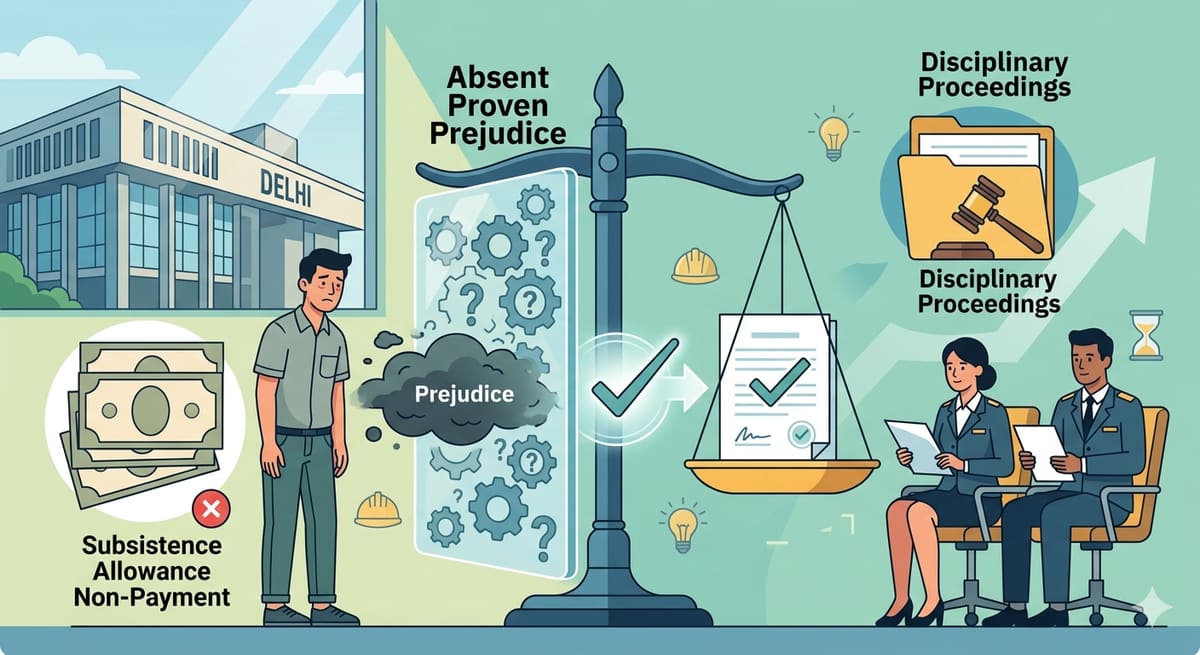
Subsistence Allowance Non-Payment Does Not Vitiate Disciplinary Proceedings Absent Proven Prejudice : Delhi HC

Delhi High Court rules that failure to pay subsistence allowance during disciplinary proceedings does not automatically invalidate the inquiry unless the employee demonstrates concrete financial hardship that prevented participation. The judgment reinforces that procedural lapses must cause actual prejudice to warrant interference under service law.

Natural Justice in Quasi-Judicial Proceedings | Contract Labour Board Must Adjudicate Jurisdictional Objections Before Passing Orders : Delhi HC
Case Law Analysis
|Delhi High Court

Natural Justice in Quasi-Judicial Proceedings | Contract Labour Board Must Adjudicate Jurisdictional Objections Before Passing Orders : Delhi HC

The Delhi High Court quashed a Contract Labour Board order for failing to address jurisdictional objections and record reasons, reinforcing that quasi-judicial bodies must adhere to natural justice principles even under consent orders. This ruling mandates reasoned decisions in all adjudicatory proceedings, impacting employers, unions, and regulatory authorities under the Contract Labour Act.