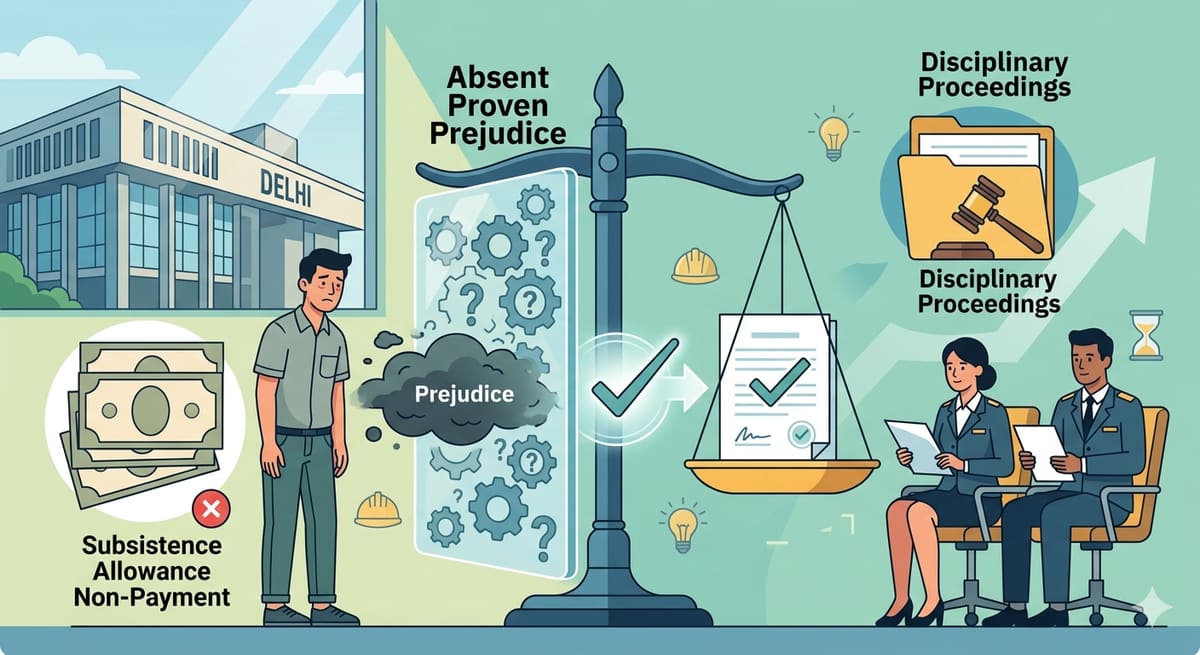
The Delhi High Court has clarified that the mere non-payment of subsistence allowance to a suspended government servant does not automatically invalidate disciplinary proceedings, unless the employee demonstrates concrete prejudice arising from financial incapacity to participate in the inquiry. This ruling reinforces the principle that procedural irregularities must be shown to have materially affected the right to fair hearing before they can render proceedings void.
Background & Facts
The Dispute
The petitioner, Mukesh Kumar, was appointed as an Assistant Sub Inspector in the Border Security Force (BSF) in 2001 and promoted to Sub Inspector in 2013. From July 2013 to September 2017, he was posted at the Administrative Directorate, Force Headquarters (FHQ), BSF, New Delhi, serving as Cashier in the SPBY Cell of the Welfare Section. Upon relief in September 2017, he was granted 30 days of earned leave and directed to join the Force Headquarters, Salbagan, Agartala, Tripura (West), which he did.
Key Facts
The petitioner was granted extended earned leave until 04.12.2017, with instructions to rejoin on 05.12.2017.
After visiting the Adm-I (SPBY Cell), HQ, DG, BSF, New Delhi, he was temporarily attached to that unit to rectify discrepancies in welfare fund accounts.
He was declared absent without leave (AWOL) with effect from 12.12.2017 for failing to report to his designated posting in Tripura or inform authorities of his whereabouts.
An FIR was registered against him on 03.01.2018 for embezzlement of welfare funds.
He surrendered before the Trial Court on 12.03.2018 and was granted bail on 01.05.2018.
He was placed under deemed suspension with effect from 12.03.2018 (date of arrest), and the suspension was extended periodically.
On 27.07.2018, he requested remittance of subsistence allowance to his wife’s account.
On 30.04.2019, he submitted a representation seeking exemption from reporting to Tripura due to psychological distress from pending criminal proceedings and requested subsistence allowance.
A petition filed in the High Court of Patna on 26.03.2019 seeking subsistence allowance was dismissed.
Suspension was revoked on 17.11.2020, but the order was not communicated to him.
He rejoined duty on 21.05.2022 at Ftr HQ BSF, Tripura.
Between 04.12.2024 and 12.12.2024, the General Security Force Court (GSFC) tried him on two charges of absence without leave.
He was dismissed from service on 12.12.2024.
His pre-confirmation petition was rejected on 16.01.2025.
The findings of the GSFC were communicated to him on 07.02.2025, with the observation that his unauthorized absence would be treated as 'Dies-Non' for all purposes.
A writ petition filed on 28.01.2026 was disposed of with a direction to the competent authority to consider his representation within four weeks.
The impugned order dated 25.02.2026 dismissed his statutory appeal, holding that he failed to rejoin duty despite multiple notices.
Procedural History
05.12.2017: Deadline to rejoin duty after leave
12.12.2017: Declared AWOL
03.01.2018: FIR registered for embezzlement
12.03.2018: Arrested; deemed suspension commenced
01.05.2018: Granted bail
27.07.2018: First request for subsistence allowance
30.04.2019: Representation seeking exemption from duty posting and payment of allowance
26.03.2019: Patna High Court dismissed petition for subsistence allowance
17.11.2020: Suspension revoked (uncommunicated)
21.05.2022: Rejoined duty
12.12.2024: Dismissal order passed by GSFC
16.01.2025: Pre-confirmation petition rejected
07.02.2025: GSFC findings communicated
28.01.2026: Writ Petition No. 1132/2026 disposed of with direction to reconsider representation
25.02.2026: Impugned order dismissing statutory appeal
04.05.2026: Present writ petition dismissed by Delhi High Court
Relief Sought
The petitioner sought:
Quashing of the impugned order dated 25.02.2026
Reinstatement with continuity of service, full consequential benefits, and arrears of pay and allowances
Payment of subsistence allowance for the entire period of suspension with interest
Treatment of the entire period of suspension and absence as duty for all purposes
Quashing of orders dated 07.02.2025 and 16.01.2025
The Legal Issue
The central question was whether non-payment of subsistence allowance during suspension automatically vitiates disciplinary proceedings under the BSF Act, 1968, or whether the employee must demonstrate actual prejudice in defending himself due to financial incapacity.
Arguments Presented
For the Petitioner
The petitioner relied on Ghanshyam Das Shrivastava v. State of Madhya Pradesh and State of Bihar v. Arbind, arguing that non-payment of subsistence allowance deprived him of a reasonable opportunity to defend himself in the disciplinary proceedings. He contended that his absence was not wilful, as he was bound to remain in Delhi for criminal proceedings and suffered psychological distress. He further argued that the disciplinary charges of absence without leave were unrelated to the criminal allegations of embezzlement and that the punishment of dismissal was disproportionate.
For the Respondent
The respondents countered that the petitioner was declared AWOL for failing to report to his designated posting in Tripura, irrespective of the criminal case. They emphasized that the suspension was triggered by arrest, not the pendency of criminal proceedings, and that the petitioner never established financial incapacity to participate in the inquiry. Multiple notices were issued, and the petitioner’s failure to rejoin despite bail and the completion of investigation demonstrated wilful absence. The disciplinary proceedings were conducted in accordance with the BSF Act and Rules.
The Court's Analysis
The Court emphasized that its jurisdiction under Article 226 is limited to reviewing the legality and procedural fairness of the impugned order, not to reappreciate evidence or substitute its own view. The Court found that the charges of absence without leave were distinct from the criminal allegations of embezzlement, and therefore, Section 80 of the BSF Act, 1968, which bars concurrent proceedings, was inapplicable.
The petitioner’s reliance on Ghanshyam Das Shrivastava and State of Bihar v. Arbind was examined closely. In both cases, the Supreme Court quashed dismissal orders because the employees had specifically pleaded and substantiated that non-payment of subsistence allowance rendered them financially incapable of attending the inquiry. In Ghanshyam Das, the employee had written to the Enquiry Officer stating he could not face proceedings due to acute shortage of funds, and the government did not rebut this claim. In Arbind, the employee had remained at his posting for five months before leaving due to financial hardship and had communicated his inability.
In the present case, the Court noted that the petitioner never claimed in his representations that he was unable to attend the inquiry due to financial hardship. His 30.04.2019 application cited psychological distress and fear of appearing with an "unfair character" - not financial incapacity. The Court observed:
"The Petitioner has not contested that his absence was the result of any incapacity stemming from financial difficulty. Rather, it appears from his application dated 30.04.2019 that he did not wish to join his posting in Tripura as the criminal proceedings had affected his morale and he was apprehensive of reporting in Tripura with an unfair character."
The Court further held that the petitioner’s temporary attachment to Delhi HQ did not alter his official posting in Tripura, and multiple notices were issued to report there. His absence spanned approximately four years, and he rejoined only after his earlier petition for subsistence allowance was dismissed as withdrawn. The Court found no evidence of depression sufficient to excuse prolonged absence, and the bail order contained no restriction requiring him to remain in Delhi.
The Court concluded that the disciplinary proceedings were not vitiated by non-payment of subsistence allowance because the petitioner failed to establish any prejudice in his ability to defend himself. The punishment of dismissal, while severe, was not disproportionate given the length and nature of the absence in a disciplined force.
The Verdict
The petition was dismissed. The Court upheld the dismissal order dated 12.12.2024 and the impugned order dated 25.02.2026. The petitioner’s claim for subsistence allowance for the period of absence was rejected. The Court held that the period of unauthorized absence shall continue to be treated as 'Dies-Non' for all purposes, and no arrears of pay, allowances, or consequential benefits are payable for the period of absence. The petitioner’s request for reinstatement was denied.
What This Means For Similar Cases
Non-Payment Alone Does Not Vitiate Proceedings
Practitioners must now prove actual prejudice - such as documented financial incapacity preventing participation in the inquiry - to challenge disciplinary proceedings on grounds of non-payment of subsistence allowance.
Mere assertion of hardship without supporting evidence or prior communication to the authority will not suffice.
Wilful Absence in Disciplined Forces Is Severely Penalized
In paramilitary and uniformed services, prolonged absence without leave, even during pending criminal proceedings, will be viewed as wilful misconduct.
Temporary attachments or postings in different locations do not override official duty stations unless formally altered.
Strategic Use of Representations Is Critical
Employees must clearly articulate the basis of their inability to participate in proceedings - whether financial, medical, or otherwise - in writing and at the earliest opportunity.
Vague references to "stress" or "morale" without medical or financial documentation will not be accepted as valid justification for absence.
Burden of Proof Lies with the Employee
The burden to demonstrate that non-payment caused prejudice rests entirely on the suspended employee.
Authorities are not obligated to infer hardship from silence or post-hoc explanations.
Precedent Clarified
Ghanshyam Das and Arbind remain good law but are confined to their facts: where the employee proved financial incapacity and communicated it to the authority.
This judgment establishes a clear threshold: no automatic vitiation; only vitiation upon proven prejudice.