Allahabad High Court judgments

902 Allahabad High Court judgments explained in plain English: what was decided, the law applied and why it matters. Page 34 of 38.

BNSS Section 2(1)(h) | Charge Sheets for Non-Cognizable Offences Must Be Treated as Complaints, Not Police Cases : Allahabad HC
Case Law Analysis
|Allahabad High Court

BNSS Section 2(1)(h) | Charge Sheets for Non-Cognizable Offences Must Be Treated as Complaints, Not Police Cases : Allahabad HC

Allahabad High Court rules that charge sheets filed for non-cognizable offences under the Bharatiya Nyaya Sanhita (BNS) must be processed as complaints under BNSS Section 2(1)(h), not as police cases. The court set aside the improper cognizance, emphasizing that Investigating Officers cannot proceed as complainants without adhering to complaint case procedures, impacting how non-cognizable offences are adjudicated.

Concurrent Maintenance Under CrPC 125 & DV Act Capped at 25% of Husband’s Net Income : Allahabad HC Reaffirms Kalyan Dey Chowdhury Precedent
Case Law Analysis
|Allahabad High Court

Concurrent Maintenance Under CrPC 125 & DV Act Capped at 25% of Husband’s Net Income : Allahabad HC Reaffirms Kalyan Dey Chowdhury Precedent

Allahabad HC rules that maintenance awards under CrPC 125 and the Domestic Violence Act must be consolidated and cannot exceed 25% of the husband’s net income, ensuring proportionality. The judgment reinforces the Kalyan Dey Chowdhury precedent, mandating a fair cap to prevent double recovery and financial hardship on the paying spouse.

Habeas Corpus | Minor’s Voluntary Preference for Mother Overrides Custody Claim Under Family Law : Allahabad HC Upholds Child Autonomy
Case Law Analysis
|Allahabad High Court

Habeas Corpus | Minor’s Voluntary Preference for Mother Overrides Custody Claim Under Family Law : Allahabad HC Upholds Child Autonomy

Allahabad High Court dismisses a habeas corpus petition after confirming a 17-year-old minor’s unequivocal choice to reside with his mother, rejecting allegations of coercion or substance abuse. The ruling reinforces that a minor’s voluntary preference, when free from undue influence, prevails over custodial claims by other relatives, even in the absence of visitation rights.

Service Law | Officiating Principals Entitled to Higher Salary After Three Months: Allahabad HC Applies Veeresh Chandra Mishra Precedent
Case Law Analysis
|Allahabad High Court

Service Law | Officiating Principals Entitled to Higher Salary After Three Months: Allahabad HC Applies Veeresh Chandra Mishra Precedent

Allahabad High Court rules that officiating principals in educational institutions are entitled to the higher salary of a regular principal after completing three months of service, as per the Veeresh Chandra Mishra precedent. The judgment mandates payment of arrears, reinforcing the rights of ad-hoc principals under service law.

Section 498A IPC | Omnibus Allegations Against Family Members Insufficient for Bail Denial : Allahabad HC Reaffirms Geeta Mehrotra Precedent
Case Law Analysis
|Allahabad High Court

Section 498A IPC | Omnibus Allegations Against Family Members Insufficient for Bail Denial : Allahabad HC Reaffirms Geeta Mehrotra Precedent

Allahabad HC grants bail to a mother-in-law in a dowry harassment case, ruling that general allegations without specific conduct against individual family members cannot justify denial of bail. The court emphasized the misuse of Section 498A IPC in matrimonial disputes and reiterated the need for caution against false implications, aligning with the Supreme Court's Geeta Mehrotra judgment.

Section 406 & 420 IPC | Repayment of Defrauded Money Does Not Absolve Criminal Liability : Allahabad HC Reaffirms Non-Compoundable Nature of Cheating Offences
Case Law Analysis
|Allahabad High Court

Section 406 & 420 IPC | Repayment of Defrauded Money Does Not Absolve Criminal Liability : Allahabad HC Reaffirms Non-Compoundable Nature of Cheating Offences

Allahabad High Court holds that returning the defrauded amount does not erase criminal liability under Sections 406 (criminal breach of trust) and 420 (cheating) IPC. The ruling underscores that fraud offences are non-compoundable, reinforcing strict accountability for accused even post-restitution.

MSVE-2016 | 75% Attendance Rule Cannot Bar Academic Continuity When Delay Is Beyond Student’s Control: Allahabad HC
Case Law Analysis
|Allahabad High Court

MSVE-2016 | 75% Attendance Rule Cannot Bar Academic Continuity When Delay Is Beyond Student’s Control: Allahabad HC

The Allahabad High Court ruled that rigid enforcement of the 75% attendance requirement under MSVE-2016 violates the fundamental right to education when a student’s delay is due to circumstances beyond their control. This sets a precedent for sympathetic interpretation of academic regulations in veterinary and medical education, ensuring no student is arbitrarily dropped from a course for procedural non-compliance without individualized consideration.

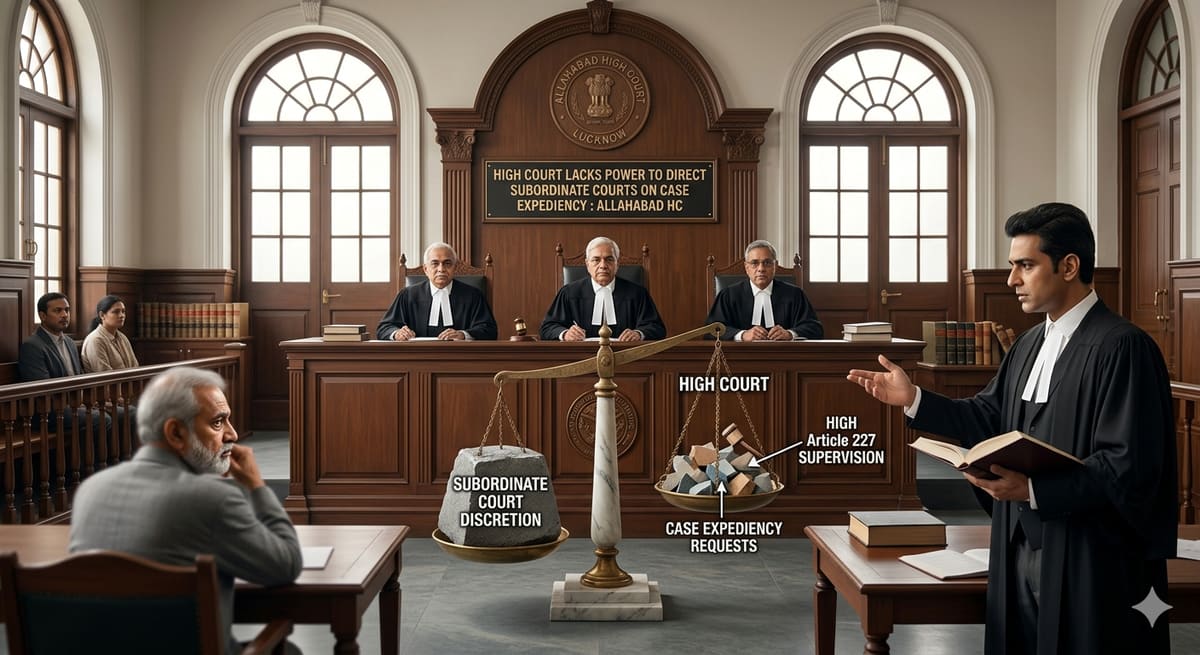
Article 227 | High Court Lacks Power to Direct Subordinate Courts on Case Expediency : Allahabad HC
Case Law Analysis
|Allahabad High Court

Article 227 | High Court Lacks Power to Direct Subordinate Courts on Case Expediency : Allahabad HC

Allahabad HC reaffirms that constitutional courts cannot interfere with the judicial discretion of subordinate courts in managing case timelines. The ruling underscores that expedited disposal orders under Article 227 would create preferential treatment, undermining the trial court's authority to assess urgency based on facts like disability or socio-economic hardship.

Section 19 Declaration | R&R Land Distinct from Acquisition Land but Still Covered Under Statutory Framework: Allahabad HC
Case Law Analysis
|Allahabad High Court

Section 19 Declaration | R&R Land Distinct from Acquisition Land but Still Covered Under Statutory Framework: Allahabad HC

The Allahabad High Court has ruled that land designated for rehabilitation and resettlement under Section 19(2) of the Land Acquisition Act, 2013, is legally distinct from the land being acquired, but remains part of the same statutory process. This clarifies that consent from 73.02% of affected families validly covers both acquisition and R&R components, reinforcing the validity of PPP-based infrastructure projects under the Act.

Mukhyamantri Krishak Durghatna Kalyan Yojna | Bataidar Certificate Overrides Initial Rejection; Administrative Reconsideration Mandated : Allahabad HC
Case Law Analysis
|Allahabad High Court

Mukhyamantri Krishak Durghatna Kalyan Yojna | Bataidar Certificate Overrides Initial Rejection; Administrative Reconsideration Mandated : Allahabad HC

Allahabad HC rules that a bataidar certificate, even if produced belatedly, must be considered for compensation under the Mukhyamantri Krishak Durghatna Kalyan Yojna. The court set aside the initial rejection, emphasizing that welfare schemes must account for rural beneficiaries' limited legal awareness and procedural hurdles.

Section 306 IPC | Proximate Incitement, Not Mere Harassment, Required for Abetment to Suicide: Allahabad HC
Case Law Analysis
|Allahabad High Court

Section 306 IPC | Proximate Incitement, Not Mere Harassment, Required for Abetment to Suicide: Allahabad HC

Allahabad HC clarifies that caste-based harassment alone does not constitute abetment under Section 306 IPC unless it directly incites suicide. The ruling reinforces the need for proximate causation, aligning with the precedent in Ude Singh v. State of Haryana, and sets a higher threshold for bail in SC/ST Act cases involving suicide allegations.

SC/ST Act Section 3(2)(v) | Private Caste-Based Insults Without Public View Do Not Constitute Atrocity: Allahabad HC
Case Law Analysis
|Allahabad High Court

SC/ST Act Section 3(2)(v) | Private Caste-Based Insults Without Public View Do Not Constitute Atrocity: Allahabad HC

The Allahabad High Court ruled that caste-based insults exchanged in a private setting, without public corroboration or a broader discriminatory context, do not prima facie attract the SC/ST (Prevention of Atrocities) Act. The decision underscores the necessity of a public dimension for offences under the Act, impacting bail jurisprudence in caste-related cases.

Order 47 Rule 1 CPC | Review Petition Cannot Be Used as Appeal in Disguise: Allahabad HC Reaffirms Parsion Devi Precedent
Case Law Analysis
|Allahabad High Court

Order 47 Rule 1 CPC | Review Petition Cannot Be Used as Appeal in Disguise: Allahabad HC Reaffirms Parsion Devi Precedent

Allahabad HC dismisses a review petition attempting to reargue a dismissed writ, holding that review under Order 47 Rule 1 CPC is not a substitute for appeal. The court reiterated the Supreme Court’s Parsion Devi ruling that errors requiring reasoning cannot be grounds for review, reinforcing finality of judgments and preventing abuse of process.