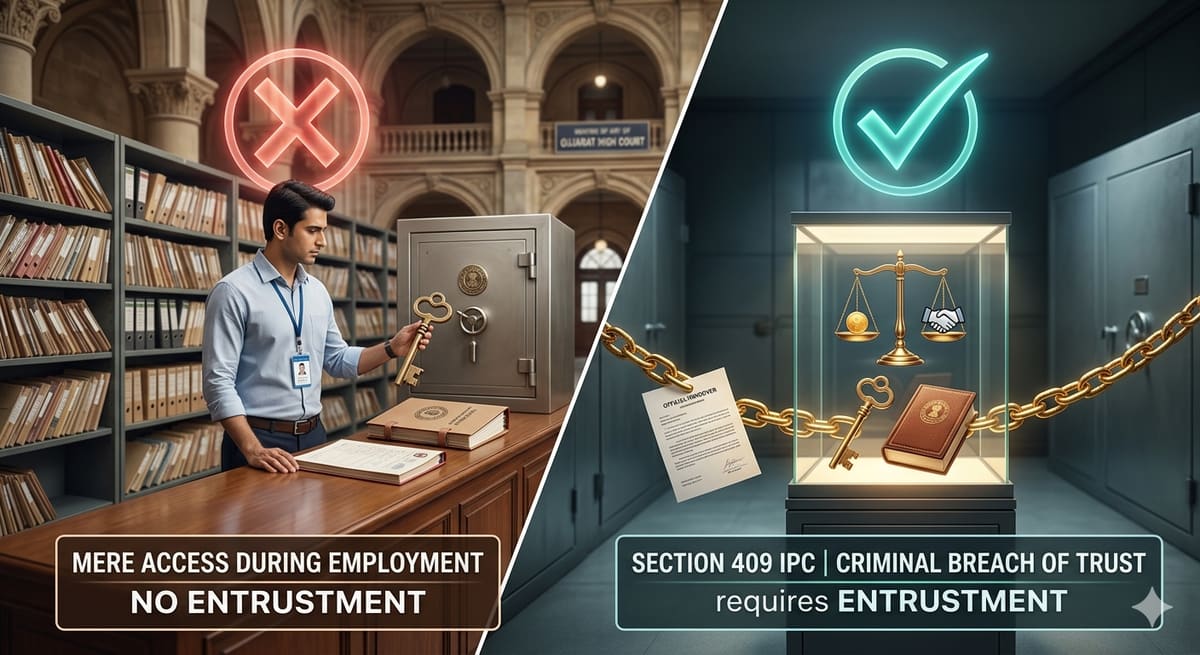
The Allahabad High Court has clarified that a charge under Section 406 IPC cannot be sustained without establishing the essential ingredients of entrustment and subsequent dishonest misappropriation. This ruling reinforces the doctrinal boundary between cheating under Section 420 IPC and criminal breach of trust, offering critical guidance for prosecutors and defense counsel in property-related criminal cases.
Background & Facts
The Dispute
The revisionist, Ajay Pandey, was accused by the opposite party no. 2 of committing an offence under Section 406 IPC in relation to the sale of a plot of land. The complainant alleged that she paid Rs. 1,60,000 to the revisionist for the purchase of the plot and subsequently paid Rs. 70,000 in installments toward an existing bank loan. Later, she discovered that Rs. 6 lakhs in loan arrears remained unpaid, which the revisionist had allegedly concealed at the time of transferring the property. She filed an FIR alleging cheating and criminal breach of trust.
Key Facts
- The complainant paid Rs. 1,60,000 as direct payment to the revisionist on or before the sale transaction
- An additional Rs. 70,000 was paid by the complainant toward the revisionist’s outstanding bank loan on the property
- The revisionist transferred the plot to the complainant without disclosing the full extent of the loan arrears
- The complainant claimed she was induced to pay the Rs. 70,000 under the belief that the loan was fully settled
- The total loan arrears at the time of transfer were Rs. 6 lakhs, which remained unpaid by the revisionist
- No written agreement or formal contract of sale was produced in the record
- The complainant did not allege that the revisionist was entrusted with her money or the property itself
Procedural History
- Date of transaction: Exact date not specified, but occurred prior to FIR filing
- Date of FIR: Not specified in judgment
- Date of investigation: Conducted by local police, concluded with charge-sheet filing
- Date of remand application: Filed by Investigating Officer under Section 420 IPC, rejected by Magistrate
- Date of remand application: Re-filed under Section 406 IPC, accepted by Magistrate
- Date of charge-sheet filing: Filed under Section 406 IPC
- Date of discharge application: Filed by revisionist before trial court
- 17.11.2023: Trial court rejected discharge application without analyzing prima facie case under Section 406 IPC
- 2024: Criminal Revision No. 749 of 2024 filed before Allahabad High Court
- 29.04.2026: Judgment delivered by Hon’ble Justice Subhash Chandra Sharma
Relief Sought
The revisionist sought quashing of the charge-sheet and setting aside of the trial court’s order dated 17.11.2023 rejecting his discharge application, on the ground that no offence under Section 406 IPC was made out.
The Legal Issue
The central question was whether the facts alleged in the FIR and the evidence collected during investigation establish the essential ingredients of criminal breach of trust under Section 405 IPC, specifically entrustment of property and dishonest misappropriation, to sustain a charge under Section 406 IPC.
Arguments Presented
For the Appellant/Petitioner
The learned counsel for the revisionist argued that Section 406 IPC requires a prior relationship of entrustment, where the accused is lawfully in possession of property and then dishonestly converts it to his own use. In this case, the complainant paid money to the revisionist as purchase consideration and toward a loan - not as property entrusted to him for safekeeping or specific use. The concealment of loan arrears, even if fraudulent, amounts to cheating under Section 420 IPC, not criminal breach of trust. The trial court failed to apply the legal test for entrustment and dismissed the discharge application mechanically.
For the Respondent/State
The learned Additional Government Advocate contended that the revisionist’s conduct in concealing material facts about the loan arrears during the sale amounted to dishonest misappropriation of the complainant’s payments. The fact that the complainant paid Rs. 70,000 toward the loan meant that the revisionist was effectively entrusted with those funds to discharge the debt, and his failure to do so constituted misappropriation. The charge-sheet was properly filed and the trial court’s rejection of discharge was within its discretion.
The Court's Analysis
The Court undertook a detailed examination of Section 405 IPC, which defines criminal breach of trust. It emphasized that the provision requires two indispensable elements: (1) entrustment of property or dominion over property, and (2) subsequent dishonest misappropriation or conversion.
"Whoever, being in any manner entrusted with property, or with any dominion over property, dishonestly misappropriates or converts to his own use that property... commits criminal breach of trust."
The Court held that the complainant’s payment of Rs. 1,60,000 was purchase consideration, and Rs. 70,000 was payment toward a pre-existing loan obligation of the revisionist. There was no evidence that the revisionist was entrusted with these sums for a specific fiduciary purpose. The complainant did not hand over money to the revisionist to hold or apply toward the loan; she paid the bank directly or made payments to him with the understanding that he would settle the loan - a contractual obligation, not a trust.
The Court further noted that the trial court’s order dated 17.11.2023 rejecting the discharge application was devoid of any reasoning. It did not analyze whether the ingredients of Section 405 IPC were prima facie satisfied. The court observed that the Investigating Officer had initially sought remand under Section 420 IPC, which was rejected, and only then shifted to Section 406 IPC - suggesting an attempt to fit the facts into a more serious charge without legal basis.
The Court concluded that mere concealment of a debt or misrepresentation in a sale transaction, without entrustment of property, cannot be elevated to criminal breach of trust. The remedy, if any, lies in civil proceedings or prosecution under Section 420 IPC, if the elements of cheating are established.
The Verdict
The revisionist succeeded. The High Court set aside the trial court’s order dated 17.11.2023 rejecting the discharge application. The Court directed the trial court to reconsider the discharge application afresh, applying the correct legal test for entrustment and misappropriation under Section 405 IPC. The charge-sheet under Section 406 IPC stands suspended pending fresh adjudication.
What This Means For Similar Cases
Entrustment Must Be Proven, Not Assumed
- Practitioners must distinguish between contractual obligations and fiduciary entrustment
- Payments made as purchase consideration or toward third-party debts do not constitute entrustment under Section 405 IPC
- Prosecutors cannot rely on allegations of fraud to bootstrap a Section 406 IPC charge
Discharge Applications Require Judicial Scrutiny
- Trial courts cannot reject discharge applications mechanically
- A prima facie case under Section 406 IPC must be established by demonstrating both entrustment and misappropriation
- Failure to apply legal tests renders discharge orders liable to be set aside on revision
Section 420 IPC Remains the Appropriate Charge for Concealment in Sales
- Cases involving concealment of material facts in property transactions should be prosecuted under Section 420 IPC
- Section 406 IPC is not a catch-all provision for dishonest sales - its scope is narrow and strictly defined
- Defense counsel should move for discharge at the earliest opportunity where entrustment is absent