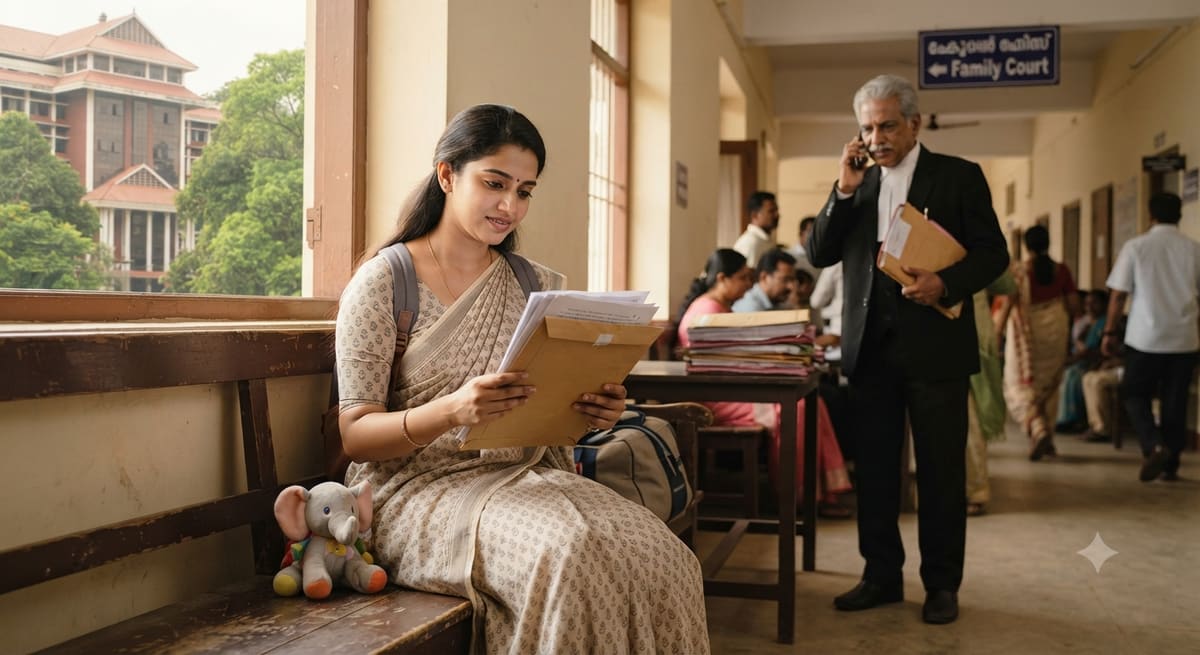
The Allahabad High Court has affirmed that in matrimonial disputes, the convenience of the wife, especially when supported by the opposite party’s consent, is a decisive factor for transferring proceedings under Section 24 of the Code of Civil Procedure. This ruling reinforces the principle that procedural justice must accommodate the practical hardships faced by spouses in异地 litigation.
Background & Facts
The Dispute
The applicant, Smt. Divya Mishra, is the wife in a matrimonial dispute initiated by her husband, Shri Kamlesh Kumar Mishra, who filed a divorce petition under Section 13 of the Hindu Marriage Act, 1955, in the Court of the Principal Judge, Family Court, Ballia (Case No. 683 of 2022). The marriage was solemnized in 2015, after which domestic discord arose. The applicant has been residing at her parental home in Lucknow since the breakdown of the marriage.
Key Facts
- The marriage between the parties took place in 2015
- The divorce petition was filed by the husband in 2022 at Ballia
- The applicant has been residing continuously at her parental residence in Lucknow since the separation
- No children are involved in the dispute
- The applicant contends that litigating in Ballia, a location distant from her residence, imposes severe logistical, emotional, and financial hardship
Procedural History
- 2022: Divorce petition filed by the husband under Section 13 of the Hindu Marriage Act, 1955, in Family Court, Ballia (Case No. 683 of 2022)
- 07.10.2025: Applicant filed Transfer Application (Civil) No. 790 of 2025 before the Allahabad High Court, seeking transfer to Lucknow
- 07.10.2025: High Court, upon hearing preliminary submissions, issued notice and stayed further proceedings in the Ballia court pending disposal of the transfer application
- 27.04.2026: Final hearing before the High Court
The Parties' Positions
The applicant, through counsel R.V. Pandey and Yogesh Kumar Singh, argued that proceeding in Ballia would cause undue hardship due to her residence in Lucknow, lack of local support, and increased cost of travel and accommodation. She emphasized that the transfer would serve the ends of justice by ensuring her meaningful participation.
The opposite party, represented by Anil Kumar Mishra, did not contest the transfer. Counsel explicitly stated, without admitting any allegations, that the husband had no objection to the transfer and had instructed his counsel not to file a counter-affidavit.
Relief Sought
The applicant sought transfer of Case No. 683 of 2022 from the Family Court, Ballia, to the Family Court, Lucknow, under Section 24 of the Code of Civil Procedure, 1908.
The Legal Issue
The central question was whether the High Court may exercise its power under Section 24 of the Code of Civil Procedure, 1908 to transfer a matrimonial case from one jurisdiction to another when the wife, residing in a different location, faces hardship, and the opposite party consents to the transfer.
Arguments Presented
For the Applicant
The applicant’s counsel relied on the principle that Section 24 CPC empowers the High Court to transfer cases to ensure the ends of justice are served. They cited Smt. Akansha Saxena v. Shikhar Saxena, 2026 (3) ADJ 104, and Smt. Arju @ Vimal v. Umakant Parasar, 2026 (3) ADJ 66, where this Court held that in matrimonial matters, the convenience and welfare of the wife must be prioritized. They argued that the applicant’s residence in Lucknow for years, coupled with the absence of any counter-objection, made transfer not only equitable but necessary for fair adjudication.
For the Respondent
The respondent’s counsel did not oppose the transfer. He explicitly stated that the opposite party had no objection to the transfer and had instructed counsel not to file any counter-affidavit. This non-resistance was treated as a clear, voluntary consent to the transfer, removing any adversarial barrier to the applicant’s request.
The Court's Analysis
The Court examined the scope of Section 24 CPC, which permits transfer of cases where it is necessary for the ends of justice. It reaffirmed that in matrimonial disputes, the court must adopt a humane and pragmatic approach, recognizing that litigation in an inconvenient forum can effectively deny access to justice.
"In matrimonial cases, the convenience of the wife must be looked into; the cardinal principle for exercise of power under Section 24 CPC being that the ends of justice should be subserved."
The Court noted that the applicant’s residence in Lucknow since the separation was not disputed, and the husband’s unequivocal consent removed any concern about forum shopping or prejudice to the respondent. The Court emphasized that consent of the parties, particularly in sensitive family matters, is a powerful indicator that transfer will promote efficiency and fairness.
The Court further observed that the transfer would not prejudice the husband’s rights, as the case would proceed from the same stage in Lucknow, and the record would be transmitted in full. The absence of any objection, combined with the established hardship, rendered the transfer not merely permissible but imperative under the doctrine of justice.
The Verdict
The Transfer Application was allowed. The Court directed:
(i) The proceedings of Case No. 683 of 2022 (Kamlesh Kumar Mishra v. Smt. Divya Mishra) be withdrawn from the Family Court, Ballia, and transferred to the Family Court, Lucknow;
(ii) The Family Court, Ballia, shall transmit the entire case record to the Family Court, Lucknow, within fifteen days of receipt of a certified copy of this order;
(iii) The Transferee Court in Lucknow shall proceed with the matter from the stage at which it was transferred and endeavor to conclude the proceedings expeditiously.
What This Means For Similar Cases
Consent Amplifies the Case for Transfer
- Practitioners must document and highlight the opposite party’s explicit non-objection in transfer applications - it significantly strengthens the petition under Section 24 CPC
- A lack of opposition is not passive silence; it is a judicially recognized consent that removes the burden of proving prejudice
Convenience of the Wife Is a Valid Ground, Not a Discretionary Favor
- The Court has elevated the wife’s convenience from a mitigating factor to a central pillar of justice in matrimonial transfers
- Even without allegations of abuse or coercion, prolonged separation from residence constitutes sufficient hardship to warrant transfer
- This applies equally to women residing with parents, in rented accommodation, or in another city for employment or safety
Procedural Efficiency Must Follow Substantive Justice
- Courts must not delay transfer orders on technical grounds when consent exists and hardship is evident
- The directive to conclude proceedings expeditiously signals that transfer is not a delay tactic but a mechanism to accelerate fair resolution
- Practitioners should request specific timelines for record transmission and hearing commencement in their prayers