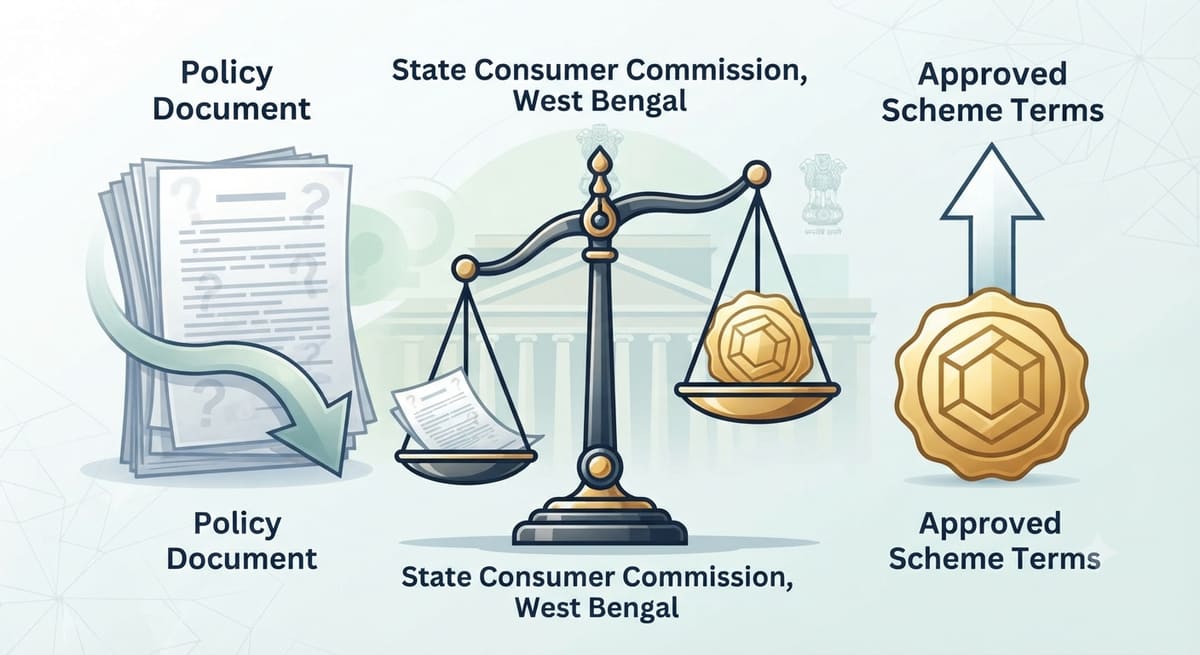
The West Bengal State Consumer Disputes Redressal Commission has delivered a landmark ruling clarifying the interpretation of ambiguous insurance policy language, affirming that the word 'or' in contractual clauses cannot be judicially rewritten to imply 'whichever is earlier.' The decision reinforces the doctrine of contra proferentem and establishes that insurers cannot arbitrarily disregard surveyor reports obtained by their own appointment.
Background & Facts
The Dispute
The dispute arose from the repudiation of an insurance claim under a Machinery Insurance Policy issued by National Insurance Company Ltd. (NICL) to the complainant, West Bengal State Electricity Distribution Company Ltd. (WBSEDCL), for its Purulia Pumped Storage Project (PPSP). The policy, effective from 24.03.2015 to 23.03.2016, required maintenance of generators 'after 32,000 hours of operation or every four years.' On 12.04.2015, Unit No. 4 of the PPSP tripped due to stator winding insulation failure. WBSEDCL submitted a claim of Rs. 5,02,43,002/- on 27.06.2016. NICL delayed responding and ultimately repudiated the claim on 16.10.2019, alleging breach of the maintenance clause.
Key Facts
- The policy was issued on 24.03.2015 with a premium of Rs. 3,37,88,714/-
- Unit No. 4 was commissioned on 12.07.2007 and had operated for approximately 18,400 hours at the time of failure on 12.04.2015
- The policy clause stated: 'overhaul after 32,000 hours of operation or every four years' - with no phrase 'whichever is earlier'
- A surveyor appointed by NICL submitted a Final Survey Report (FSR) on 22.08.2016, assessing net loss at Rs. 4,92,59,843/- after adjusting excess
- The FSR confirmed all preventive maintenance was performed per OEM recommendations
- WBSEDCL made repeated written requests for the FSR on 13.02.2017, 12.04.2017, 13.10.2018, 11.12.2018, and 12.04.2019 - all unanswered
- NICL disclosed repudiation only in its written submission to NCDRC on 16.10.2019
- WBSEDCL filed a complaint before NCDRC on 22.08.2019, withdrew it with permission, and refiled before the State Commission on 05.10.2020
Procedural History
- 12.04.2015: Unit No. 4 tripped
- 20.04.2015: NICL intimated of the incident
- 04.06.2015: Joint inspection conducted by surveyor
- 27.06.2016: Claim submitted by WBSEDCL
- 22.08.2016: Final Survey Report submitted by NICL-appointed surveyor
- 13.02.2017: First written request for FSR
- 16.10.2019: NICL internally repudiated claim
- 22.08.2019: Complaint filed before NCDRC
- 05.10.2020: Complaint refiled before West Bengal State Commission after jurisdictional shift under CP Act, 2019
- 20.04.2026: Judgment delivered by State Commission
The Parties' Positions
Complainant (WBSEDCL): Argued that the policy clause was disjunctive, not hierarchical; no breach occurred as operational hours were well below 32,000; surveyor’s report was conclusive and was wrongfully withheld; delay and non-disclosure amounted to deficiency in service.
Opposite Party (NICL): Contended that 'or every four years' implied a maximum interval; failure to overhaul since 2007 constituted breach; surveyor’s report was non-binding; delay was due to complexity and document submission issues.
Relief Sought
WBSEDCL sought: (1) payment of Rs. 4,92,59,843/- as assessed by the surveyor; (2) 9% interest from 27.06.2016; (3) Rs. 5,00,000/- as compensation for deficiency in service; (4) Rs. 1,00,000/- as litigation costs; and (5) penalties for delay.
The Legal Issue
The central question was whether the phrase 'after 32,000 hours of operation or every four years' in an insurance policy implies a mandatory overhaul at the earlier of the two thresholds, and whether an insurer may repudiate a claim by disregarding its own surveyor’s report without providing cogent, documented reasons.
Arguments Presented
For the Appellant/Petitioner
The complainant relied on the plain grammatical meaning of 'or' as a disjunctive, not conjunctive, term. It cited General Assurance Society Ltd. v. Chandmull Jain (1966) and United India Insurance Co. Ltd. v. Harchand Rai Chandan Lal (2004) to argue that courts cannot insert words like 'whichever is earlier' into insurance contracts. It emphasized that the surveyor’s report, prepared by NICL’s own appointee, confirmed compliance with OEM maintenance standards and assessed a valid loss. It further cited New India Assurance Co. Ltd. v. Pradeep Kumar (2009) and Sri Venkateswara Syndicate v. Oriental Insurance Co. Ltd. (2009) to assert that insurers cannot arbitrarily reject surveyor reports. The delay of over three years and refusal to share the FSR were argued as clear deficiencies in service under the Consumer Protection Act, 1986.
For the Respondent/State
NICL contended that industry practice and commercial intent required the clause to be read as imposing a four-year cap, regardless of operational hours. It cited general principles that surveyor reports are not binding on insurers and argued that the claim was complex, justifying delay. It did not produce any expert rebuttal to the FSR or demonstrate that non-overhauling caused the failure.
The Court's Analysis
The Commission undertook a rigorous textual analysis of the policy clause. It observed that the absence of the phrase 'whichever is earlier' was not an oversight but a deliberate drafting choice. The court held that judicial insertion of such language would violate the settled principle that insurance contracts must be interpreted strictly and not rewritten by courts. The Commission applied the doctrine of contra proferentem, noting that ambiguity in a contract drafted by the insurer must be resolved in favor of the insured.
"The clause, as drafted, employs the disjunctive conjunction 'or' which, in its ordinary grammatical sense, denotes an alternative and not a conjunctive or hierarchical condition."
The Commission further held that the surveyor’s report, prepared by NICL’s own appointee, carried substantial evidentiary weight under Section 64-UM of the Insurance Act, 1938. It cited New India Assurance Co. Ltd. v. Pradeep Kumar to affirm that while insurers are not bound by surveyor reports, they cannot discard them without cogent, documented reasons. NICL failed to produce any expert evidence, second opinion, or technical rebuttal.
The Commission condemned the inordinate delay of over three years in communicating the repudiation, particularly after the surveyor’s report was available in 2016. It noted that repudiation only after initiation of legal proceedings raised a presumption of mala fide. The refusal to provide the FSR, despite repeated requests, was held to be a violation of IRDAI’s transparency norms and a clear deficiency in service.
"Having chosen its expert, the insurer cannot be permitted to approbate and reprobate by selectively relying upon or discarding the report depending on convenience."
The cumulative conduct - non-disclosure, delay, and arbitrary repudiation - was found to be a pattern of unfair practice inconsistent with the principle of uberrima fides governing insurance contracts.
The Verdict
The complainant succeeded. The Commission directed NICL to pay Rs. 4,92,59,843/- as assessed by the surveyor, with interest at 9% per annum from 27.06.2016 until realization. It further awarded Rs. 5,00,000/- as compensation for deficiency in service and Rs. 1,00,000/- as litigation costs. Compliance was mandated within 8 weeks; failure to comply would attract interest at 12% per annum from 27.06.2016 until full payment.
What This Means For Similar Cases
Policy Language Must Be Interpreted Literally
- Practitioners must argue that ambiguous insurance clauses containing 'or' without 'whichever is earlier' cannot be expanded by implication
- Drafting omissions favor the insured under contra proferentem - insurers bear the risk of unclear language
- Always request and preserve the full policy wording; textual precision is decisive
Surveyor Reports Are Binding Unless Rebutted
- Insurers who appoint surveyors cannot later ignore their findings without independent expert evidence
- Failure to produce rebuttal evidence renders repudiation legally unsustainable
- Surveyor reports must be disclosed promptly to insureds under IRDAI guidelines - withholding constitutes deficiency in service
Delay and Non-Disclosure Are Independent Grounds for Liability
- Delays exceeding 12 months in claim settlement, especially post-surveyor report, are prima facie deficient
- Repudiation after litigation begins invites adverse inference of mala fide
- Compensation for harassment and litigation costs is now routinely awarded in such cases