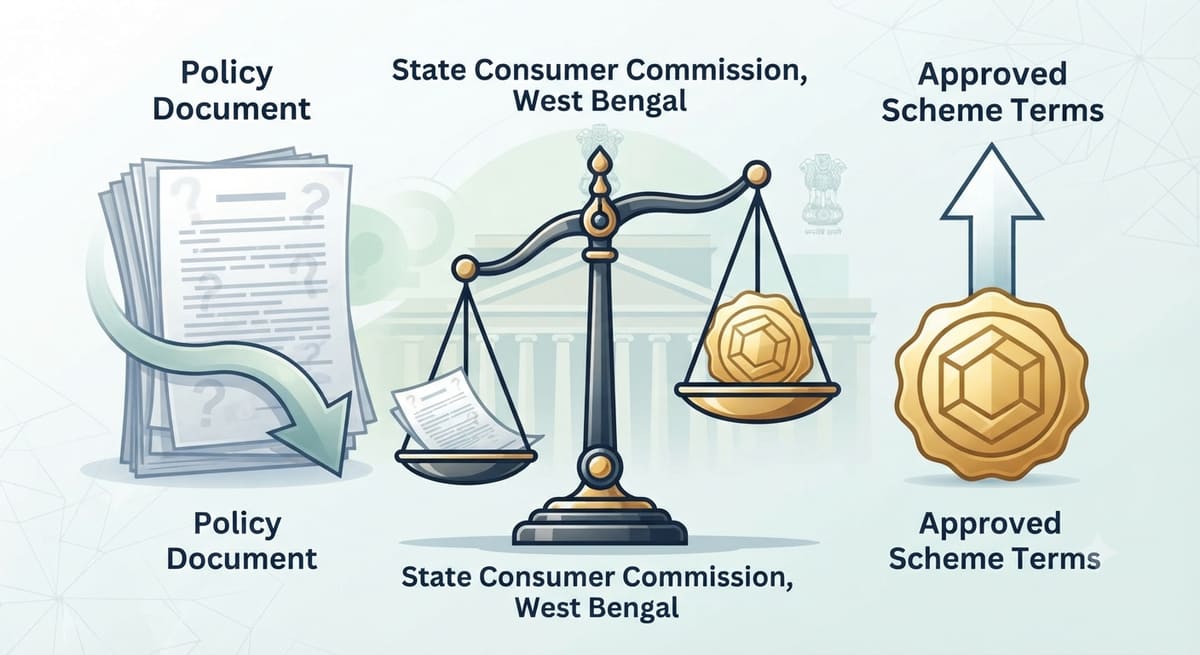
The State Consumer Disputes Redressal Commission, West Bengal has modified a District Forum order in a dispute over the maturity value of a Life Insurance Corporation (LIC) Jeevan Saral policy. The Commission held that while the policy document contained an ambiguous entry, the insurer was not contractually bound to pay a maturity benefit higher than the amount prescribed under the approved scheme terms. However, the insurer's failure to detect and rectify the ambiguity for over a decade constituted deficiency in service, warranting compensation of Rs.50,000.
Background & Facts
The Genesis of the Policy
The Respondents/Complainants (R/Cs), Sri Samir Kumar Nandy and Sri Pabitra Mohan Chakraborty, were issued a "Jeevan Saral (Plan No. 165)" Life Insurance Policy bearing No. 435909359 by the Appellants/Opposite Parties (A/Os), Life Insurance Corporation of India (LIC), on 18.03.2004. The policy was issued on payment of an annual premium of Rs.3,002/- for a term of twelve years, maturing on 18.03.2016. The R/Cs regularly paid all premiums throughout the policy term, and no default was alleged by the A/Os.
The Discrepancy in the Policy Document
The controversy arose from the policy document, which showed a figure of Rs.62,500/- against the "Death Benefit Sum Assured" column. No figure was printed against the "Maturity Sum Assured" column. The R/Cs contended that this figure represented the Maturity Sum Assured, while the A/Os later claimed it was a typographical error and that the correct Maturity Sum Assured was Rs.27,932/-.
The Insurer's Communications
On 09.09.2015, nearly eleven years after the policy's issuance and months before its maturity, the A/Os informed the R/Cs that the Maturity Sum Assured had been wrongly shown as Rs.62,500/- and that the correct amount was Rs.27,932/-. By letter dated 11.12.2015, the A/Os intimated the maturity payable as Rs.37,708/-, comprising Maturity Sum Assured of Rs.27,932/- and bonus of Rs.9,776/-. The R/Cs sought clarification through a representation dated 06.01.2016, which went unaddressed. A legal notice dated 02.05.2016 demanded Rs.62,500/-, and the A/Os reiterated their stand in a reply dated 17.05.2016.
Procedural History
26.03.2016: A/Os again communicated the typographical error and the correct Maturity Sum Assured of Rs.27,932/-.
26.03.2016: R/Cs filed Complaint Case No. 140 of 2016 before the District Consumer Disputes Redressal Forum, Hooghly, alleging deficiency in service and unfair trade practice.
16.10.2017: District Forum allowed the complaint, directing the A/Os to pay Rs.62,500/- towards maturity value, Rs.70,000/- as compensation for mental agony, and Rs.10,000/- as litigation cost.
23.07.2026: State Consumer Disputes Redressal Commission, West Bengal allowed the appeal in part, modifying the District Forum's order.
The Parties' Positions
The A/Os argued that the figure of Rs.62,500/- was the Death Benefit Sum Assured, calculated as 250 times the monthly premium, and that the Maturity Sum Assured was Rs.27,932/- as per the approved Jeevan Saral Scheme. They relied on the proposal form, policy terms, and Maturity Sum Assured Table to demonstrate that the maturity benefit was actuarially determined and not synonymous with the Death Benefit Sum Assured.
The R/Cs contended that the policy bond constituted the primary evidence of the contract and that the insurer was estopped from altering the contractual terms after accepting premiums for twelve years. They argued that the insurer's failure to correct the error within the fifteen-day free-look period rendered the defence untenable.
The Legal Issue
The central question was whether the ambiguity in the policy document, standing alone, entitled the R/Cs to payment of Rs.62,500/- as the Maturity Sum Assured, notwithstanding the approved scheme terms and documentary evidence produced by the A/Os.
Arguments Presented
For the Appellant/Petitioner
The A/Os argued that the policy document was ambiguous and that the figure of Rs.62,500/- represented the Death Benefit Sum Assured, not the Maturity Sum Assured. They relied on the proposal form, which showed "250 × 250 = 62,500" against the Death Benefit Sum Assured column, and the Maturity Sum Assured Table, which indicated a Maturity Sum Assured of Rs.27,932/- for the R/Cs' age and policy tenure. They contended that the Consumer Commission could not rewrite the contract to substitute one contractual benefit for another merely due to a clerical error.
For the Respondent/State
The R/Cs argued that the policy bond was the primary evidence of the contract and that the insurer was bound by the representation of Rs.62,500/- as the Maturity Sum Assured. They contended that the insurer's failure to correct the error within the free-look period and the prolonged ambiguity constituted deficiency in service. They also highlighted the inconsistency in the A/Os' defence regarding the nature of the alleged error.
The Court's Analysis
The Commission examined the policy document, proposal form, Jeevan Saral Scheme terms, and Maturity Sum Assured Table. It noted that the policy document was ambiguous, with the figure of Rs.62,500/- placed against the Death Benefit Sum Assured column and no figure against the Maturity Sum Assured column. The proposal form showed "250 × 250 = 62,500" against the Death Benefit Sum Assured column, consistent with the A/Os' contention that this figure represented the Death Benefit Sum Assured.
The Commission held that the Maturity Sum Assured under the Jeevan Saral Scheme was determined actuarially and was not synonymous with the Death Benefit Sum Assured. The Maturity Sum Assured Table produced by the A/Os indicated a Maturity Sum Assured of Rs.27,932/- for the R/Cs' age and policy tenure. The Commission found that the R/Cs had not produced any contrary actuarial material or document demonstrating that the Maturity Sum Assured ought to have been Rs.62,500/-.
"The policy document, when examined in isolation, undoubtedly suffers from lack of clarity. The placement of the figure 'Rs.62,500/-' in the printed format is capable of creating uncertainty, particularly because no figure appears against the column meant for the Maturity Sum Assured. However, a contract cannot be interpreted by isolating a single printed entry divorced from the remaining contractual documents forming part of the same transaction."
The Commission rejected the R/Cs' contention that the insurer was estopped from altering the contractual terms after the free-look period. It held that the free-look provision afforded an option to the policyholder to examine the policy terms and seek cancellation if dissatisfied, but could not be construed as preventing the insurer from establishing the actual contractual terms by reference to the governing scheme and foundational documents.
The Commission also rejected the R/Cs' argument that the aggregate premium paid necessarily constituted the minimum maturity value payable. It held that the premium under a life insurance contract was not appropriated exclusively towards the maturity corpus but also represented consideration for mortality risk and other contractual benefits.
However, the Commission found that the A/Os' conduct was unsatisfactory. The ambiguity in the policy schedule was entirely of their own making, and the error remained unnoticed for nearly eleven years. The defence projected by the A/Os was inconsistent, with different descriptions of the alleged mistake in the Memorandum of Appeal and Brief Notes of Argument. The Commission held that these lapses constituted deficiency in service within the meaning of the Consumer Protection Act.
The Verdict
The Appeal succeeded in part. The Commission set aside the direction to pay Rs.62,500/- towards the maturity value. The A/Os were directed to pay the maturity amount together with admissible bonus strictly in accordance with the terms and conditions of the Jeevan Saral Policy, after adjustment of any payment already made. The A/Os were also directed to pay a consolidated compensation of Rs.50,000/- for deficiency in service, and the litigation cost of Rs.10,000/- was affirmed. The amounts were to be paid within 45 days from the date of the order, failing which the compensation would carry interest at 9% per annum from the date of default until realization.
What This Means For Similar Cases
Ambiguity in Policy Documents Does Not Override Approved Scheme Terms
Practitioners must advise clients that ambiguity in a policy document, standing alone, does not entitle policyholders to benefits higher than those prescribed under the approved scheme terms. Insurers cannot be held contractually liable for clerical errors unless the policyholder can demonstrate that the error created an enforceable contractual obligation.
Key takeaway: Always examine the proposal form, policy terms, and scheme documents to determine the true contractual obligations.
Action point: Advise clients to scrutinize policy documents for ambiguities and seek clarifications within the free-look period.
Insurers' Conduct and Deficiency in Service
The Commission emphasized that insurers' failure to detect and rectify ambiguities in policy documents for prolonged periods constitutes deficiency in service. This principle applies to all standard-form contracts where insurers are expected to maintain precision and consistency.
Key takeaway: Insurers must ensure clarity and consistency in policy documents to avoid liability for deficiency in service.
Action point: Document all communications and representations made by insurers to policyholders to mitigate risks of deficiency claims.
Consumer Commissions' Role in Enforcing Contracts
The Commission held that Consumer Commissions are required to enforce the contract actually entered into between the parties and not to rewrite it by substituting one contractual benefit for another merely due to a clerical lapse. This principle reinforces the sanctity of contractual terms and the limits of consumer fora's jurisdiction.
Key takeaway: Consumer fora cannot alter contractual terms based on perceived ambiguities or errors unless the error is established as creating an enforceable obligation.
Action point: Advise clients to challenge consumer fora orders that rewrite contractual terms without adequate justification.