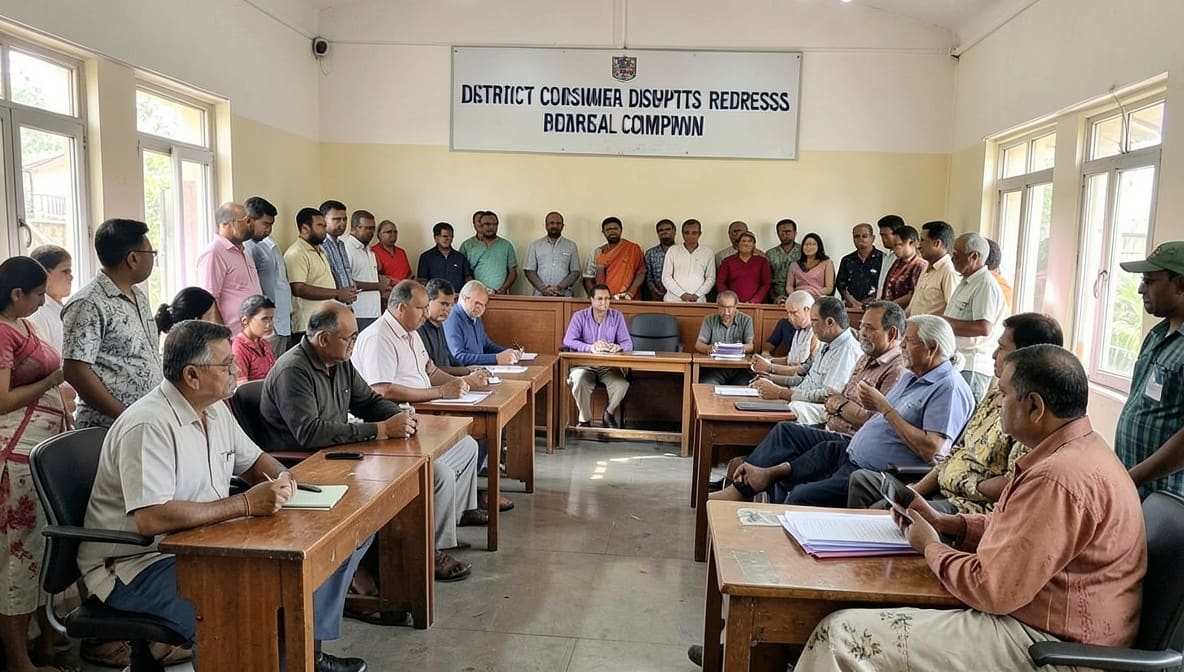
The Madhya Pradesh High Court has affirmed that the continuity of justice in consumer forums cannot be compromised due to administrative delays in framing new appointment rules. In a decisive order, the Court permitted sitting members of District Consumer Disputes Redressal Commissions to continue in office beyond their fixed tenure until new appointments are made under revised regulations.
Background & Facts
The Dispute
The petitioner, Seema Saxena, is a Member of the District Consumer Disputes Redressal Commission, Rajgarh, Madhya Pradesh. Her tenure under the Consumer Protection (Qualification for appointment, method of recruitment, procedure of appointment, term of office, resignation and removal of the Presidents and Members of the State Commission and District Commission) Rules, 2020, was set to expire in April 2026. With no new recruitment rules notified and no appointments made, she sought continuation in office to prevent disruption in the functioning of the Commission.
Key Facts
- The petitioner was appointed as Member, District Consumer Commission, Rajgarh, under the Consumer Protection Rules, 2020
- Her tenure is governed by Rule 10(2) of the 2020 Rules, which has been declared invalid by the Supreme Court
- The Supreme Court, in Ganeshkumar Rajeshwarrao Selukar and others v. Mahendra Bhaskar Limaye and Others (2025 SCC Online SC 1193), struck down Rule 10(2) of the 2020 Rules on 15.03.2025
- As of the date of the judgment, no new recruitment rules have been notified by the Central Government
- The petitioner’s tenure is scheduled to end in April 2026
- No successor has been appointed or notified
Procedural History
- 15.03.2025: Supreme Court invalidates Rule 10(2) of the Consumer Protection Rules, 2020 in Ganeshkumar Rajeshwarrao Selukar v. Mahendra Bhaskar Limaye
- 28.05.2025: Delhi High Court, in WP(C) No. 7538/2025, permits sitting Presidents and Members of Consumer Commissions to continue till new appointments are made
- 01.04.2026: Petitioner files Writ Petition No. 12749 of 2026 before the Madhya Pradesh High Court seeking continuation
- 20.04.2026: Hearing conducted before Justice Vishal Dhagat
- 20.04.2026: Judgment delivered
The Parties' Positions
For the Petitioner
The petitioner’s counsel, Shri Naman Gupta, argued that the invalidation of Rule 10(2) created a legal vacuum. He relied on the Delhi High Court’s order dated 28.05.2025, which had granted similar relief to members of consumer commissions in Delhi. He emphasized that discontinuing members would lead to functional paralysis of District Commissions, denying litigants access to justice.
For the Respondent-State
The Government Advocate, Ms. Swati Aseem George, contended that the petitioner’s tenure was fixed under statutory rules and could not be extended beyond its term. She argued that continuation without fresh appointment would violate the principle of rule of law and statutory compliance.
Relief Sought
The petitioner sought an order permitting her, and by extension all sitting Members and Presidents of District and State Consumer Commissions, to continue in office until new appointment rules are notified and appointments are made in accordance with law.
The Legal Issue
The central question was whether sitting Members and Presidents of District and State Consumer Commissions may continue in office beyond the expiry of their fixed tenure when the statutory rules governing their appointment have been struck down and no replacement rules have been notified.
Arguments Presented
For the Petitioner
The petitioner relied on the Supreme Court’s judgment in Ganeshkumar Rajeshwarrao Selukar v. Mahendra Bhaskar Limaye, which invalidated Rule 10(2) of the 2020 Rules. Counsel argued that the Court’s declaration of invalidity did not imply immediate removal of incumbents. He cited the Delhi High Court’s order dated 28.05.2025 as binding precedent in identical circumstances. He further invoked the doctrine of necessity and the constitutional obligation under Article 21 to ensure access to justice.
For the Respondent-State
The State contended that statutory tenures are sacrosanct and cannot be extended by judicial fiat. It argued that continuation without fresh appointment would amount to unauthorized exercise of power and violate the principle of separation of powers. The State also raised concerns about the legality of service continuation without a valid rule framework.
The Court's Analysis
The Court acknowledged the Supreme Court’s invalidation of Rule 10(2) but emphasized that the declaration of invalidity does not automatically terminate the service of incumbents. The Court observed that the absence of new rules creates a vacuum that cannot be filled by leaving consumer forums without functional members.
"The continuation of Members and Presidents is not an extension of tenure but a necessary measure to ensure the uninterrupted delivery of justice in consumer forums."
The Court distinguished between the invalidity of the rule and the status of the incumbent. It noted that the Delhi High Court’s order, rendered in identical circumstances, was persuasive and aligned with the principle of judicial economy and public interest. The Court held that allowing the posts to remain vacant would cause irreparable harm to litigants, particularly vulnerable consumers who rely on these forums for timely redressal.
The Court further held that the doctrine of necessity, recognized in administrative law, permits temporary continuation where statutory machinery has been rendered dysfunctional through no fault of the incumbents. The Court rejected the State’s argument that continuation violates rule of law, noting that the rule of law requires functional institutions, not institutional paralysis.
The Verdict
The petition was allowed. The Court directed that all sitting Members and Presidents of District and State Consumer Commissions in Madhya Pradesh shall continue in office beyond the expiry of their fixed tenure until new appointment rules are notified and fresh appointments are made. No deadline for notification was imposed, but the State was urged to expedite the process. The order applies prospectively to all such incumbents, ensuring continuity of service without retroactive effect.
What This Means For Similar Cases
Continuity Over Vacancy in Quasi-Judicial Bodies
- Practitioners may now invoke this judgment to seek continuation of members in other statutory tribunals where appointment rules are struck down and new rules are pending
- The principle applies equally to members of NCLT, NGT, and other quasi-judicial bodies with fixed-term appointments
- Filing a writ petition becomes a viable remedy when institutional functionality is at risk
Judicial Reliance on Parallel High Court Orders
- This judgment reinforces that High Courts may adopt the reasoning of other High Courts in identical factual matrices, even if not binding
- It establishes a precedent for cross-jurisdictional judicial comity in administrative law matters
- Lawyers should cite parallel orders from other High Courts as persuasive authority in similar petitions
No Automatic Termination Upon Rule Invalidity
- The judgment clarifies that invalidation of a rule does not ipso facto terminate service
- Service continuation is permissible until a lawful replacement mechanism is established
- This protects public interest and prevents administrative chaos