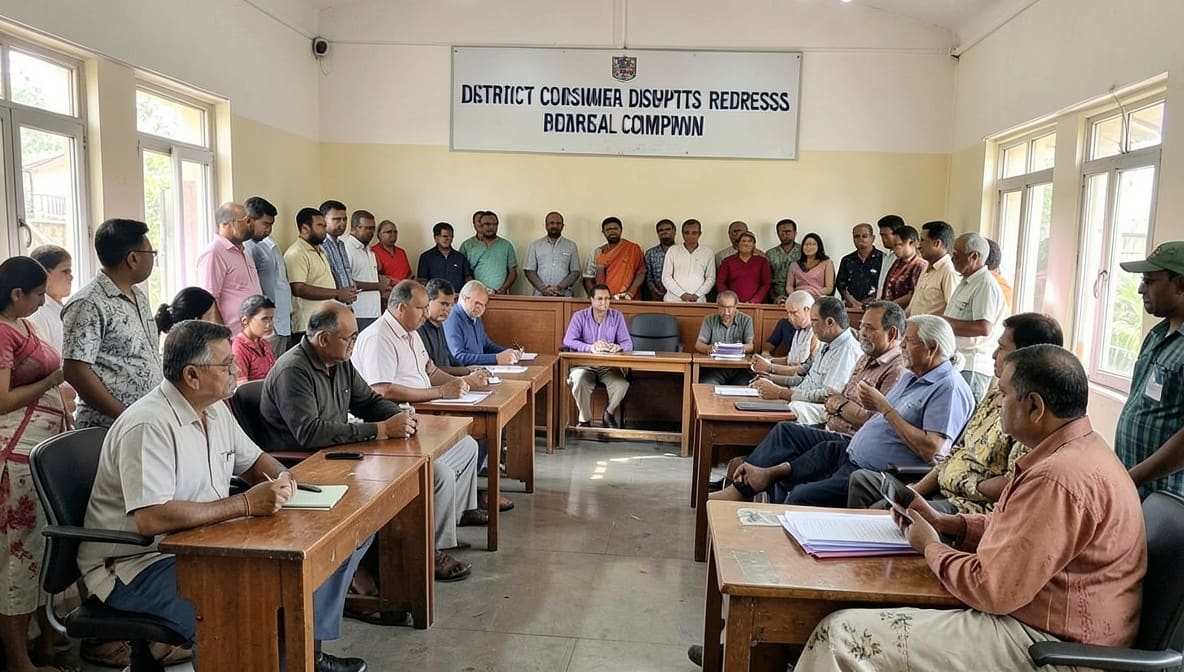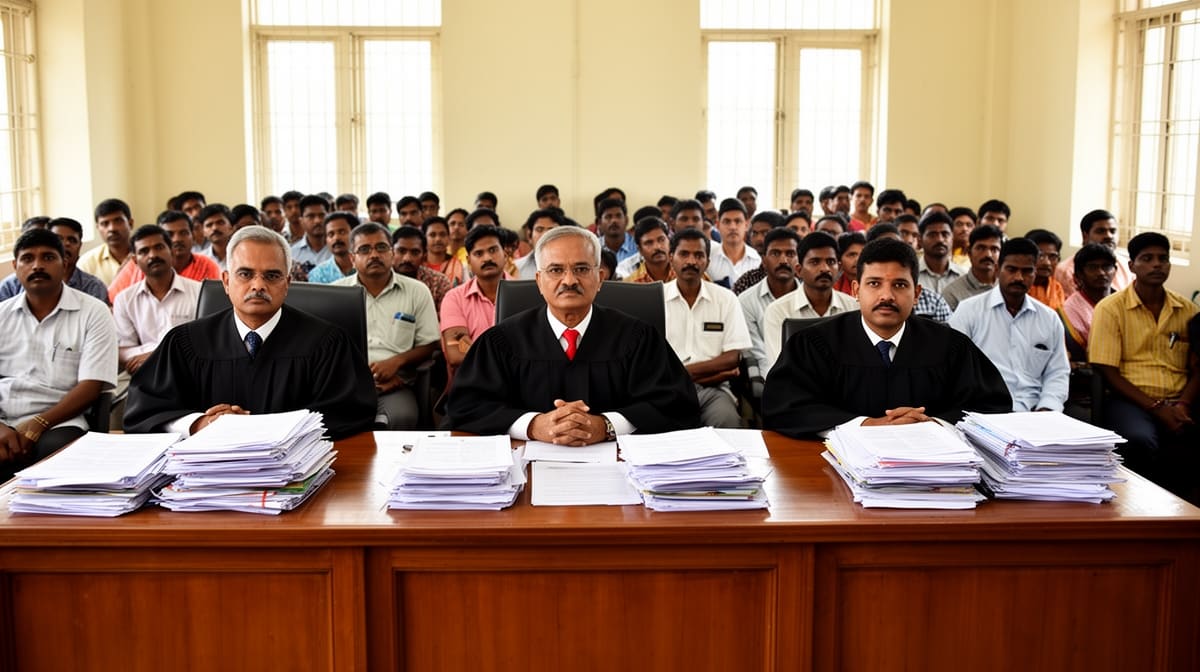
The Madhya Pradesh High Court has affirmed that the functioning of District Consumer Commissions cannot be paralyzed due to regulatory vacuum, permitting sitting members to continue beyond their fixed tenure until new appointment rules are notified. This order ensures uninterrupted adjudication of consumer disputes across the state, reinforcing the principle that institutional functionality must prevail over procedural gaps.
Background & Facts
The Dispute
The petitioner, Rajeev Krishna Sharma, is a Member of the District Consumer Disputes Redressal Commission in Shivpuri, Madhya Pradesh. His tenure under the Consumer Protection (Qualification for appointment, method of recruitment, procedure of appointment, term of office, resignation and removal of the Presidents and Members of the State Commission and District Commission) Rules, 2020, is scheduled to expire on 10.04.2026. He seeks continuation in office beyond this date, citing a recent Supreme Court judgment that invalidated Rule 10(2) of the 2020 Rules, leaving no valid legal framework for appointments.
Key Facts
- The petitioner was appointed as Member, District Consumer Commission, Shivpuri, under the Consumer Protection Rules, 2020
- His current tenure ends on 10.04.2026
- On 15.12.2025, the Supreme Court in Ganeshkumar Rajeshwarrao Selukar v. Mahendra Bhaskar Limaye (2025 SCC Online SC 1193) struck down Rule 10(2) of the 2020 Rules, holding it ultra vires the parent Act
- As a result, no new appointments can be made under the invalidated rules
- The Central Government has not yet notified replacement rules
- On 28.05.2025, the Delhi High Court in WP(C) No. 7538/2025 permitted sitting Presidents and Members of Consumer Commissions to continue in office until new rules are framed
Procedural History
- 10.04.2026: Scheduled end of petitioner’s tenure
- 15.12.2025: Supreme Court invalidates Rule 10(2) of the Consumer Protection Rules, 2020
- 28.05.2025: Delhi High Court grants continuation relief to Consumer Commission members
- 05.03.2026: Writ Petition No. 8757 of 2026 filed before the Madhya Pradesh High Court, Jabalpur
- 12.03.2026: Hearing conducted before Justice Vishal Dhagat
Relief Sought
The petitioner seeks an order permitting him and other similarly situated Members and Presidents of District and State Consumer Commissions to continue in office beyond the expiry of their tenure until new appointment rules are notified and appointments are made under them.
The Legal Issue
The central question was whether Members and Presidents of District and State Consumer Commissions may continue in office beyond the expiry of their fixed tenure when the governing appointment rules have been struck down and no replacement rules have been notified.
Arguments Presented
For the Petitioner
The petitioner’s counsel relied on the Supreme Court’s judgment in Ganeshkumar Rajeshwarrao Selukar v. Mahendra Bhaskar Limaye, which invalidated Rule 10(2) of the 2020 Rules, rendering the legal basis for tenure non-existent. He argued that discontinuing members would create a vacuum in the consumer justice system, leading to massive backlogs and denial of access to justice. He cited the Delhi High Court’s order dated 28.05.2025 as binding precedent in identical circumstances.
For the Respondent
The Government Advocate contended that the petitioner’s tenure is statutorily fixed and cannot be extended beyond 10.04.2026 without express legal authority. He argued that continuation beyond tenure would violate the principle of rule of law and that the executive must act within the confines of existing law, even if imperfect.
The Court's Analysis
The Court acknowledged the constitutional imperative of ensuring access to justice and the functional necessity of Consumer Commissions. It noted that the Supreme Court’s invalidation of Rule 10(2) did not extinguish the statutory mandate under the Consumer Protection Act, 2019, to establish and maintain District Commissions. The Court emphasized that the absence of replacement rules is a legislative and executive failure, not a justification for institutional paralysis.
"The continuation of Members and Presidents beyond their tenure is not an extension of service but a necessary measure to prevent collapse of a statutory mechanism designed for speedy redressal of consumer grievances."
The Court found the Delhi High Court’s reasoning persuasive and consistent with the doctrine of necessity and the principle of utmost good faith in public administration. It held that allowing the petitioner and others to continue would not violate any statutory provision, as the rules under which they were appointed have been declared invalid, leaving no legal barrier to their continued functioning.
The Court further observed that the Consumer Protection Act, 2019, contemplates a robust, accessible, and continuous system of redressal. Discontinuing members would undermine this objective and cause irreparable harm to litigants awaiting adjudication.
The Verdict
The petition is allowed. The Court directs that all sitting Members and Presidents of District and State Consumer Commissions in Madhya Pradesh shall continue in office beyond the expiry of their tenure until new appointment rules are notified and appointments are made under them. This order applies to all such officers whose tenure has expired or will expire before the notification of replacement rules. No further extensions shall be permitted beyond the issuance of new rules.
What This Means For Similar Cases
Continuity of Statutory Bodies Trumps Technical Tenure Expiry
- Practitioners may now invoke this judgment to seek continuation for members of quasi-judicial bodies when governing rules are struck down and no replacement exists
- Courts are likely to apply the doctrine of necessity to prevent institutional collapse in consumer, labor, and environmental tribunals
- The burden shifts to the executive to notify replacement rules within a reasonable timeframe
Precedent from Other High Courts Is Binding in Similar Contexts
- The Madhya Pradesh High Court explicitly adopted the Delhi High Court’s reasoning, affirming that identical factual matrices across jurisdictions create binding persuasive authority
- Lawyers should cite parallel orders from other High Courts when seeking interim relief in analogous situations
- This reinforces the trend of inter-court judicial comity in protecting public interest institutions
No Automatic Termination Without Replacement Framework
- The judgment establishes that statutory officers cannot be unilaterally removed merely because their appointment rules are invalidated
- Any termination must be preceded by a lawful replacement mechanism
- This principle may extend to other bodies like State Human Rights Commissions, Lokayuktas, and regulatory authorities