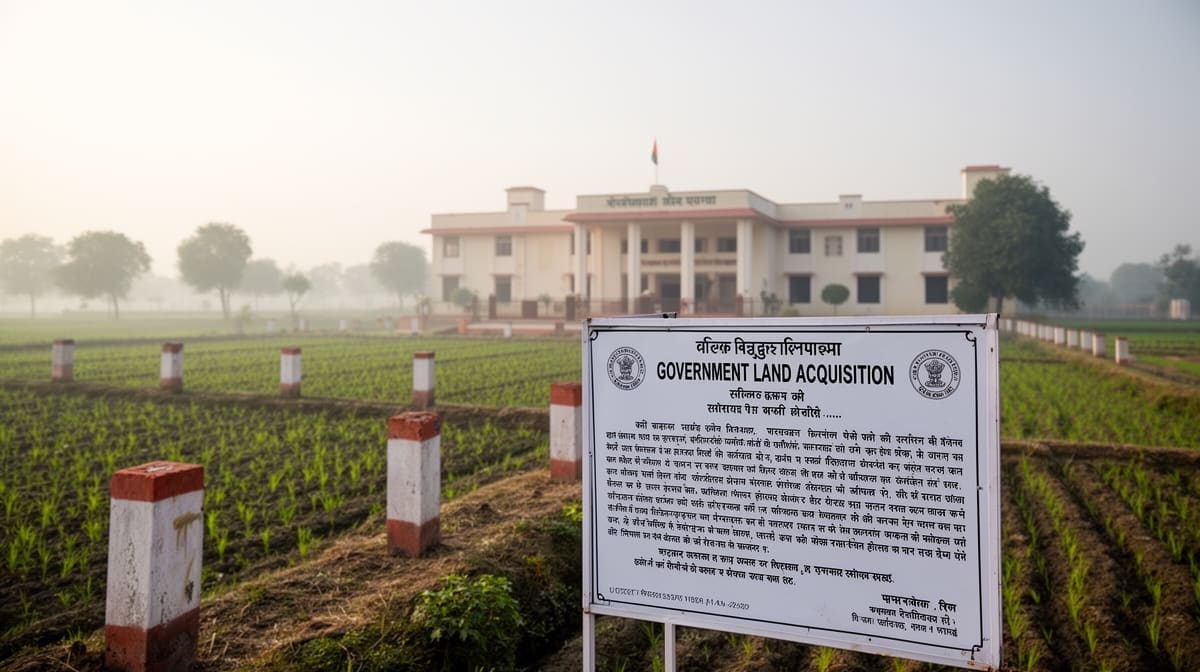
The High Court of Telangana has issued a significant directive requiring state authorities to justify why landowners were compensated at 600 square yards per acre when a formal memo promised 1000 square yards per acre. This order reinforces the constitutional guarantee against arbitrary deprivation of property and sets a clear standard for administrative accountability in land acquisition cases.
Background & Facts
The Dispute
The petitioner, Kothadhi Narsamma, surrendered three acres of her agricultural land in Sy.No. 62, Medipally Mandal, pursuant to a formal memorandum issued by the State Revenue Department on 08.05.2018. The memo, numbered 7279/ASSN.II(3)/2018-1, explicitly stated that landowners would be allotted 1000 square yards of developed land per acre surrendered in HMDA layouts as compensation. Despite this commitment, the respondents allotted only 600 square yards per acre, without explanation or legal basis.
Procedural History
The petitioner filed a writ petition under Article 226 of the Constitution seeking:
- A declaration that the reduced compensation is illegal and violative of Articles 14, 21, and 300A
- A writ of mandamus directing the allotment of 3000 square yards (1000 sq.yards/acre × 3 acres)
- An interim order restraining interference with her possession of the original land
The Court had previously issued interim directions on 11.08.2023 and 16.10.2023, which remained uncomplied with.
Relief Sought
The petitioner seeks enforcement of the State’s own policy as embodied in the 2018 memo, demanding specific identification of plots for the 3000 sq.yards of developed land, and protection of her possession until such allotment is made.
The Legal Issue
The central question was whether the State can unilaterally reduce compensation from the promised ratio of 1000 sq.yards per acre to 600 sq.yards per acre without statutory authority or rational justification, thereby violating Article 300A and the principle of legitimate expectation.
Arguments Presented
For the Petitioner
The petitioner’s counsel relied on State of Maharashtra v. Manubhai Pragjibhai Patel to argue that when the State makes a specific, unambiguous promise in an official memo, it creates a legitimate expectation enforceable under Article 300A. The reduction in compensation was arbitrary, lacked transparency, and violated the principle of non-arbitrariness under Article 14. The petitioner also cited K.S. Puttaswamy v. Union of India to emphasize that property rights are integral to personal liberty.
For the Respondent
The State did not file a detailed counter-affidavit. The Assistant Government Pleader and HMDA counsel offered no documentary or policy basis for the reduced compensation. They merely requested time to furnish information, indicating no substantive defense to the discrepancy.
The Court's Analysis
The Court examined the binding nature of official memoranda issued by state departments. It held that such documents, when issued in the course of public administration and relied upon by citizens, acquire legal significance. The Court emphasized that Article 300A requires that deprivation of property must be by authority of law, and that administrative convenience cannot override a clear, public commitment.
"A promise made by the State in an official memorandum, upon which a citizen has acted to surrender valuable land, cannot be cavalierly withdrawn or diluted without a valid, transparent, and lawful reason."
The Court noted that the respondents failed to produce any rule, notification, or policy document justifying the reduction from 1000 to 600 sq.yards. The absence of such documentation rendered the action arbitrary. The Court further observed that the petitioner had acted in good faith, surrendering her land based on the State’s assurance, and therefore, the doctrine of legitimate expectation was squarely engaged.
The Court also rejected the notion that compensation could be determined ad hoc. It held that procedural fairness demands that any deviation from a published policy must be explained with reference to objective criteria, not administrative discretion.
The Verdict
The petitioner prevailed. The Court held that the State cannot unilaterally reduce promised compensation without lawful justification, and directed the respondents to furnish a detailed explanation for the discrepancy within the stipulated time. The Court further ordered the Revenue Divisional Officer to appear personally to explain the modalities of land acquisition and compensation calculation.
What This Means For Similar Cases
Promised Compensation Is Legally Binding
- Practitioners must now treat official memoranda issued by revenue or development authorities as enforceable commitments, not mere policy statements
- Where citizens surrender land based on such promises, courts will enforce them under Article 300A and the doctrine of legitimate expectation
- Any deviation must be justified by a published rule, notification, or rational policy rationale
Documentation Is Non-Negotiable
- Authorities must maintain and produce records justifying compensation ratios
- Failure to produce documentation will be treated as evidence of arbitrariness
- In future litigation, petitioners should demand production of the original policy document and compensation calculation sheets as part of discovery
Interim Possession Rights Are Protected
- Courts are increasingly willing to restrain interference with possession of surrendered land until replacement is secured
- Petitioners should routinely seek interim protection under Section 151 CPC in land acquisition cases
- The Court’s direction to preserve possession reinforces that deprivation without substitution violates constitutional norms