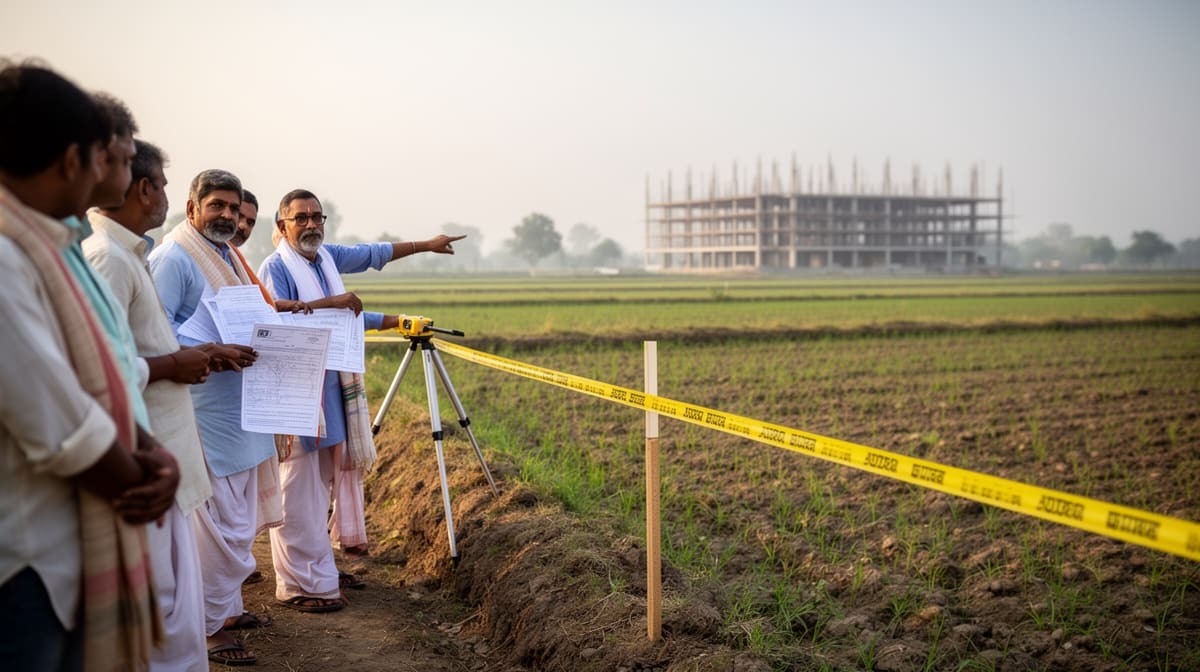
The Punjab & Haryana High Court has reinforced the parity principle in land acquisition compensation cases, holding that similarly situated landowners must receive equal treatment under Section 18 of the Land Acquisition Act, 1894. This judgment clarifies that once a coordinate bench has enhanced compensation for lands acquired under identical notifications, subsequent appeals must follow the same precedent to avoid unjust discrimination.
Background & Facts
The Dispute
The appellants, landowners from village Sewli in Sonipat district, challenged the compensation awarded for their land acquired by the Haryana government for the Rajiv Gandhi Education City project. The Land Acquisition Collector's award was initially enhanced by the Reference Court under Section 18 of the Land Acquisition Act, 1894, but the appellants sought further enhancement through RFA-4682-2014.
Procedural History
The case followed a complex trajectory through multiple judicial forums:
- 2012: Reference Court enhanced compensation under Section 18
- 2014: RFA-4682 filed before Punjab & Haryana High Court
- 2015: Coordinate Bench disposed of the appeal along with similar matters
- 2016: Supreme Court granted liberty to file review petitions after noting discrepancies
- 2019: Coordinate Bench in HSIDC v. Rajesh Kumar-II enhanced compensation for similarly situated landowners
- 2026: Present judgment disposing of RFA-4682 in terms of the 2019 precedent
Relief Sought
The appellants sought:
- Disposal of RFA-4682 in terms of the 2019 judgment in HSIDC v. Rajesh Kumar-II
- Enhanced compensation with statutory benefits under the Land Acquisition Act, 1894
- Correction of clerical errors in the memo of parties regarding village name and LAC case number
The Legal Issue
The central question was whether the parity principle requires identical compensation for landowners whose properties were acquired under the same notifications and proceedings, when a coordinate bench had already enhanced compensation for similarly situated landowners in the same acquisition.
Arguments Presented
For the Appellants
The appellants contended that:
- Their land was acquired under identical Sections 4 and 6 notifications as those in HSIDC v. Rajesh Kumar-II
- The Reference Court proceedings and Land Acquisition Collector's award were identical to those in the precedent case
- The State had conceded that the present case was covered by the 2019 judgment
- Denial of equal compensation would violate principles of natural justice and equality before law under Article 14 of the Constitution
For the Respondent/State
The State, through its counsel:
- Did not oppose the correction of clerical errors in CM-1413-CI-2020
- Conceded that the present case was factually identical to HSIDC v. Rajesh Kumar-II
- Did not contest the application of the 2019 judgment to dispose of RFA-4682
The Court's Analysis
The Court conducted a three-pronged analysis to establish the applicability of the parity principle:
-
Factual Identity Test: The Court examined whether the appellants' land was acquired under the same notifications and proceedings as those in HSIDC v. Rajesh Kumar-II. It found that:
- The land formed part of the same acquisition for Rajiv Gandhi Education City
- The Sections 4 and 6 notifications were identical
- The Land Acquisition Collector's award and Reference Court proceedings were the same
- The State had conceded these factual similarities
-
Precedential Consistency: The Court noted that:
"Once the State has conceded the factual position and this Court, in RFA No.4101-2008 titled HSIDC v. Rajesh Kumar-II and others decided on 05.07.2019 has enhanced compensation for lands forming part of the same acquisition, denial of the same benefit to the present applicants would be wholly unjustified."
The judgment emphasized that judicial consistency requires coordinate benches to follow established precedents unless distinguishable facts exist.
-
Equity and Natural Justice: The Court invoked Article 14 of the Constitution to hold that:
- Similarly situated landowners must receive equal treatment
- Arbitrary discrimination in compensation awards violates natural justice
- The parity principle is inherent in the Land Acquisition Act, 1894, particularly in Section 23 which mandates fair compensation
The Court distinguished this case from situations where factual differences justify varied compensation, noting that no such distinguishing factors existed here.
The Verdict
The appellants succeeded. The Court held that:
- The parity principle mandates equal compensation for similarly situated landowners in identical acquisition proceedings
- RFA-4682-2014 was disposed of in terms of the 2019 judgment in HSIDC v. Rajesh Kumar-II
- The appellants are entitled to enhanced compensation with all statutory benefits under the Land Acquisition Act, 1894
- Clerical errors in the memo of parties were corrected to reflect the accurate village name and LAC case number
What This Means For Similar Cases
The Parity Principle Is Now Binding Precedent
The judgment establishes that:
- Coordinate benches must follow earlier judgments in identical acquisition cases
- Landowners can now cite this case to claim equal compensation when:
- Their land was acquired under the same notifications
- Similarly situated landowners have received enhanced compensation
- No material factual distinctions exist
Procedural Compliance Is Non-Negotiable
Practitioners must ensure:
- Accurate documentation of land details in acquisition cases
- Timely correction of clerical errors through Section 151 CPC applications
- Explicit comparison with precedent cases to establish factual identity
When Delay Defeats Remedy
This case demonstrates:
- The importance of proactive case management in land acquisition matters
- That judicial delays can be mitigated by relying on coordinate bench judgments
- Landowners should monitor parallel proceedings to leverage favorable precedents
Key takeaways for practitioners:
- Always compare acquisition notifications, awards, and reference proceedings with precedent cases
- File Section 151 CPC applications promptly to correct procedural errors
- Argue Article 14 violations when similarly situated landowners receive disparate compensation
- Cite this judgment to expedite disposal of pending appeals based on coordinate bench decisions