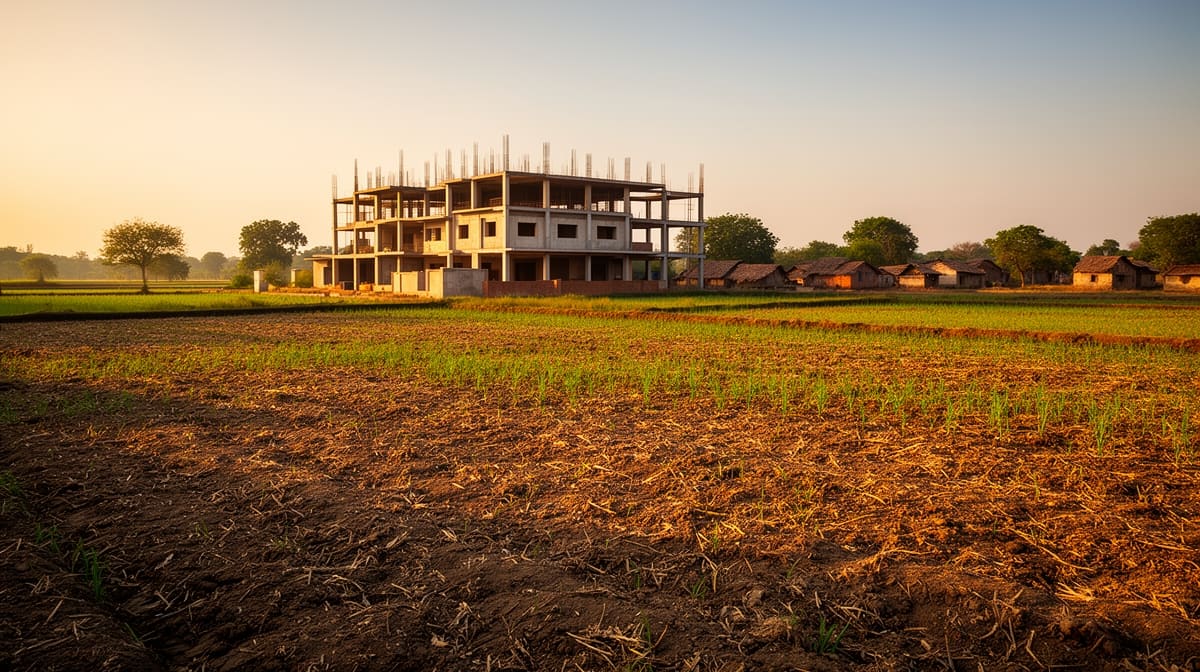
The Madras High Court has clarified that compensation under the Land Acquisition Act, 1894 must reflect not only proximate sale deeds but also the developmental potential of acquired land, setting aside an undervalued award and directing a significant enhancement to Rs.11,500 per Are.
Background & Facts
The Dispute
The dispute arose from the acquisition of agricultural land in Akkarai Vattam village, Karaikal, for construction of coastal shelters and infrastructure. A notification under Section 4(1) of the Land Acquisition Act, 1894 was issued on 17.10.2005, invoking Section 17(4). The land was classified as wet land and manai. The Land Acquisition Officer initially fixed compensation at Rs.4,500 per Are based on statistical data and guideline values. The landowner challenged this valuation, leading to a reference proceeding before the II Additional District Judge, Pondicherry.
Key Facts
- The acquired land was located in Akkarai Vattam village, classified as wet land
- Initial award by Land Acquisition Officer dated 16.07.2008: Rs.4,500 per Are
- Reference Court examined 98 sale deeds and selected 8 for comparison
- Sale deed Ex.C3, dated 05.03.2008, recorded a sale of similar wet land at Rs.11,500 per Are
- Ex.C3 land was located in close proximity to the acquired land
- Reference Court found Ex.C3 relevant but declined to adopt its full value, fixing compensation at Rs.10,000 per Are
- The appellant did not dispute the Reference Court’s finding that Ex.C3 land was proximate to the acquired land
- The land had potential for residential development, as noted by the Reference Court
Procedural History
- 17.10.2005: Notification under Section 4(1) issued
- 16.07.2008: Initial award by Land Acquisition Officer fixing value at Rs.4,500 per Are
- 26.07.2011: Reference Court order passed by II Additional District Judge, Pondicherry, enhancing compensation to Rs.10,000 per Are
- 12.04.2016: Appeal filed by Union of India (A.S. No. 392 of 2016)
- 20.04.2017: Cross-objection filed by landowner’s representatives (Cros.Obj. No. 34 of 2017)
- 17.02.2022: Court order brought R2-R9 on record as LRS of deceased respondent N. Ramasamy (CMP Nos. 254, 256 & 259 of 2022)
- 09.10.2025: Court order brought R2-R9 on record as LRS of deceased appellant N. Ramasamy (CMP Nos. 18401, 18403, 18405 of 2025)
- 17.03.2026: Judgment reserved
- 20.04.2026: Judgment pronounced
Relief Sought
- Appellant sought to set aside the enhancement to Rs.10,000 per Are and restore Rs.4,500 per Are
- Cross-objectors sought enhancement to Rs.11,500 per Are, matching the consideration in Ex.C3
- Claim for solatium and interest on enhanced compensation
The Legal Issue
The central question was whether the Reference Court erred in not adopting the market value reflected in a proximate sale deed (Ex.C3) when the acquired land had demonstrable development potential, and whether compensation under Section 23 of the Land Acquisition Act, 1894 must account for such potential.
Arguments Presented
For the Appellant
The Government Advocate contended that Ex.C3 involved sale of land as plots, whereas the acquired land was classified as wet land, making it non-comparable. He argued that the Reference Court correctly discounted Ex.C3’s value due to differences in land use and size. He relied on statistical data and guideline values prevailing at the time of notification, asserting that speculative development potential cannot override objective market indicators.
For the Respondent
The counsel for cross-objectors argued that Ex.C3 was a genuine, contemporaneous sale of wet land in close proximity, with similar extent and no evidence of artificial inflation. He emphasized that the Reference Court itself acknowledged proximity and relevance but arbitrarily reduced the value. He cited Ram Kishan v. State of Haryana to assert that developmental potential must be factored into market value, and that Rs.11,500 per Are - less than the Ex.C3 consideration - was a reasonable and conservative benchmark.
The Court's Analysis
The Court examined the principles under Section 23 of the Land Acquisition Act, 1894, which mandates determination of market value based on comparable sales, location, and potential. It noted that the Reference Court had correctly identified Ex.C3 as proximate and relevant but failed to justify its deviation from the sale consideration.
"A perusal of the Schedule under Ex.C3 do not indicate that the land had been sold as a plot, as the nature of the land had been shown is only as wet land, but however of a similar extent."
The Court held that the classification of land as wet land did not preclude its development potential, especially where the surrounding area was being developed for infrastructure. It relied on Ram Kishan v. State of Haryana to affirm that developmental potential is a legitimate factor in market valuation.
The Court further observed that the appellant had not challenged the Reference Court’s finding of proximity, which rendered its objection to the comparability of Ex.C3 legally untenable. The reduction from Rs.11,500 to Rs.10,000 per Are was arbitrary and lacked reasoning. The Court concluded that the cross-objectors’ claim of Rs.11,500 per Are was not only supported by the evidence but also conservative in light of the transaction.
The Verdict
The appeal was dismissed and the cross-objection was allowed. The market value of the acquired land was fixed at Rs.11,500 per Are. The respondents are entitled to solatium at 30% of the enhanced compensation and interest at 9% per annum from the date of possession until payment. No costs were awarded. The Land Acquisition Officer shall compute and disburse the enhanced amount within 8 weeks.
What This Means For Similar Cases
Proximate Comparable Sales Must Be Given Weight
- Practitioners must identify and produce sale deeds within 1-2 km of the acquired land, especially if the land use is identical
- Courts cannot arbitrarily discount proximate sales without specific, documented reasons
- Classification as agricultural or wet land does not automatically disqualify a sale deed if the nature and extent are similar
Development Potential Is a Legitimate Valuation Factor
- Evidence of nearby infrastructure projects, zoning changes, or municipal development plans must be submitted to support claims of enhanced value
- The burden shifts to the acquiring authority to prove why potential should be ignored
- Valuation must be forward-looking, not merely retrospective based on outdated guidelines
Conservative Claims Are Advantageous
- Claiming an amount below the actual sale consideration (as done here with Rs.11,500 vs. Ex.C3’s higher figure) strengthens credibility
- Courts are more likely to adopt conservative, evidence-based enhancements than speculative demands
- Always align your claimed enhancement with the highest credible comparable sale, not theoretical maximums