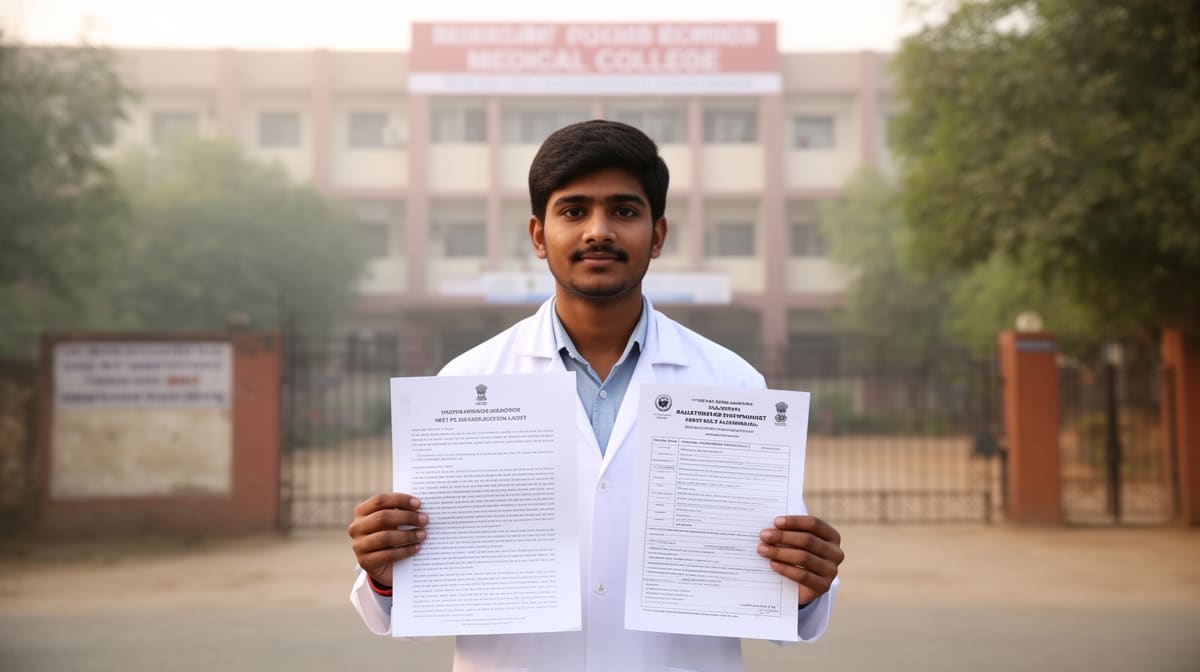
The Rajasthan High Court has reaffirmed that medical officers selected for higher academic courses cannot be denied relieving on grounds of administrative convenience alone. In a significant order, the Court directed immediate relieving of doctors for Senior Residency Course, emphasizing that constitutional rights to career advancement must be balanced with public health exigencies, while rejecting unsubstantiated claims of doctor shortages.
Background & Facts
The Dispute
The petitioner, Dr. Annu Devi, a Medical Officer employed with the Government of Rajasthan, was selected for a one-year Senior Residency Course pursuant to a notification dated 30.05.2026. Despite her merit-based selection vide order dated 12.06.2026, the respondents failed to relieve her to join the course, jeopardizing her career progression and academic advancement. The petitioner challenged this inaction through a writ petition before the Rajasthan High Court.
Key Facts
The petitioner is a Medical Officer under the Department of Medical and Health Services, Rajasthan
She completed her PG course as an in-service candidate and applied for the Senior Residency Course to qualify for the post of Assistant Professor
Notification dated 30.05.2026: Invited applications for one-year Senior Residency Course
Order dated 12.06.2026: Petitioner declared selected for the course on merit basis
Circular dated 05.07.2022: Direction No. 4 mandates relieving of candidates selected for higher studies, including PG, DNB, and Senior Residency courses
The petitioner’s NEET-PG scores were considered for selection, and her merit position qualified her for the course
The respondents cited administrative exigency and a temporary shortage of doctors as reasons for not relieving the petitioner
Procedural History
11.02.2026: In a similar case (SBCWP No. 2936/2026: Dr. Nidhi Punia v. State of Rajasthan & Ors.), the High Court issued notices and granted interim relief
07.07.2026: Present writ petition (SBCWP No. 13736/2026) filed before the Rajasthan High Court
07.07.2026: Notice issued to respondents, returnable within four weeks
07.07.2026: Interim order passed directing respondents to relieve the petitioner by 08.07.2026
The Parties' Positions
For the Petitioner:
Argued that the petitioner’s selection for the Senior Residency Course was merit-based, considering her NEET-PG scores
Contended that non-relieving would cause irreparable loss, as the course is critical for career advancement to the post of Assistant Professor
Relied on the circular dated 05.07.2022, which mandates relieving of candidates selected for higher studies
Submitted that the respondents’ refusal was contrary to their own policy and arbitrary
For the Respondents:
Claimed that relieving around 450 doctors for Senior Residency and 800 doctors for Post-Graduation simultaneously would severely disrupt health services
Asserted that the petitioner’s posting was made in public interest and administrative exigency
Failed to provide concrete data or material to substantiate the alleged acute shortage of doctors
Relief Sought
The petitioner sought:
A direction to the respondents to relieve her immediately to join the Senior Residency Course pursuant to the allotment letter dated 12.06.2026
A declaration that the respondents’ refusal to relieve her was arbitrary, illegal, and violative of her constitutional rights
Any other relief deemed just and proper by the Court
The Legal Issue
The central question before the Court was whether the respondents could deny relieving a meritorious candidate selected for a Senior Residency Course on grounds of administrative convenience or temporary shortage of doctors, without balancing the constitutional right to career advancement with the public interest in maintaining health services.
Arguments Presented
For the Petitioner
Constitutional Right to Career Advancement: The petitioner relied on the Supreme Court’s decision in Dr. Rohit Kumar v. Secretary, Office of Lt. Governor of Delhi & Ors. (Civil Appeal No. 2739 of 2021), which held that doctors with advanced qualifications are an asset to society and public health. Denial of career advancement opportunities would deprive the medical fraternity and society of enhanced skills.
Policy Compliance: The petitioner argued that the respondents’ own circular dated 05.07.2022 (Direction No. 4) mandates relieving candidates selected for higher studies, including Senior Residency courses. Non-compliance with this circular was arbitrary and contrary to the respondents’ own policy.
Merit-Based Selection: The petitioner’s selection was based on NEET-PG scores, and her merit position qualified her for the course. Denying her the opportunity to join would cause irreparable harm to her career, which cannot be compensated later.
For the Respondents
Administrative Exigency: The respondents contended that relieving a large number of doctors (450 for Senior Residency and 800 for Post-Graduation) simultaneously would severely affect health services. The petitioner’s posting was made in public interest to address this exigency.
Lack of Substantiation: The respondents failed to provide concrete data or material to prove the alleged acute shortage of doctors, relying instead on bald assertions.
The Court's Analysis
The Court undertook a balancing exercise between the petitioner’s constitutional right to career advancement and the public interest in maintaining uninterrupted health services. The analysis hinged on the following key principles:
Constitutional Perspective: The Court observed that the right to career advancement is not merely an individual right but also serves the larger public interest. Doctors with advanced qualifications enhance the quality of healthcare services. The Supreme Court’s decision in Dr. Rohit Kumar was cited, where it was held that denying such opportunities would deprive society of skilled medical professionals.
"Doctors with advanced qualifications are an asset not only to the medical fraternity but also to society at large. After completion of the course, such doctors return to serve the cause of public health with enhanced skill and expertise."
Policy Compliance: The Court noted that the respondents’ own circular dated 05.07.2022 (Direction No. 4) explicitly mandates relieving candidates selected for higher studies. The respondents’ failure to comply with their own policy was prima facie arbitrary and contrary to law.
Administrative Convenience vs. Constitutional Rights: The Court rejected the respondents’ argument that administrative inconvenience or a temporary shortage of doctors could justify denying the petitioner’s right to join the course. The respondents had not placed any concrete evidence on record to substantiate their claims of acute shortage. The Court emphasized that constitutional rights cannot be sacrificed at the altar of administrative convenience without a proper balancing of interests.
Irreparable Prejudice: The Court recognized that the petitioner would suffer irreparable prejudice if not relieved immediately, as the last date for joining the course was imminent. Delay would defeat the very purpose of her selection and cause irreversible harm to her career.
Public Interest in Long-Term: The Court underscored that permitting doctors to pursue higher education ultimately strengthens the public healthcare system. Denying such opportunities would be counterproductive to the long-term public interest.
The Verdict
The Court allowed the writ petition in part and issued the following directions:
The respondents were directed to relieve the petitioner latest by 08.07.2026 to join the Senior Residency Course pursuant to the allotment letter dated 12.06.2026
The matter was connected with SBCWP No. 2936/2026 (Dr. Nidhi Punia v. State of Rajasthan & Ors.) for further proceedings
Notices were issued to the respondents, returnable within four weeks
What This Means For Similar Cases
Constitutional Rights Trump Administrative Convenience
Burden of Proof on the State: The judgment establishes that administrative convenience or temporary shortages cannot justify denial of constitutional rights unless the State provides concrete evidence to substantiate its claims. Bald assertions, without supporting data, will not suffice.
Policy Compliance is Mandatory: Government departments must adhere to their own policies and circulars. Non-compliance, especially when it affects fundamental rights, will be viewed as arbitrary and illegal.
Career Advancement as a Fundamental Right
Doctors’ Rights: The judgment reinforces that medical officers have a constitutional right to pursue higher education and career advancement, particularly when their selection is merit-based. This right cannot be denied without a valid, substantiated reason.
Public Interest Nexus: The Court recognized that permitting doctors to advance their qualifications ultimately serves the public interest by enhancing the quality of healthcare services. Denying such opportunities is counterproductive.
Practical Takeaways for Practitioners
Interim Relief Strategy: In cases involving imminent deadlines (e.g., joining dates for courses), practitioners should emphasize the irreparable prejudice caused by delay and seek urgent interim relief.
Merit-Based Selections: Where selection is based on merit (e.g., NEET-PG scores), non-relieving of selected candidates will be viewed as arbitrary unless the State provides compelling evidence to the contrary.
Policy Documents as Evidence: Government circulars and policies can be powerful tools in litigation. Practitioners should highlight non-compliance with such policies to establish arbitrariness.
Balancing Test: Courts will undertake a balancing test between individual rights and public interest. Practitioners must frame arguments to show that the individual’s rights align with long-term public interest.