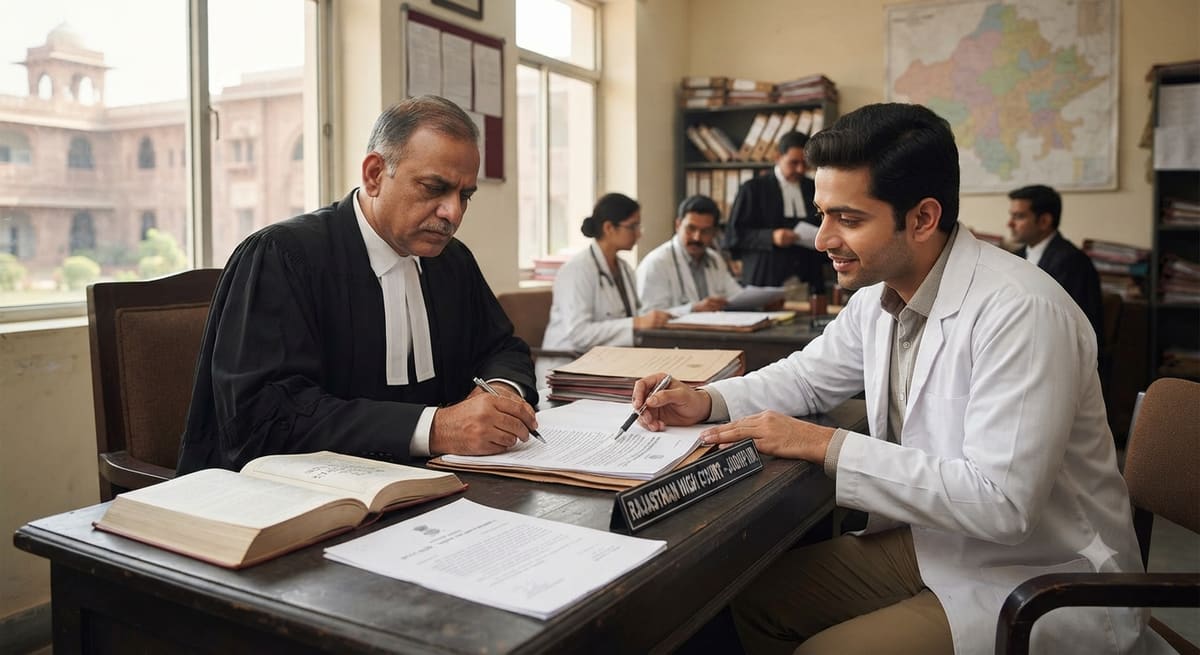
The Rajasthan High Court has clarified that differential pay fixation between senior and junior medical officers cannot be challenged merely on grounds of seniority when the disparity arises from a voluntary choice to opt for or decline Non-Practicing Allowance. The judgment reinforces that statutory rules governing pay revision must be applied as written, and equitable considerations cannot override explicit provisions.
Background & Facts
The Dispute
The dispute centers on the pay fixation of medical officers under the Rajasthan Civil Services (Revised Pay Scale) Rules, 2017, which implemented the recommendations of the 7th Central Pay Commission. The core issue is whether doctors who declined to opt for Non-Practicing Allowance (NPA) on 01.01.2016 are entitled to have their pay stepped up to match that of junior colleagues who opted for NPA and received enhanced pay fixation under Rule 11(B)(1) of the Rules of 2017.
Key Facts
- The Non-Practicing Allowance (NPA) was introduced in Rajasthan via Finance Department orders dated 07.06.1989 and 16.05.1998, initially limited to specific posts.
- On 12.09.2008, NPA was extended to all Medical Officers at 20% of basic pay, subject to a condition: no private practice allowed.
- On 28.06.2013, the benefit was further extended to teaching staff and required annual option submission.
- The Rajasthan Civil Services (Revised Pay Scale) Rules, 2017, notified on 30.10.2017 and effective from 01.10.2017, introduced a new pay matrix and revised fixation methodology.
- Rule 11(B)(1) of the Rules of 2017 provided a special formula for pay fixation for Medical Officers drawing NPA as on 01.01.2016: existing basic pay multiplied by 2.57, plus Dearness Allowance on NPA as on that date.
- Medical Officers not drawing NPA on 01.01.2016 were governed by Rule 11(A), which applied the standard 2.57 multiplier without adding DA on NPA.
- The respondent, Dr. Dinesh Kumar Sharma, and other petitioners in the batch had not opted for NPA as of 01.01.2016 and therefore received lower revised pay than juniors who had opted for NPA.
- The respondents claimed that this created a "pay anomaly" and sought stepping up of pay under Rule 11(7).
- The Rajasthan Civil Services Appellate Tribunal, Jaipur, accepted this claim in its order dated 16.08.2021 and directed the State to either grant a fresh option for NPA or step up the pay of the respondents.
Procedural History
- 01.10.2017: Rajasthan Civil Services (Revised Pay Scale) Rules, 2017, came into effect.
- 30.10.2017: Notification issued under the Rules of 2017, detailing pay fixation methodology.
- 01.01.2016: Cut-off date for determining NPA eligibility under Rule 11(B)(1).
- 16.08.2021: Rajasthan Civil Services Appellate Tribunal allowed appeals of medical officers and directed pay parity or fresh NPA option.
- 12.05.2026: Oral arguments concluded before the Rajasthan High Court.
- 26.05.2026: Judgment pronounced by the High Court.
- S.B. Civil Writ Petition No. 8978/2022: Filed by the State of Rajasthan challenging the Tribunal’s order dated 16.08.2021.
- S.B. Civil Writ Petitions No. 1846/2026, 12/2023, 38/2023, 244/2023, and 18374/2024: Filed by medical officers directly seeking pay stepping up.
- All matters were heard together due to identical legal issues.
The Parties' Positions
For the State (Petitioners)
- Argued that NPA is a voluntary benefit tied to surrender of private practice.
- Contended that Rule 11(B)(1) explicitly creates a separate pay fixation formula for those drawing NPA as of 01.01.2016.
- Stated that Rule 11(7) applies only to similarly situated employees, not to those under different statutory regimes.
- Cited Calcutta Municipal Corporation v. Sujit Baran Mukherjee and Union of India v. P.V. Hariharan to argue against judicial overreach in pay fixation.
- Asserted that the Tribunal exceeded its jurisdiction by directing a fresh option for NPA, which was not challenged in the proceedings.
For the Respondents (Medical Officers)
- Argued that NPA is merely an allowance and cannot be merged with basic pay.
- Claimed that juniors drawing higher pay than seniors violates the principle of seniority and Rule 11(7).
- Relied on Gurcharan Singh Grewal v. Punjab State Electricity Board and Commissioner v. Ram Sarup Ganda to support parity claims.
- Cited circulars dated 28.05.2021 and 06.07.2021 to argue for correction of pay anomalies.
Relief Sought
The State sought quashing of the Tribunal’s order dated 16.08.2021 and rejection of the respondents’ appeals. The respondents sought: (1) inclusion of NPA in basic pay for fixation purposes; (2) stepping up of their pay to match juniors under Rule 11(7); and (3) payment of arrears with interest.
The Legal Issue
The central question was whether Rule 11(7) of the Rajasthan Civil Services (Revised Pay Scale) Rules, 2017 permits stepping up of pay for medical officers who declined Non-Practicing Allowance, when their juniors received higher pay due to the inclusion of Dearness Allowance on NPA under Rule 11(B)(1).
Arguments Presented
For the Appellant/Petitioner
The State contended that the Rules of 2017 explicitly distinguish between two classes of medical officers: those who opted for NPA and those who did not. Rule 11(B)(1) provides a special formula for pay fixation for the former, incorporating DA on NPA as of 01.01.2016. The latter are governed by Rule 11(A), which applies the standard multiplier without DA on NPA. The State argued that this distinction is not arbitrary but is rooted in a voluntary choice: surrendering private practice for enhanced pay. The Tribunal’s direction to grant a fresh option for NPA amounted to judicial legislation, as no challenge was made to the validity of the 30.10.2017 notification. The State relied on Calcutta Municipal Corporation v. Sujit Baran Mukherjee to argue that pay differences arising from voluntary choices cannot be corrected by stepping up, and on Union of India v. P.V. Hariharan to caution against tribunal interference in pay scales.
For the Respondent/State
The respondents argued that NPA is merely an allowance and cannot form part of basic pay. They claimed that Rule 11(7) mandates pay parity between seniors and juniors in the same cadre, regardless of the reason for disparity. They contended that the differential pay was discriminatory and violated the principle of equal pay for equal work. They relied on judgments from other jurisdictions and circulars issued by the Finance Department to support their claim that the pay fixation was anomalous and required correction.
The Court's Analysis
The Court undertook a detailed textual analysis of the Rules of 2017 and found that the distinction between Rule 11(A) and Rule 11(B)(1) is clear, unambiguous, and intentional. Rule 11(B)(1) explicitly provides for the addition of Dearness Allowance on NPA to the basic pay for those drawing NPA as of 01.01.2016. This provision demonstrates that the rule-making authority intended to reward those who surrendered private practice with enhanced pay fixation. The Court emphasized that the Rules do not treat NPA as a mere allowance for DA calculation alone; rather, it is integrated into the revised pay structure as a qualifying condition for the enhanced formula.
"The very inclusion of Dearness Allowance on NPA as a component for calculation under Clause 11(B)(1) demonstrates that receipt of NPA formed an integral and indispensable basis for grant of the enhanced benefit under the revised pay structure."
The Court rejected the Tribunal’s characterization of the pay difference as a "pay anomaly." It held that an anomaly arises only when identically situated employees are treated differently. Here, the two groups are not similarly situated: one group surrendered private practice and accepted NPA; the other retained private practice and declined NPA. The Court cited Calcutta Municipal Corporation v. Sujit Baran Mukherjee to affirm that pay differences arising from voluntary choices cannot be equated with discrimination.
The Court also found the Tribunal’s direction to grant a fresh option for NPA to be beyond its jurisdiction. The respondents never challenged the validity of the 30.10.2017 notification. Judicial bodies cannot rewrite statutory schemes or create new rights where none exist under the law. The Court held that such an order amounted to judicial legislation.
Regarding Rule 11(7), the Court clarified that it applies only when employees are similarly situated under the same pay fixation regime. Since the respondents were governed by Rule 11(A) and their juniors by Rule 11(B)(1), the stepping up provision was inapplicable.
The Court further noted that the Gujarat High Court’s decision in Mahesh Kumar P Kapadia was distinguishable, as it dealt with different rules where NPA was explicitly included in basic pay. In Rajasthan, the Rules of 2017 do not merge NPA into basic pay; they use it as a condition for a separate calculation.
The Court also dismissed reliance on circulars dated 28.05.2021 and 06.07.2021, holding that they were general in nature and could not override specific statutory provisions.
The Verdict
The State succeeded. The Rajasthan High Court quashed the order dated 16.08.2021 of the Rajasthan Civil Services Appellate Tribunal and dismissed all appeals filed by the medical officers. The Court held that no stepping up of pay is permissible under Rule 11(7) for those who declined NPA. The writ petitions filed by the State were allowed, and the writ petitions filed by the medical officers were dismissed. No monetary relief, arrears, or interest was awarded to the respondents.
What This Means For Similar Cases
Pay Fixation Is Rule-Dependent, Not Equity-Driven
- Practitioners must analyze the exact wording of pay fixation rules before claiming parity.
- A difference in pay arising from a voluntary choice under a statutory scheme does not constitute a pay anomaly.
- Tribunals cannot invoke "equal pay for equal work" to override explicit statutory classifications.
Judicial Restraint in Pay Matters
- Administrative Tribunals must avoid substituting their own policy preferences for legislative intent.
- Courts will intervene only where there is clear hostile discrimination, not where differences stem from lawful options.
- Any claim for pay revision must be grounded in the specific provisions of the applicable rules, not general principles of fairness.
NPA as a Conditional Benefit
- Medical officers must submit NPA options within stipulated timelines; failure disqualifies them from the enhanced pay formula.
- Declining NPA is a strategic choice with financial consequences: continued private practice rights in exchange for lower government pay fixation.
- Employers may enforce compliance with NPA conditions through disciplinary action and recovery of improperly paid allowances.