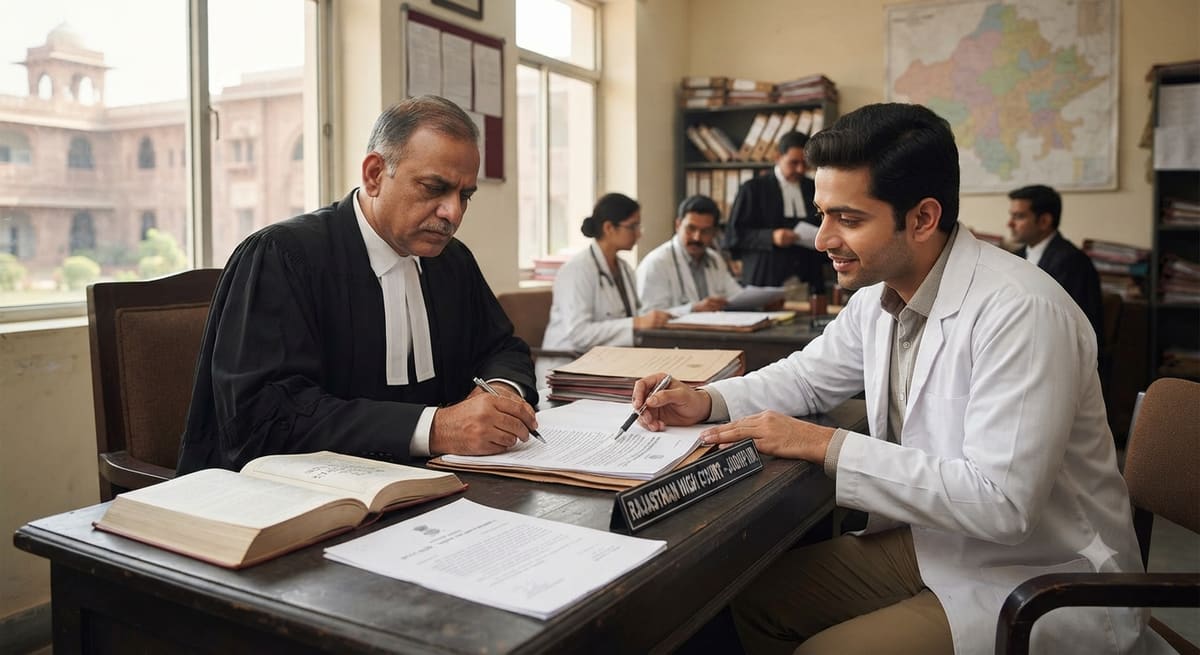
The Rajasthan High Court has clarified that probationary Medical Officers selected for Senior Residentship through NEET PG merit cannot be denied leave to pursue higher training, establishing a critical precedent for service entitlements in public health administration.
Background & Facts
The Dispute
The petitioners are probationary Medical Officers in the Rajasthan Health Department who secured selection for Senior Residentship programs in government medical colleges based on their NEET PG ranks. Despite formal allotment orders dated 21.01.2026, the department refused to relieve them from their current posts or grant leave to join the residency programs, citing their probationary status and lack of explicit policy authorization.
Procedural History
- 2024 - 2025: Petitioners completed their M.D./M.S. and were appointed as Medical Officers on probation.
- Late 2025: Petitioners appeared for NEET PG and secured selection in Senior Residentship programs across multiple institutions.
- January 2026: Allotment orders issued by the M.D./M.S./D.M./M.CH Candidates Allotment Board.
- January - February 2026: Petitioners requested relieving orders and leave; department remained silent or denied requests.
- February 2026: Eight writ petitions filed before the Rajasthan High Court, Jaipur Bench, consolidated for hearing.
Relief Sought
The petitioners sought:
- Immediate relief from their current posts to join Senior Residentship
- Grant of extraordinary or study leave under Rajasthan Service Rules, 1951
- Preservation of their selected seats until they could join
- Alternative: One-year extraordinary leave without loss of service benefits
The Legal Issue
The central question was whether probationary Medical Officers selected for Senior Residentship through NEET PG merit are entitled to extraordinary leave under departmental circulars, despite not having completed probation, and whether the department’s refusal violates principles of fair administrative practice and educational advancement.
Arguments Presented
For the Petitioner
Counsel relied on multiple circulars issued by the Medical and Health Department:
- Circular dated 05.07.2022 explicitly extended leave entitlements to both regular and probationary officers for pursuing higher education, waived the requirement of a No Objection Certificate, and permitted up to one year of extraordinary leave.
- Circulars dated 22.02.2021 and 24.03.2022 supported the grant of extraordinary leave for competitive examinations and higher studies.
- Precedents from Dr. Yogesh Saini v. State of Rajasthan and Dr. Prateek Verma v. State of Rajasthan were cited, where coordinate benches had granted similar reliefs.
For the Respondent
The State contended:
- Senior Residentship is not "higher education" but a professional service posting, and thus not covered under educational leave rules.
- Circulars permitting leave apply only to regular employees, not probationers.
- Circular dated 30.01.2019 restricted leave grants to officers who had completed probation.
- Granting leave to probationers would disrupt departmental functioning and set a precedent undermining service discipline.
The Court's Analysis
The Court conducted a detailed review of the circulars, particularly circular dated 05.07.2022, which explicitly stated:
"The provisions of this circular shall be applicable to both regular as well as probationer Medical Officers... Extraordinary leave may be granted for pursuing higher educational courses... Such leave shall not be counted for pension, annual grade increment or other service benefits."
The Court rejected the State’s narrow interpretation that Senior Residentship is not "higher education." It held that the course constitutes advanced clinical training mandated by the National Medical Commission and is the next mandatory step in medical specialization. The circular’s language was unambiguous in covering probationers, and the department could not selectively apply its own rules to deny entitlements.
The Court further noted that the department’s silence and inaction amounted to arbitrary denial of a right secured by its own policy. The precedents from Dr. Yogesh Saini and Dr. Prateek Verma were affirmed as binding on coordinate benches. The Court emphasized that administrative circulars, once issued, create legitimate expectations and cannot be disregarded to the detriment of public servants who have fulfilled all merit-based criteria.
The Court also dismissed the argument that granting leave would cause administrative disruption, noting that the circular permits a maximum of one year’s leave and explicitly excludes service benefits, thereby protecting departmental interests.
The Verdict
The petitioners won. The Court held that probationary Medical Officers selected for Senior Residentship via NEET PG are entitled to extraordinary leave under circular dated 05.07.2022, regardless of probationary status. The State was directed to immediately relieve the petitioners and grant leave with the condition that it shall not count toward pension or increments.
What This Means For Similar Cases
Leave Cannot Be Denied on Probationary Status Alone
- Practitioners representing government employees in health services must now argue that probationary status does not disqualify an employee from leave under departmental circulars that explicitly include probationers.
- Any denial based solely on probation must be challenged as violative of the circular’s express terms.
Circulars Create Legitimate Expectations
- Administrative circulars that confer rights on employees, even if not statutory, create enforceable expectations under Article 14 and Article 21.
- Courts will enforce such circulars unless they are ultra vires or clearly revoked.
- Practitioners should cite Dr. Yogesh Saini and Dr. Prateek Verma as binding precedents in similar cases.
Documentation Is Key - But Policy Trumps Silence
-
Employees must retain copies of all selection letters and circulars.
-
Departmental inaction or non-communication cannot override written policy.
-
If a circular permits leave for "higher education," and the course is recognized by NMC or MCI, courts will treat it as qualifying.
-
Actionable Takeaway: File writ petitions within 30 days of denial; cite circular 05.07.2022 and Dr. Yogesh Saini as primary authority.
-
Risk Mitigation: Always request written reasons for denial - this preserves grounds for judicial review.