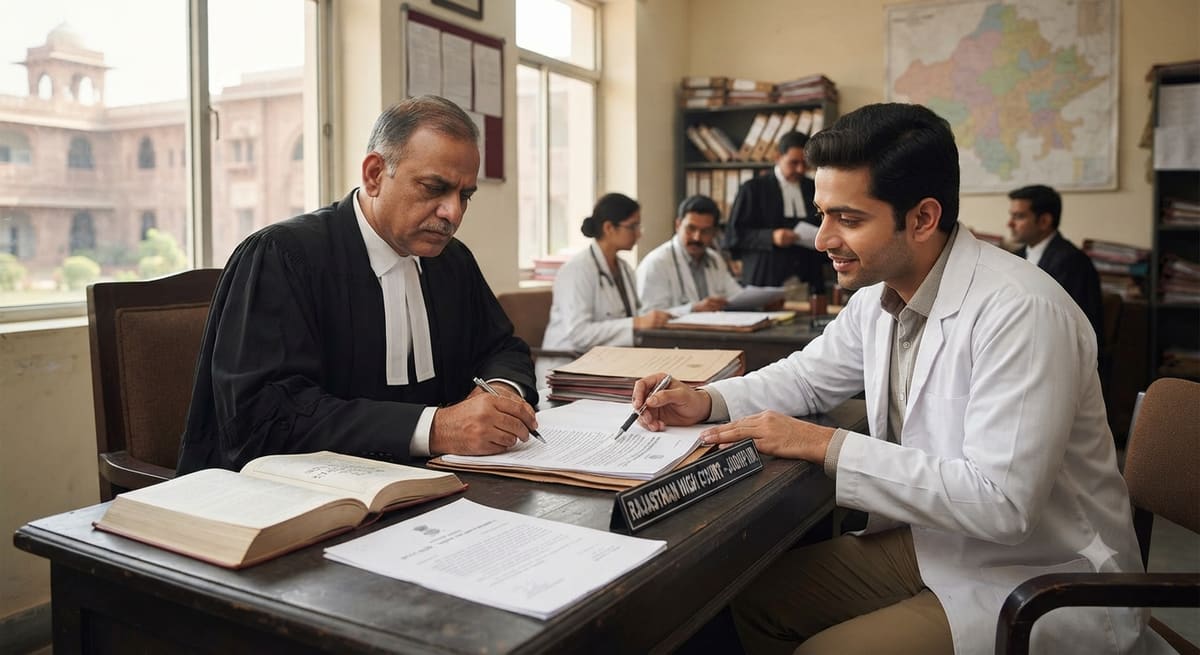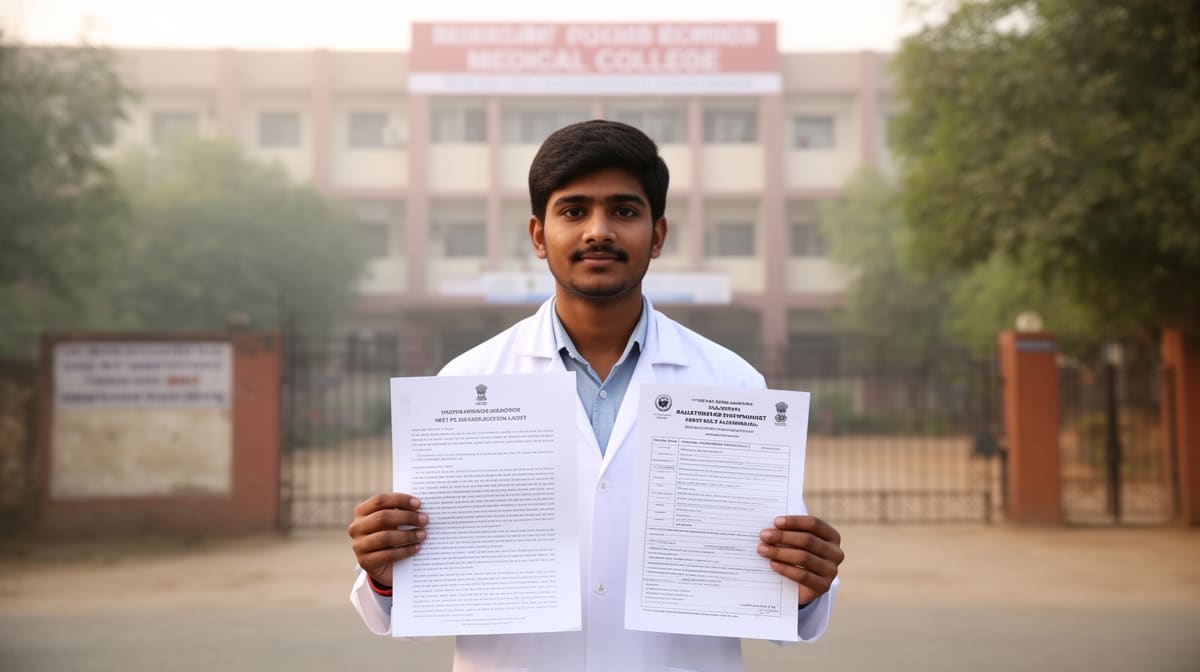
The Rajasthan High Court has affirmed that public employers must exercise reasonable discretion under Article 309 of the Constitution to accommodate candidates selected for service who are in the final stages of postgraduate medical education. The judgment establishes a principled balance between administrative rigidity and the legitimate professional interests of appointees pursuing essential specialization.
Background & Facts
The Dispute
The petitioner, Dr. Anil Verma, was selected for the post of Medical Officer in the State of Rajasthan through the Recruitment Examination-2024 conducted by the Rajasthan University of Health Sciences. Upon receiving the appointment order, he requested an extension of time to join, as he was then enrolled in the MD program at All India Institute of Medical Sciences (AIIMS), New Delhi. The appointing authority granted an extension of six months, but the petitioner contended that this period was insufficient to complete his course, which required more than six months.
Key Facts
- The petitioner was selected for the post of Medical Officer in Rajasthan on the basis of merit in the Recruitment Examination-2024
- At the time of selection, he was already enrolled in the MD program at AIIMS, New Delhi
- The appointment order was issued on or before 05.02.2026
- On 13.02.2026, the appointing authority issued an extension order granting six months to join the post
- The MD course at AIIMS has a duration exceeding six months, and completion requires submission of original academic documents
- The petitioner’s original certificates, including degree and mark sheets, remain in the custody of AIIMS until course completion
- The petitioner made repeated requests to AIIMS for release of documents, which were not acted upon
- The petitioner could not join the post within the six-month extension period due to non-release of documents
Procedural History
- 05.02.2026: Appointment order issued for the post of Medical Officer
- 13.02.2026: Extension of six months granted for joining the post
- Between 13.02.2026 and 13.08.2026: Petitioner attempted to obtain original documents from AIIMS; no release occurred
- 28.03.2026: Writ Petition No. 2860/2026 filed before the High Court of Rajasthan, Jaipur Bench
- 07.04.2026: Writ petition taken up for final disposal at admission stage with consent of parties
The Parties' Positions
Petitioner’s Position: The six-month extension is inadequate as the MD course cannot be completed within that period. The employer, under Article 309, has the power to grant reasonable extensions to facilitate completion of professional training. The non-release of documents by AIIMS is beyond his control and should not disentitle him to service.
Respondents’ Position: The extension of six months was granted as per the applicable circular. Beyond this period, the rules require the appointee to join and seek extraordinary leave. The petitioner failed to join even within the extended period. AIIMS is an independent institution and not bound to release documents at the behest of the State.
Relief Sought
The petitioner sought:
- A direction to extend the joining period until completion of the MD course
- A direction to AIIMS to release the original academic documents temporarily
- A direction to the State to permit him to join the post and thereafter apply for leave
The Legal Issue
The central question was whether the appointing authority, under Article 309 of the Constitution of India, is obligated to grant a reasonable extension of time to join a government post when the appointee is pursuing a mandatory postgraduate medical course that cannot be completed within the initially granted extension period, and the delay in joining is due to circumstances beyond the appointee’s control.
Arguments Presented
For the Petitioner
The petitioner’s counsel relied on the broad discretionary powers conferred under Article 309, which permits the State to regulate conditions of service, including the timing of joining. He cited the spirit of administrative fairness and the principle of reasonable accommodation for professionals in training. He emphasized that the petitioner was selected on merit and the post remains vacant. The non-release of documents by AIIMS is a systemic barrier, not a personal default. The six-month extension was arbitrary given the known duration of MD courses.
For the Respondent
The State contended that the extension of six months was already a generous concession beyond the norm. The rules clearly state that beyond this period, the appointee must join and apply for leave. The petitioner’s failure to join within the extended period constitutes non-compliance. AIIMS, as a separate entity, is not bound by the State’s administrative directives, and the State cannot compel it to release documents.
The Court's Analysis
The Court examined the nature of Article 309, which empowers the State to make rules regulating recruitment and conditions of service. It noted that this power is not merely procedural but substantive, allowing for flexibility in implementation to serve public interest and administrative equity.
"The power under Article 309 is not confined to rigid rule-making; it encompasses the authority to adapt conditions of service to accommodate legitimate professional development, particularly in fields like medicine where specialization is mandatory for public service."
The Court observed that the petitioner was selected on merit and the MD course is a recognized pathway to enhance public health service delivery. The six-month extension, while granted sympathetically, was clearly inadequate given the standard duration of MD programs. The Court rejected the notion that the petitioner’s failure to join within six months was a voluntary default, noting that the impediment - non-release of documents by AIIMS - was external and systemic.
The Court further held that while AIIMS is an autonomous institution, its cooperation is essential for the petitioner’s compliance with State service conditions. The State, as the appointing authority, has a duty to facilitate the appointee’s transition into service, including by engaging with third parties like AIIMS to resolve document-related impediments.
The Verdict
The writ petition was disposed of with the following directions:
- The petitioner is granted liberty to make a representation to respondent No. 3 - Director, Medical Health & Family Welfare Department - seeking extension of time to join the post
- Respondent No. 3 shall dispose of the representation within one week of receipt of this order
- If extension is granted, respondent No. 4 - AIIMS - is directed to temporarily release the petitioner’s original academic documents to facilitate joining
- Upon joining, the petitioner must apply for leave under applicable rules
- If leave is not granted within one week of joining, the petitioner shall immediately return the original documents to AIIMS and resume his course
What This Means For Similar Cases
Reasonable Accommodation Is a Duty Under Article 309
- Practitioners must argue that Article 309 empowers authorities to grant extensions beyond rigid timelines when professional training is essential for public service
- The burden shifts to the employer to justify why a longer extension cannot be granted, especially when the appointee is pursuing a recognized, mandatory specialization
- Administrative convenience cannot override the public interest in retaining qualified professionals
Third-Party Cooperation Must Be Facilitated by the State
- Government departments cannot disclaim responsibility for delays caused by institutions like AIIMS, universities, or certification bodies
- The State must proactively engage with such institutions to resolve document release issues
- Failure to do so cannot be used to penalize the appointee
Extension Requests Must Be Evaluated on Merit, Not Form
- Applications for extension should be assessed on the actual duration of training, not arbitrary caps
- Courts will intervene where the extension granted is manifestly insufficient to achieve the purpose for which it was sought
- Practitioners should document all attempts to obtain documents and communicate delays to the appointing authority