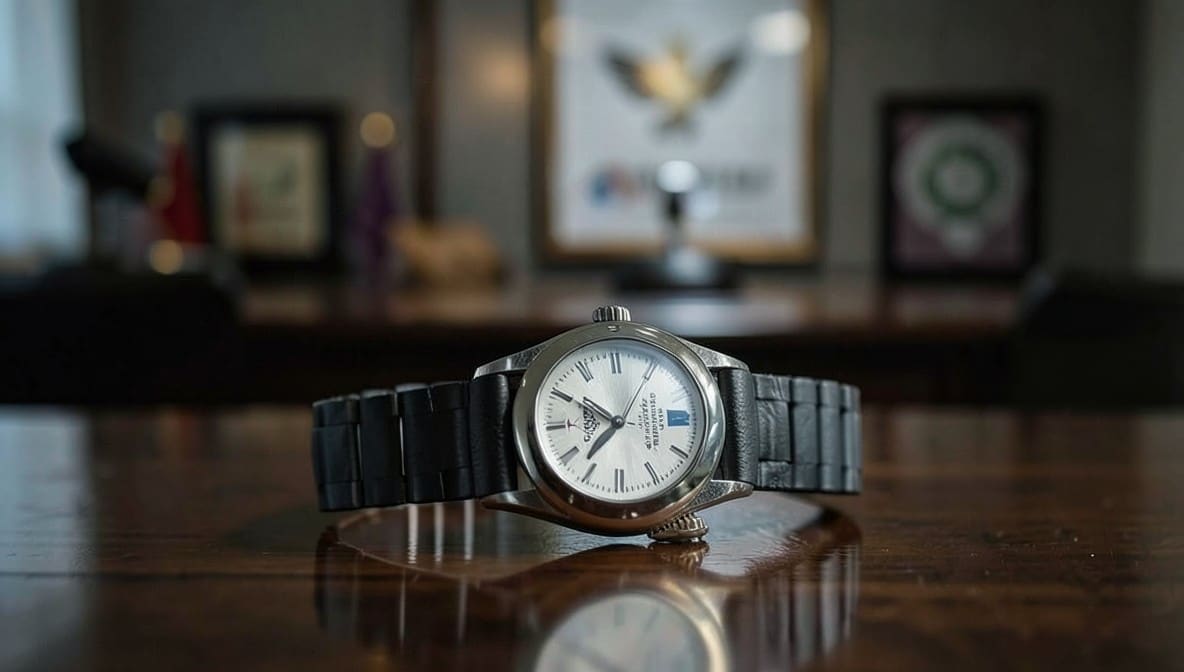
The Delhi State Consumer Disputes Redressal Commission dismissed a complaint seeking Rs. 57.5 lakh for a lost Breguet wristwatch under a home insurance policy, ruling that the complainant failed to discharge the burden of proving ownership, the cash transaction, and the alleged snatching incident with credible evidence. The judgment underscores that while consumer fora apply the preponderance of probabilities standard, claimants must still establish their case with consistent and cogent documentary proof, especially in high-value insurance claims.
Background & Facts
The Dispute
The complainant, Mr. Parichay Kumar Upadhyay, obtained a Gruh Suraksha Home Insurance Policy (Diamond Plan) from Royal Sundaram General Insurance Co. Ltd. (Opposite Party), valid from 26.11.2018 to 25.11.2021. The policy covered jewellery and valuables up to Rs. 50,00,000. The complainant claimed to have purchased a Breguet wristwatch (Model No. 5377BR129WU) for Rs. 57,50,000 from Johnson Watch Co. Ltd., New Delhi, vide a bill dated 15.11.2015.
Key Facts
- 13.07.2019: The complainant alleged that the wristwatch was snatched near Bhagwan Mahavir Hospital, Delhi, at about 5:00 PM.
- 13.07.2019: FIR No. 659/2019 was registered at Police Station Mangol Puri under Sections 356 and 379 IPC.
- 18.07.2019: The complainant lodged an insurance claim with the Opposite Party.
- 16.08.2019: The Opposite Party sought documents and clarifications regarding the claim.
- 18.11.2019: The complainant issued a legal notice demanding Rs. 57,50,000 with interest.
- 24.12.2020: The Opposite Party repudiated the claim, citing mala fide intention, misdescription, and fraud under Condition No. 8.10 of the policy.
- The Opposite Party also filed a criminal complaint under Sections 420, 406, 467, 468, 471, 120B, and 34 IPC alleging fraudulent conduct.
Procedural History
- 08.06.2020: Complaint filed before the Delhi State Consumer Disputes Redressal Commission (CC/166/2020).
- 15.12.2025: Final hearing conducted via video conferencing.
- 29.06.2026: Commission dismissed the complaint.
The Parties' Positions
Complainant
- Argued that the Opposite Party was deficient in service by repudiating the claim without valid grounds.
- Relied on judgments such as M/s. Anjaneya Jewellery v. New India Assurance Co. Ltd and New India Assurance Co. Ltd v. Mukesh Sehgal to support the claim.
Opposite Party
- Contended that the Commission lacked pecuniary jurisdiction as the matter involved allegations of fraud.
- Argued that the complainant failed to establish ownership of the watch and the occurrence of the snatching incident with credible evidence.
- Highlighted inconsistencies in the invoice produced, absence of bank records for the cash transaction, and lack of CCTV footage or eyewitness corroboration.
- Submitted that the seller’s records were allegedly under Directorate of Revenue Intelligence (DRI) custody, but no proof was provided.
Relief Sought
The complainant sought:
- Rs. 57,50,000 as indemnification for the lost watch.
- Interest @ 2% p.a. over the prevailing bank rate from the date of loss.
- Rs. 5,00,000 towards mental agony and financial hardship.
The Legal Issue
The Commission addressed two central questions:
- Whether the complaint fell within its pecuniary jurisdiction under Section 17(1) of the Consumer Protection Act, 1986?
- Whether the Opposite Party was deficient in service by repudiating the claim, or whether the complainant failed to discharge the burden of proof to establish the genuineness of the claim?
Arguments Presented
For the Complainant
- Argued that the Commission had pecuniary jurisdiction as the claim exceeded Rs. 20 lakhs.
- Contended that the Opposite Party acted arbitrarily by repudiating the claim without sufficient grounds.
- Relied on precedents to emphasize that mere registration of an FIR establishes the occurrence of the incident.
For the Opposite Party
- Raised a preliminary objection regarding the Commission’s jurisdiction, arguing that the matter involved fraud and required a detailed trial.
- Submitted that the complainant failed to prove ownership of the watch and the cash transaction with credible evidence.
- Highlighted that the initial invoice produced did not mention the model number or the complainant’s name, and a subsequent invoice was produced only under investigative pressure.
- Argued that the absence of bank records, ITR entries, or proof of source of funds for the cash transaction raised suspicions of unaccounted money.
- Pointed out that no CCTV footage or eyewitness corroborated the snatching incident.
- Contended that the seller’s records were allegedly under DRI custody, but no proof was provided, shielding the transaction from scrutiny.
The Court's Analysis
The Commission conducted a detailed analysis of the evidence and legal principles:
Jurisdictional Question
The Commission referred to Section 17(1) of the Consumer Protection Act, 1986, which grants jurisdiction for claims exceeding Rs. 20 lakhs but not exceeding Rs. 1 crore. Since the complainant sought Rs. 57,50,000 along with Rs. 5,00,000 as compensation, the aggregate claim fell within the Commission’s jurisdiction. The preliminary objection was dismissed.
Burden of Proof and Standard of Evidence
The Commission emphasized that while consumer fora apply the preponderance of probabilities standard, claimants must still establish their case with credible, consistent, and cogent evidence. It relied on the Supreme Court’s decision in P.C. Chacko v. Chairman, LIC of India, which reiterated the principle of utmost good faith (uberrima fides) in insurance contracts, as established in All India General Insurance Co. Ltd. v. S.P. Maheswari.
"One great principle of insurance law is that a contract of insurance is based upon utmost good faith uberrima fides; in fact it is the fundamental basis upon which all contracts of insurance are made."
Examination of the Complainant’s Conduct
The Commission scrutinized the complainant’s conduct at every stage and found it evasive and dishonest, falling short of the utmost good faith required:
-
Ownership of the Watch:
- The initial invoice produced did not mention the complainant’s name or the model number of the watch.
- A subsequent invoice was produced only under investigative pressure, raising doubts about its authenticity.
-
Cash Transaction:
- The complainant claimed to have paid Rs. 57,50,000 in cash but failed to produce bank records, ITR entries, or any proof of source of funds.
- The Commission noted that under the Prevention of Money Laundering Act, 2002, cash transactions above prescribed thresholds require mandatory reporting, which was absent here.
-
Seller’s Records:
- The seller claimed its records were under DRI custody following a raid, but the complainant failed to produce any seizure memo, panchanama, or DRI communication to substantiate this claim.
-
Snatching Incident:
- The alleged incident occurred near a hospital, a location ordinarily covered by CCTV surveillance, but no footage was recovered.
- No eyewitness was examined to corroborate the incident.
Opposite Party’s Investigation
The Commission noted that the Opposite Party conducted a thorough and bona fide investigation, including:
- Examination of the complainant.
- Verification attempts with the seller.
- An RTI query to the PCR authorities, which revealed no record of the alleged incident.
- Repeated requests for documentary proof of the financial transaction.
The repudiation was based on specific, demonstrable, and unrefuted inconsistencies in the complainant’s case, justifying the invocation of Condition No. 8.10 of the policy (mala fide intention and misdescription).
The Verdict
The Commission dismissed the complaint, holding that:
- The complainant failed to establish deficiency in service on the part of the Opposite Party.
- The repudiation of the claim was justified and did not amount to deficiency in service under Section 2(1)(g) of the Consumer Protection Act, 1986.
- There was no order as to costs, considering the facts and circumstances of the case.
What This Means For Similar Cases
Burden of Proof Lies on the Claimant
- Claimants must provide consistent and cogent documentary evidence to establish ownership, transaction details, and the incident in insurance disputes.
- Bare assertions unsupported by evidence are insufficient, even under the preponderance of probabilities standard.
Cash Transactions Require Scrutiny
- High-value cash transactions without bank records, ITR entries, or proof of source of funds raise red flags and may lead to repudiation of claims.
- Claimants must ensure compliance with regulatory requirements (e.g., Prevention of Money Laundering Act, 2002) to avoid suspicions of unaccounted money.
Importance of Transparency in Investigations
- Claimants must cooperate fully with insurers during investigations, including providing access to seller records, CCTV footage, and eyewitness accounts.
- Unverified explanations (e.g., records under DRI custody) without supporting documentation weaken the claimant’s case and may be viewed as evasive conduct,